
This audio is voiced by AI and may occasionally mispronounce words.
Share your feedback and help us improve this feature. Read more about how we use AI at SBS here.
Videos of people drinking hot water, wearing slippers at home and boiling apples have gone viral on social media, as creators look to emulate traditional Chinese practices. But the trend, known as 'Chinamaxxing', has sparked mixed responses from those of Chinese heritage.
Some of the videos feature people of non-Asian backgrounds embracing Chinese food customs, such as drinking soup for breakfast, and adopting Traditional Chinese Medicine (TCM) practices, with creators proclaiming, "You met me at a very Chinese time of my life".
One TikTok video of a young man eating steamed buns has been viewed 1.4 million times since being posted in October.
Chinese Australian content creator Vanessa Li says she found the trend interesting when she first saw it, and initially thought it was cool that people were embracing Chinese culture, but now she has mixed feelings about it.
I'm seeing Chinese culture be reduced to very consumable aesthetics such as wearing slippers or the Tang jacket, or going to yum cha.
News that makes sense
Your trusted source for staying up-to-date with the world around you. Get free daily news updates and analysis, straight to your inbox.
"I [also] wonder if it's something that people are adopting because, right now, it's trendy and therefore it's cool ... [and] it's going to get you [social media] engagement."
How did being Chinese become cool?
Some of the content appears to have been inspired by a line in the 1999 movie Fight Club, where the protagonist says: "You met me at a very strange time in my life", which creators have appropriated to "a very Chinese time".
Dr Jennifer Beckett, a senior lecturer in media and communications at the University of Melbourne, says the videos became a trend in late 2025.
"It was bubbling away slightly in the background in mid-2025 and then it just really takes off."
More recently comedian Jimmy O Yang posted a TikTok video referencing the catchphrase while wearing a traditional Tang-inspired jacket released as part of Adidas' Chinese New Year collection designed by Canadian-born Hong Kong performer and designer Edison Chen.
Some Chinese influencers are also hopping on the trend, providing tips to followers on how to be a "Chinese baddie". Other videos talk about 'Chinamaxxing' — essentially wanting to maximise Chinese attributes.
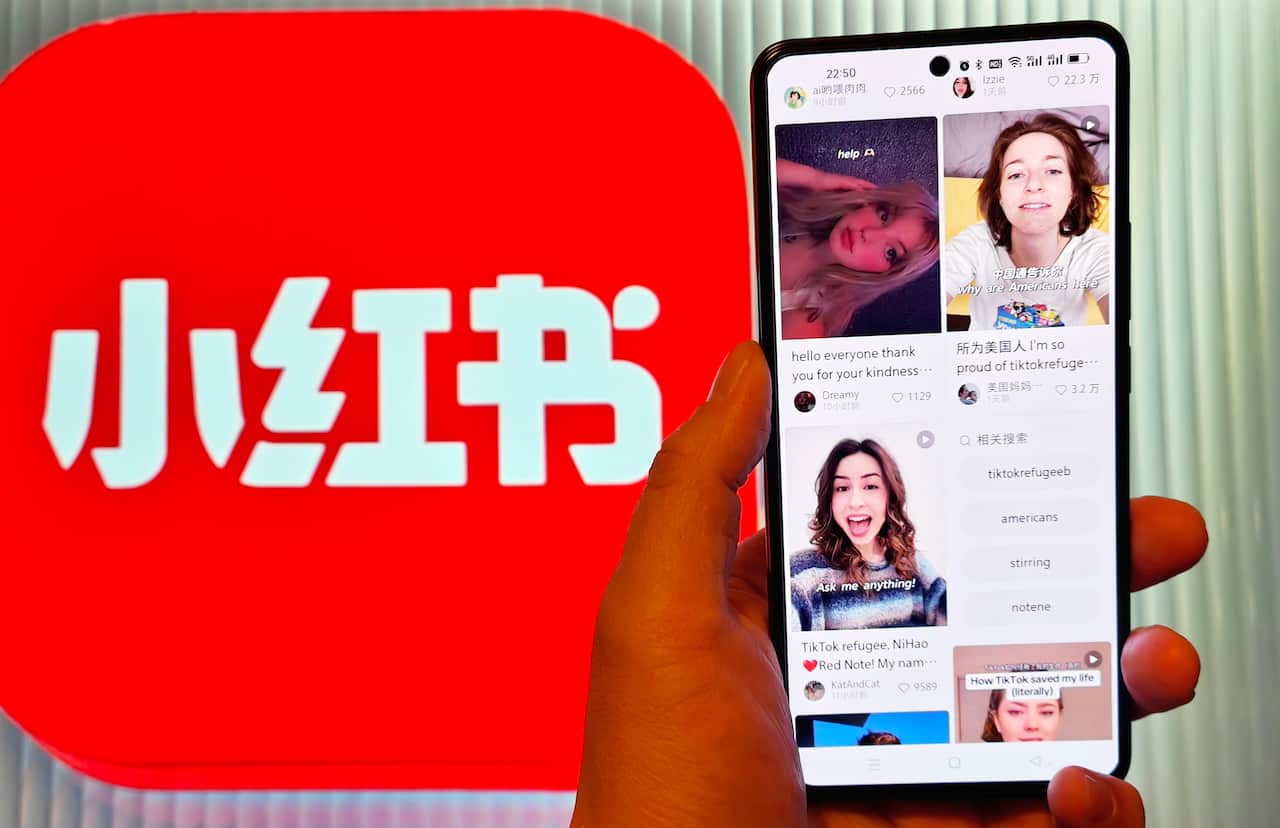
Dr Fan Yang, a research fellow on digital technologies at the University of Melbourne, says she first noticed the trend on Xiaohongshu, the Chinese lifestyle app (also known as RedNote), which became popular with Americans last year ahead of a threatened US ban of TikTok.
Yang recalls seeing a British vlogger putting goji berries into her tea and talking about how good it was.
"This is interesting because on the Chinese internet, on RedNote, we've seen people embracing so-called Western culture [and the fact that] it is not good to drink hot water anymore because the hot water [burns] your throat."
What's driving the trend?
Beckett says although the "Chinese time in my life" videos started in America, and the trend remains predominantly US-based, social media users in countries such as Australia are seeing it because of the dominance of US-based content on platforms such as Instagram and TikTok.
She believes the current state of US politics and global instability is playing a part in the rise of Chinamaxxing.
People appear to be drawn to a sense of community amid the ramping up of the US government's rhetoric about "who belongs and who doesn't belong", Becketts says.
"[It's] almost like nostalgia for a Western idea of what collectivism and community looks like," she says, adding that it's something they feel they are missing.
There is something really nostalgic about looking at a collectivist culture like China.
Another factor that may be driving the trend is the uptick in wellness culture, and the move away from Western medicine.
This could also be in part linked to the Make America Healthy Again (MAHA) movement led by Robert F Kennedy Jr, which emphasises reducing ultra-processed foods, removing food dyes and reviewing vaccine safety, she says. The movement has been met with backlash from public health officials over its promotion of anti-vaccine sentiment and unsubstantiated medical claims.
"There's also an element of it [Chinamaxxing] which is really about slowing down and responding to the [seasons], and sort-of anti-tech."

Cultural exchange increasing on social media
The third aspect influencing the trend may be the cultural dialogue fostered on Xiaohongshu, which has changed following an influx of Americans who joined the platform last year.
"[The rush of Americans onto the platform] saw a lot more cultural exchange between young Westerners and young Chinese people," Becketts says.
"Xiaohongshu — which had until then been a completely Chinese language platform — is now suddenly a dual language platform, and the cultural exchange that [has been] going on there [is] fascinating.
There was a lot of breaking down of stereotypes on both sides.
Yang agrees RedNote has facilitated cultural exchange between Chinese people and the rest of the world, and this is also partly due to how easy it is to get an account.
Unlike other popular Chinese platforms, such as WeChat and Weibo, which require a Chinese national ID to verify an account, RedNote only asks for a valid mobile phone number.
Chinese culture is being more widely distributed
Another type of content that could be influencing the Chinamaxxing trend are videos created by foreigners living in China; or videos showing quirky aspects of life, such as people as rapping while cooking, or doing tai chi.
These videos can encourage interest in the culture and are often redistributed outside of China by intermediaries — such as Chinese-based agencies managing vloggers.
Yang notes it's suspected that some intermediaries in China disseminate content showing the country in a positive light because they're paid by the government to do so.
China has also made it easier to travel to the country, with visa-free travel for Australia and many other European countries introduced in 2024.
So in this way the nation opens the door and gives foreigners access to make posts about the country, to understand the country, and to give foreigners opportunities to explore the country and culture as well.
More generally, Yang says people are seeing images and videos about China's rapidly evolving infrastructure and technological advancements — particularly via innovations in AI and electric vehicles, which are now competitive with those coming out of the US.
The Trump effect and 90s nostalgia
The framing of China's regime as authoritarian and America's as democratic may also be shifting amid recent coverage of Immigration and Customs Enforcement (ICE) raids in America.
Yang points to the sarcastic nickname "Chuan Jianguo" often used by Chinese netizens for US President Donald Trump, which translates to "Trump the Nation Builder".
It's a phrase that suggests Trump's policies — such as his trade war and treatment of allies — is actually helping China, and could be encouraging people to rethink their views of the country.
Yang says these complex issues could also be driving the Chinamaxxing trend.
Aesthetically the world is also embracing 90s nostalgia, Beckett notes, an era that saw fashion imbued with Chinese influences, including the wearing of traditional dresses such as the cheongsam (also called a qipao), and the study of Chinese medicine being brought into Australian universities.
"There's a distinct possibility that this is also part of a more generalised 90s nostalgia being picked up [on social media], hitting this particularly restless time in US politics and global politics, hitting this uptick in wellness trends — and it's just created a perfect storm," Beckett says.
"I think [we need to] watch where the trend goes. Look to see who's taking it forward and where it's going, and whether or not those people are people we should be concerned about."

Is the Chinamaxxing trend positive?
Yang says so far, the trend of embracing aspects of the Chinese lifestyle is positive but she is concerned that it could also perpetuate stereotypes.
"Not every single Chinese person drinks hot water," she says.
But she is hoping the trend could also help to debunk myths around Asian food, including the use of MSG, which has long-been been stigmatised and labelled as unhealthy.
"Asian food is healthy, it's healthier than some foods like McDonald's because it is less processed — it's just more ingredients and more flavourful, it doesn't mean that it's not healthy," Yang says.
One part of the positive development is about accepting China's culture rather than opposing a culture that one doesn't know. [It's] about being willing to understand the culture rather than being afraid.
Yang says if it helps people to distinguish between Chinese culture and China's political system, that could also be a welcome development.

But the intention of the content is very important.
"Are [these bloggers] trying to be part of the Chinese culture to be funny — which is also racism — or are they genuinely interested in learning more about the country [and culture]?
"They have to be catchy in order to get clicks, but catchy videos can also apply some kind of mockery, stigma, stereotypes or even new stereotypes.
"The negative side ... would be taking the culture at face value [saying] I want to be like this just because it's trendy, without knowing why."
When being Chinese becomes a vibe
Part of the reason why Li has mixed feelings about the trend is because of her experiences growing up.
She was teased about the food in her lunchbox, and more recently, points to the racism Chinese people suffered during the COVID-19 pandemic.
"I spent most of my teenage years trying not to be Chinese, I dyed my hair blonde, I only spoke English, and I really tried to remove myself from my culture."
While it feels validating to see aspects of her culture that were previously ridiculed and othered being embraced, she's concerned about Chinese culture being reduced to a "vibe and a trend".
"It's kind of neglecting the fact that it's this whole value system and it's a lifestyle, and it's thousands of years of history and culture and traditions," Li says.
When culture becomes a trend ... it becomes disposable, and given the nature of social media, the trends cycle so quickly.
"I worry that in a year's time, or even a few months' time ... will Chinese culture just be another thing that people thought was cool once and then discarded because it's not relevant anymore?"
For the latest from SBS News, download our app and subscribe to our newsletter.







