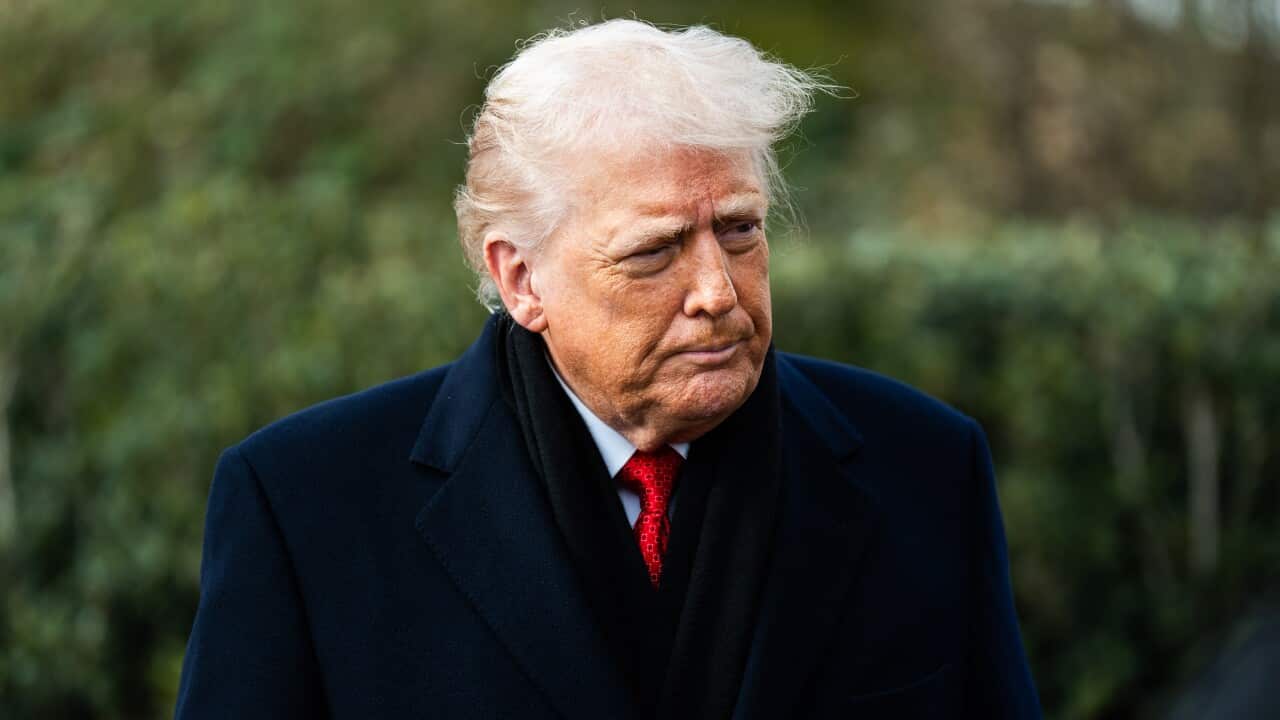
United States President Donald Trump could land in hot water over his latest tariff threats, with experts saying his planned import taxes could backfire or drag other countries into painful trade stoushes.
Trump vowed over the weekend to implement a wave of increasing tariffs on EU members Denmark, Sweden, France, Germany, the Netherlands and Finland, along with Britain and Norway, until the US is allowed to buy Greenland.
He has threatened to "100 per cent" follow through on his threats, as the EU leaders plan to discuss their options at an emergency summit in Brussels on Thursday.
One option is a package of tariffs on €93 billion ($161 billion) of US imports that could automatically kick in on 6 February after a six-month suspension.
German Chancellor Friedrich Merz said he would try to meet with Trump on Wednesday, adding that a trade dispute was not wanted.
News that makes sense
Your trusted source for staying up-to-date with the world around you. Get free daily news updates and analysis, straight to your inbox.
"But if we are confronted with tariffs that we consider unreasonable, then we are capable of responding," Merz said.
Tim Harcourt, chief economist at the University of Technology Sydney, told SBS News Trump is using the threat of tariffs as an economic bargaining chip in his push to acquire Greenland, a sovereign territory of Denmark.
However, Trump might get more than he wagered for, with experts saying Europe could make good on a proposal to retaliate with its own aggressive economic measures against the US, which would have wide-reaching consequences.
Stock markets in Australia and the US have taken a dip after the latest tariff threats.
AMP chief economist Shane Oliver said this shows Australians should take the threatened tariffs seriously as Europe and the US are big export partners with each other.
This could impact markets across the globe and cause share prices to fall for Australian investors, he said.
"There are worries that there'll be a new trade with Europe but it's perhaps not as severe as it was back in April," he said.
"We should take it seriously.
"I suspect we'll continue to see a knee-jerk negative reaction, but I suspect it will be smaller than what we saw last year," he said, referencing Trump's so-called 'Liberation Day' tariffs.
In April, the tariffs targeted almost every country in the world with a 10 per cent baseline US tariff on imported goods, which Australia was exempt from.
Trump's threat means that EU tariffs, already at 15 per cent, could rise an additional 10 per cent, and a further 25 per cent if a deal is not reached in June, according to the Atlantic Council.
Harcourt said that the tariffs are unlikely to impact Australia directly but could hamper international trade.
"We don't trade much with those countries compared to Asia," he said.
"However, they could impact the global economy if there's retaliation."
'Strike back with force'
While European countries have been reluctant to place reciprocal tariffs on the US in the past, that could now be changing.
French media are reporting that France's President Emmanuel Macron is calling on leaders to activate the European Union's anti-coercion measures.
The anti-coercion law, which has never been used, would enable the bloc to impose punitive economic measures on a country seeking to force policy change.
Rasmus Søndergaard, a senior researcher at the Danish Institute for International Studies, says it may be Europe's best option to deter Trump.
This could look like tariffs directed back at Trump and his allies.
"The EU has the ability to really strike back with force if they want to," he said.
"It will hurt European economies, and it will hurt American economies."
According to Deutsche Bank data, European countries own US$8 trillion ($11.9 trillion) worth of US bonds and equities, more than double any other investor.
Should the US continue to threaten Europe with sanctions, the targeted countries could divest in US shares and cause problems for its economy.
Tariffs could backfire
Betashares chief economist David Bassanese said the EU is a major trading partner with the US, and that tariffs towards its members could "ultimately backfire" for Trump.
"Further large tariffs on major trading partners would only add to the risks facing the US economy — especially if Europe finally responds with trade retaliation of its own," he said.
"If Trump is ultimately forced to back down without getting Greenland, it could once again expose many of these threats as hollow, undermining all future negotiations."
Not only could escalating tariffs between the US and EU weaken their respective economies, it could also undermine confidence in global markets.
Oliver said that Trump would be reluctant to make good on the tariff threats, and would likely back down before the deadline and "cut a deal", due to how unpopular tariffs are for US voters.
"He was elected on the basis of reducing the cost of living, but his tariffs added to it. And so therefore he's under pressure to reduce the cost of living," he said.
"Trump wants to win elections. He doesn't want to go into what would become a new trade war."
For the latest from SBS News, download our app and subscribe to our newsletter.







