
In brief
- Emotional scenes as remaining Iranian women's players depart Gold Coast hotel under police guard.
- Prime Minister Anthony Albanese says players who seek support "will receive it".
An Iranian activist in daily contact with Iran's women's football team is urging the Australian government to protect the rest of the players, after five were granted humanitarian visas and Australian Federal Police (AFP) protection.
Tina Kordostami, an activist and City of Ryde councillor in NSW, told SBS News she was shaken after an emotional farewell in the lobby of the Gold Coast hotel, where the players had been monitored by Iranian security officials.
One of the women immediately started crying and yelling as they hugged, gripping onto Kordostami's arm as she was "practically dragged" away.
"She's clearly being put in a horrible place where she can't make a decision, she was begging us for help," Kordostami told SBS News.
The remaining team members left a Gold Coast hotel on Tuesday afternoon under police guard with one player appearing to be dragged by a teammate onto the bus bound for the airport in a video published by Nine newspapers.
News that makes sense
Your trusted source for staying up-to-date with the world around you. Get free daily news updates and analysis, straight to your inbox.
Protesters attempted to block the bus amid safety concerns for the women returning to Iran after arriving at a Gold Coast airport a short time later.
Australia had refused visas to some Iranian officials, the Australian Associated Press reported, citing sources. There were concerns handlers were coercing the remaining players to return to Iran and not apply for asylum.
Kordostami echoed those concerns, saying the players were unable to communicate their intention to seek protection. SBS News has not been able to independently verify these claims.
The Home Affairs Department would not confirm how many visas were refused on security or character grounds, citing privacy restrictions.
"The Department of Home Affairs works with law enforcement and intelligence partners to cancel or refuse visas of non-citizens who are at risk to Australia's national security," a spokesperson said in a statement.
Kordostami, who says she has been in constant contact with the athletes, said face-to-face interactions are full of pleasantries but loaded with coded language due to the constant surveillance.
"When you know these people well and you know how much they want to stay, it's very hard to see these things. Your heart just breaks," she said.
Kordostami has ramped up her efforts in recent days to communicate the women's options to them, fearing for their safety after the Iranian state media branded them traitors following their refusal to sing the national anthem before their tournament-opening game against South Korea on Monday, in what was viewed as a silent protest.
"I think if our government agencies stepped in with a lot more confidence, the girls would be defecting right now," she said.
Prime Minister Anthony Albanese told parliament on Tuesday that Australia "stood in solidarity with these brave women".
"They are safe in Australia and they should feel at home here," he said.
"We have made it clear that if there are other members of the team who make a decision to ask for support, they will receive it from Australia."
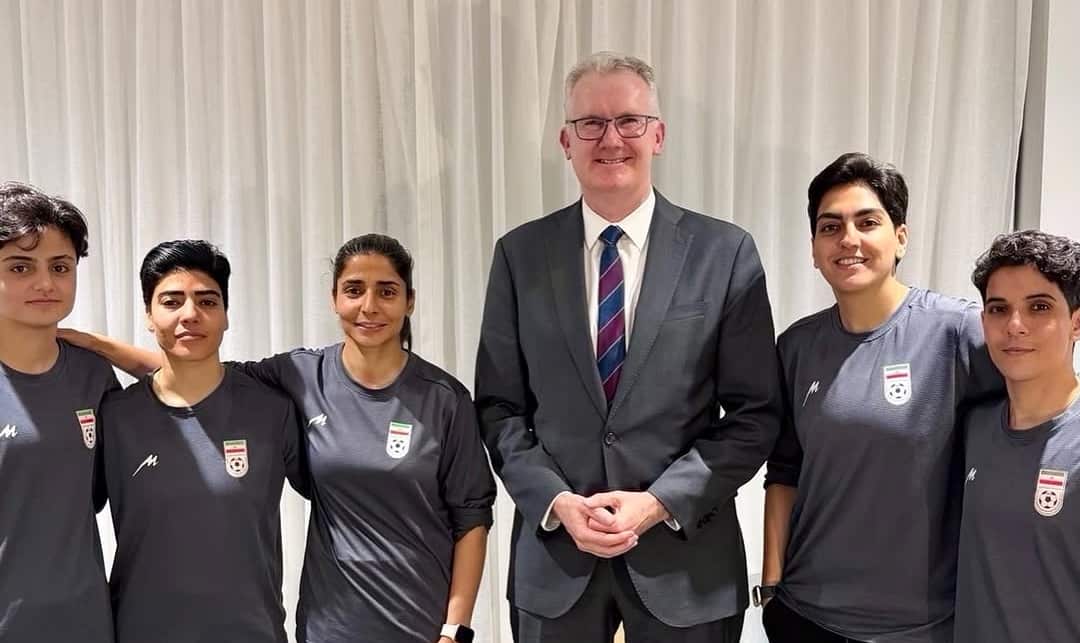
The Australian Federal Police (AFP) said it had been working closely with the Home Affairs Department over the last 72 hours and engaging members of the Iranian diaspora.
The AFP acknowledged the advocacy and work of the community in relation to the women's safety but refused to make any further comment.
NSW anti-slavery commissioner James Cockayne is concerned by information that suggests members of the women's football team are being "threatened or coerced into agreeing to exit Australia".
"There is a long history, unfortunately, in the Islamic Republic of Iran, of the government seeking to control political speech by athletes, both in the country and abroad, through intimidation, coercion against them and against family members," he told SBS News.
However, he was encouraged by the emphasis Home Affairs Minister Tony Burke placed on their safety as he announced he'd signed five humanitarian visas overnight.
A sensitive operation has taken place to circumvent the players' restrictive handlers and separate those looking to escape.
The visas were granted after security checks were satisfied, and there was an outbreak of "Aussie, Aussie, Aussie, oi, oi, oi" once the applications had been approved, Burke said.
The Lionesses' team captain, Zahra Ghanbari, and players Fatemeh Pasandideh, Zahra Sarbali Alishah, Atefeh Ramezanizadeh and Mona Hamoudi took up the offer of safe haven and gave their permission for their names and pictures to be published.
"It's very important that we send a signal that human trafficking will not be tolerated in this country," Cockayne said.
— With additional reporting by the Australian Associated Press.
For the latest from SBS News, download our app and subscribe to our newsletter.







