in brief
- All AUKUS subs will be second-hand while underwater drones unveiled as new defence agreement focus.
- US defence secretary Pete Hegseth told SBS News that the country is "grateful" for Australia's provision of military assets.
All nuclear-powered submarines Australia will receive under the AUKUS military pact will be second-hand, Defence Minister Richard Marles has revealed.
Australia had been expecting to receive two used submarines and one new one but now plans for all three to be in-service vessels from the United States Navy.
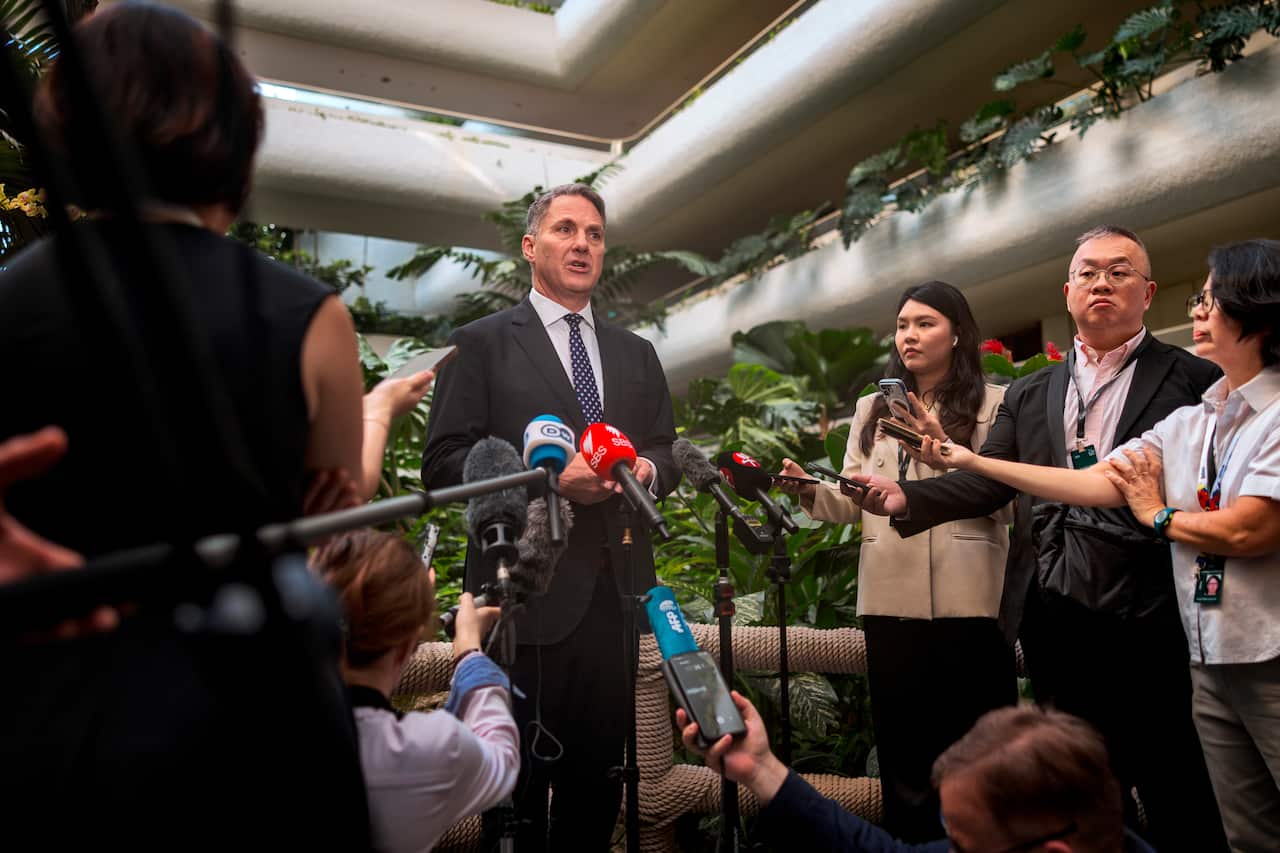
Speaking at a high-level gathering of military and defence leaders in Singapore on Sunday, Marles said the new approach would be "cost-effective" and "streamline" the delivery of the Virginia-class submarines.
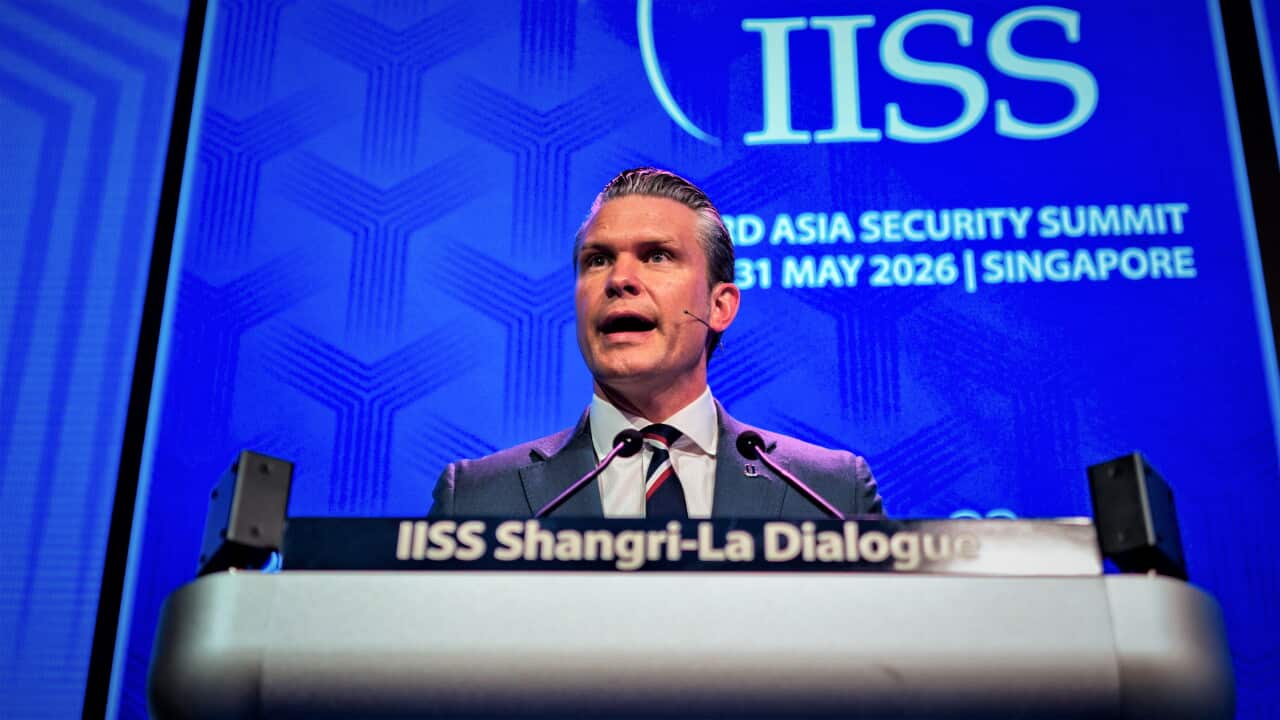
It comes after US defence secretary Pete Hegseth told SBS News that the country is "grateful" for Australian support while warning that other allies need to step up their military spending as he outlined the US' vision for Indo-Pacific security.
In a joint statement with his US and UK counterparts, Marles said the "seabed is a battlefield" as he announced a shift in focus from pillar one of the AUKUS deal to pillar two. The first phase's nuclear-powered submarines will be supported by second-phase underwater drones designed to protect underwater infrastructure like internet cables.
News that makes sense
Your trusted source for staying up-to-date with the world around you. Get free daily news updates and analysis, straight to your inbox.
"The Deputy Prime Minister and Secretaries welcomed the proposed approach to streamline Australia's acquisition of Virginia-class submarines (VCS), simplifying supply chain management, operational and maintenance requirements, and maximising cost efficiencies," Marles said in a statement about the second-hand submarines.
"This approach would enable Australia to acquire three in-service VCS in lieu of a mixture of new and in-service VCS variants."
Hegseth praises Australia, condemns other allies
The US defence leader emphasised the need for a "durable balance of power" in the Pacific to counter Chinese influence during his Saturday speech at the International Institute for Strategic Studies Shangri-La Dialogue, which brings together top defence officials and experts from about 45 countries.
"The era of the United States subsidising the defence of wealthy nations is over. We need partners, not protectorates. We seek alliances built on shared responsibility, not dependency," Hegseth said.
"For those who continue to free-ride on the generosity of the American taxpayer, hear us now: those days are over. Allies that refuse to stand up and carry their weight for our collective defence will face a clear shift in how we do business," he added later.
Last month, US President Donald Trump said he was "not happy with Australia" over its perceived failure to come to their aid in opening the Strait of Hormuz — a key strategic blow the US has suffered during its conflict with Iran, which continues to cause havoc to global shipping.
Speaking to SBS News in Singapore, Hegseth softened on those comments, saying that the US is "grateful" for Australian support in the Middle East.
"When we've called Australia in this context, they've been willing to help with whatever assets they've been able to provide and we're grateful with that," he said.
"It's in keeping with how Australia has been a strong partner of ours."
The US has made repeated demands that its allies increase their defence spending to at least 3.5 per cent of gross domestic product (GDP), as it warns the world is tilting toward an international power balance that is increasingly hard-edged.
New Zealand, which has recently announced its ambition to increase defence spending to 2 per cent of GDP, was lambasted by the US at the global summit.
"Two per cent is not enough, so 2 per cent is freeloading," Hegseth said when asked about the NZ strategy. "I don't have anything against New Zealand, I want partners to step up."
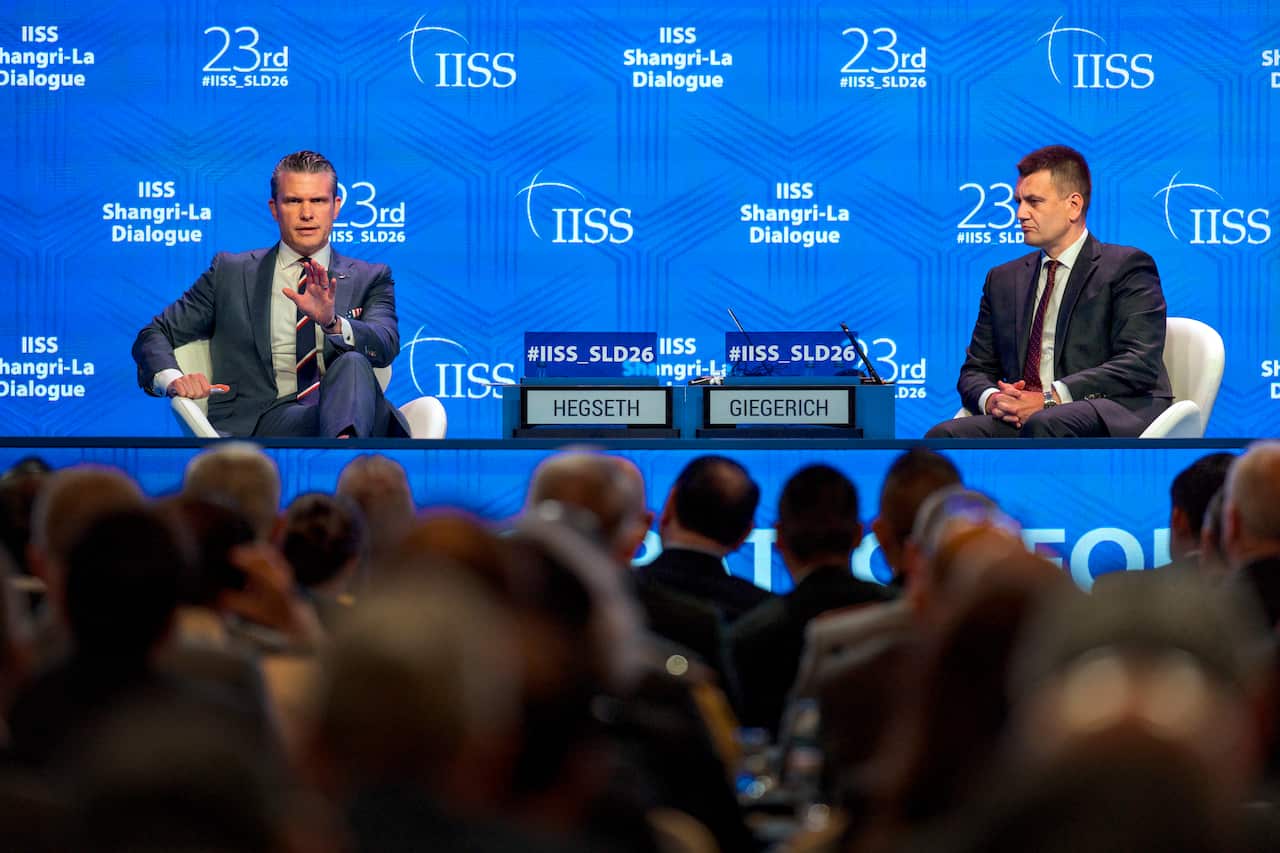
"We can't just say 'we have been friends for a long time, so let's just work together'.
"It's: 'we've been friends for a long time, so you better have the same capabilities that we do because if we don't, our alliance is meaningless'."
In April, Australia announced plans to scale up its defence spending from $63.4 billion in the 2026-27 budget to $112.1 billion within a decade. This would take Australia's military spending from 2.8 per cent to 3 per cent of GDP — although questions remain over the methods used to calculate this higher figure.
AI-powered underwater drones
Asia's highest-level annual defence forum is taking place against the backdrop of rising Chinese economic and military might, with many discussions alluding to the need to counter
Marles used his speech at the conference to address the increasing vulnerability of undersea infrastructure, without directly naming Australia's biggest trading partner.
"Over the past eighteen months, we have witnessed a series of attacks against subsea critical infrastructure at a scale and frequency that is historically unprecedented. This is not speculation. This is a documented pattern of behaviour. And we must reckon with it honestly," he said.
Almost all of Australia's internet traffic flows through just 15 undersea cables, Marles noted, highlighting the country's vulnerability as similar cables around the world are cut, and Russia and China are suspected.
"It is striking that several cables have been severed across the Baltic and the Taiwan Strait since November 2024," he said.
"Now, maybe these were accidents. But even if they were, it highlights the vulnerability of this crucial part of the globe's infrastructure.
"If they were intentional, we are left to wonder: are countries testing our response times, testing our attribution thresholds and testing our political will to respond?"
In response to global challenges, Marles noted that the Australian Defence Force is now undergoing a "hard power transformation" in order to "deter force projection" across Asia.
Part of that transformation includes the recently announced investment in underwater drones, jointly unveiled by Hegseth and UK defence secretary John Healey at the US embassy in Singapore.
"For too long with AUKUS, we talked too much and delivered too little," Healey said. "That has now changed."
The "first ever signature project" under the second pillar of the AUKUS deal, originally signed by the Morrison government in 2021, will deliver a range of "cutting-edge sensors and weapons systems for undersea drones", Healey said.
"This will give us the ability to detect, to deter, and to deal with threats, including to our underwater cables and pipelines on which so much of our daily life depends," he continued.
Healey said the UK government has committed more than US$170 million ($236 million) to the project, although Australia and the US have not announced their spending.
In 2025, the US private military firm Anduril was awarded a $1.7 billion contract by the Royal Australian Navy to build a large fleet of "ghost shark" underwater drones at its new factory in Sydney.
The factory will be used to manufacture Ghost Shark XL-AUV and Dive-XL and XD variants of AI-powered autonomous unmanned vehicles for allies and partners around the world, subject to government approval.
Second-hand submarines
One of the biggest announcements to come from the conference is the news that Australia will only receive old US submarines instead of a newly manufactured one in the first round of AUKUS deliveries.
The nuclear-powered submarines are one of the flagship agreements under the AUKUS deal. All of them will now be second-hand, as agreed to by the tripartite defence leaders in Singapore.
Under the terms of the original AUKUS deal, Australia would purchase three Virginia-class nuclear-powered submarines from the US, with an option to buy two more if needed. Two of those would be Block IV vehicles currently in service, while a third would be a brand-new Block VII vessel, the latter of which has been scrapped.
The change will not affect the agreement to build AUKUS submarines in Australia in the 2040s, all three leaders confirmed.
Marles said that the option for three vintage submarines had always been considered and that he was "very pleased" to have made the deal with the US and the UK. The entirely second-hand option is cheaper and simpler, he added, noting that the original overall project was incredibly expensive, particularly when Australia would then have to manage four classes of submarines at once.
"That gets pretty complicated in terms of how you're operating a fleet of submarines. What we will have here is a much simpler pathway. It will mean that the Virginia-class submarines that we are acquiring will all be of the same type," he said.
"It is definitely cost-effective. And to be clear, you know, this is a very expensive program, obviously. And so we are trying to find every cost-effective option as we walk down this path."
Australia has $8 billion worth of infrastructure and logistical investments planned at HMAS Stirling on Garden Island, Western Australia, to facilitate the Submarine Rotational Force-West project, allowing UK and US vessels to be maintained and repaired near Perth.
An additional $3.9 billion has already been made as a down payment for a new submarine construction year in South Australia. A total of $12 billion has also been committed for the Henderson Defence Precinct in WA.
All of these AUKUS investments were touted by Marles as he noted the significant changes being made to the country's military capabilities.
"All of this is the single biggest industrial project in Australia's history," he said. "All of this represents the biggest leap in Australia's military capability in more than a century, really, since the establishment of the Navy."
For the latest from SBS News, download our app and subscribe to our newsletter.







