In brief
- The government has said that defence spending will rise to 3 per cent of GDP by 2033.
- Experts are challenging the government to outline exactly what that will mean in real-world terms.
Defence Minister Richard Marles has announced that Australia's defence spending will rise to 3 per cent of GDP, taking the nation's budget allocation for the military to a historic high.
"We are now seeing the biggest peacetime increase in our defence spending in our nation's history," Marles said while outlining the 2026 National Defence Strategy in a speech at the National Press Club on Thursday.
However, the government is facing questions over the headline figures, with one expert accusing the government of "desperate, Enron-like creative accountancy" to reach the 3 per cent figure.
This is because Marles has adopted the North Atlantic Treaty Organization (NATO) figure for some projections in his speech. NATO, of which Australia is not a member, has historically always calculated defence spending differently from this country.
Their figures include, amongst other things, military pensions in total budgetary allocation, resulting in a higher percentage of GDP spent.
News that makes sense
Your trusted source for staying up-to-date with the world around you. Get free daily news updates and analysis, straight to your inbox.
Michael Shoebridge of Strategic Analysis Australia said it was "shameless and simply pretends we are spending more" on the Australian Defence Force (ADF).
"If the government and defence were as creative in building the ADF's military power as they are in pretending to so, we'd be in much better shape," he added.
Three per cent of what?
Marles, in his speech on Thursday, said Australia was currently spending 2.8 per cent of GDP on defence.
"Based on current GDP projections, we now have spending committed in the budget that will take us to a defence spend of 3 per cent of GDP by 2033," he told the Press Club.
"It is much more than this when you include other supporting investments in critical infrastructure, the defence of networks, civil preparedness and resilience, innovation, and the full strengthening of our defence industrial base."
The newly announced spend was touted by the defence minister as "the most of any comparable, like-minded country in the Indo-Pacific". He added that it was "more than most countries in NATO, including the UK, Germany, France, Italy and Canada".
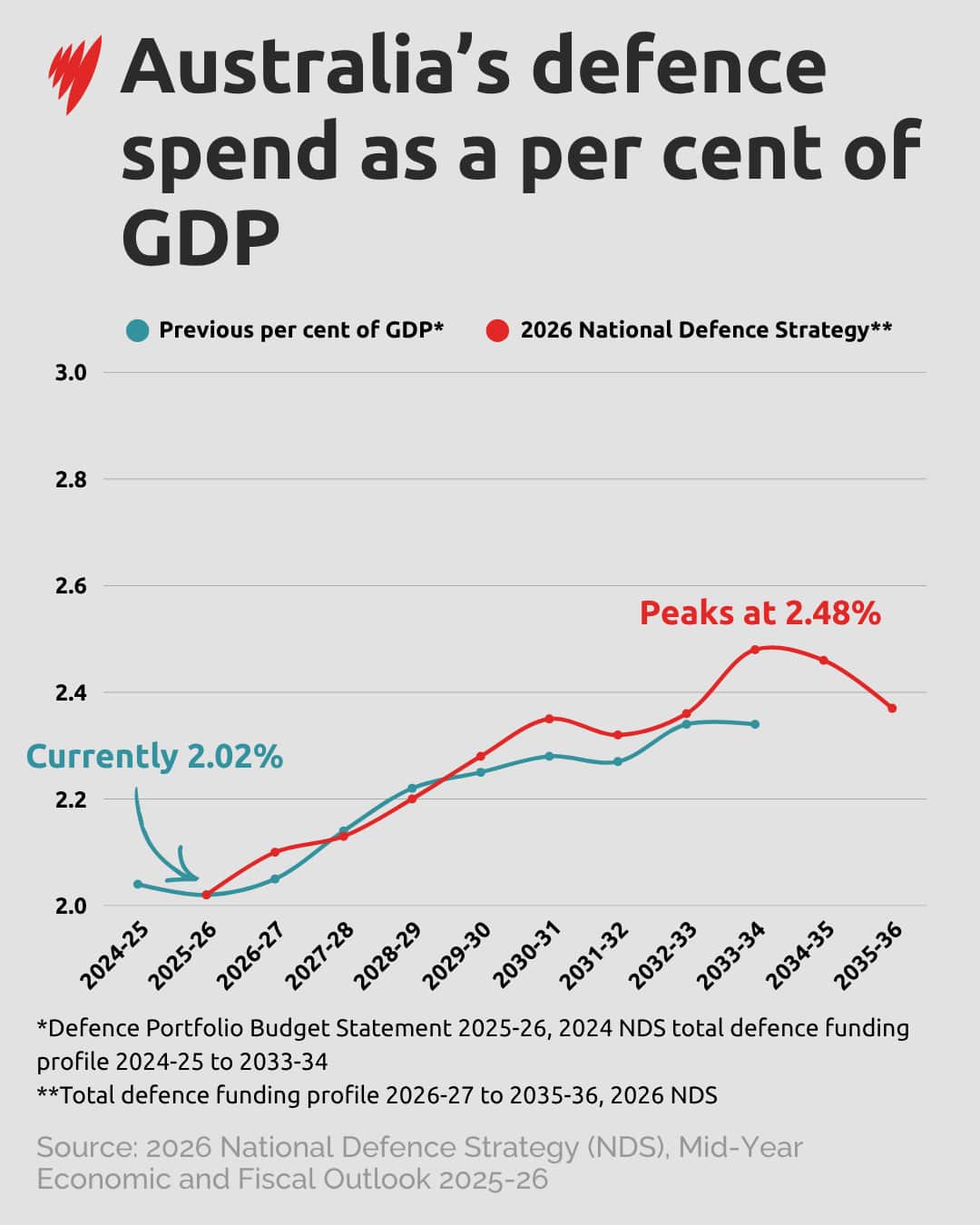
Defence spend for 2025-26 was outlined in the previous Budget at $58.98 billion per year.
However, under traditional Australian measurements, this figure means we are currently spending 2.02 per cent of GDP on defence, the Australian Strategic Policy Institute (ASPI) has argued.
Malcolm Davis, a senior analyst at ASPI's Defence Strategy Program, told SBS News the NATO method "basically brings in all sorts of other non-defence things, such as housing, health care, and pensions".
"That's not as helpful in terms of deciding how much money the government is actually spending on capability."
Marles denied the accusation that his government was attempting to project a larger figure than it was planning to spend, telling National Press Club host and Sky News reporter Tom Connell that it did not "have a new way of measuring defence spending".
"We are using the NATO measure, which is how you compare apples with apples," he said.
While the increase will see Australia spend a record total of $425 billion over the next decade on defence, the increase announced Thursday will only equate to a 0.3-0.4 per cent rise over the next eight years.
"When you think about that, that's not an awful lot, given the fact that the minister quite correctly said: 'Look, we're in very dangerous, challenging times with real uncertainty ahead,'" Davis said.
Opposition defence spokesman James Paterson said that the government is artificially inflating the numbers.
"Accounting tricks do not make our country safer, and changing the rules about how we measure defence spending is pulling the wool over the eyes of the Australian people, not being upfront and honest with them about exactly how much we are spending," he said.
"We have not previously counted things like military pensions towards our defence expenditure. And if we're now going to do so, the government should be utterly transparent about how that has changed the figures."
How Australia's defence budget stacks up
In 2024, Australia was spending closer to 1.9 per cent of GDP on defence, according to government figures.
Stockholm International Peace Research Institute data indicates that percentage spent would put roughly 60 countries ahead of Australia in defence expenditure that year.
While it may sound like the country falls well short in international comparisons, experts caution that this approach offers a very distorted understanding.
"Spending as a per cent of GDP is a poor way to measure defence spending," associate professor Andrew Carr of the strategy and Australian defence policy team at the Australian National University told SBS News.
"It doesn't tell you if you're spending it on the right things. It doesn't tell you if you're spending enough," he said.
"We have to look at these in terms of what specific problems we are trying to solve."
At the very top of the defence spend list are countries actively engaged in military conflict.
Ukraine, which continues to fight off Russia's invasion, spent 34.5 per cent of its budget on defence in the same year. Israel, Russia, and Myanmar were all in the top ten, as were Eritrea, Saudi Arabia, and Qatar.
"Australia is a historically secure country, and we remain in a very secure place, so I think a much better measurement than 3 per cent is asking: 'Do we have a clear idea of what the problem we're trying to solve with this military spending and our defence forces?'" Carr said.
Why an increased defence spend
The defence budget increase is designed to protect Australia's national interests in a global context that is "increasingly contested and uncertain," the defence department has said.
Marles spoke to the necessity of increasing defence spending in the context of a deteriorating 'rules-based order' of global politics.
"Any rules-based order can only prevent conflict when it is underpinned by the hard power necessary for collective deterrence," he said. "Australia must contribute to this, and we are."
The conflict in Ukraine, the war in Iran, and the looming potential threat from an increasingly militarised China are the kinds of perceived risks that the increase is designed to buffer against.
Natural disasters, cyber warfare, and the potential assistance of neighbouring nations during times of crisis are also considerations factored into defence-spending decisions.
"There's a lot of those kinds of demands increasingly being faced by the government, and you might have to start doing two or more at once," Carr said.
"That's perhaps the biggest change of what's new in our environment."
Trump's NATO demands and Australia
The increase brings Australia closer to alignment with what both NATO and United States President Donald Trump have been demanding of member states as international allies raise their own defence budgets.
In June of last year, NATO ruled that member nations ought to achieve a defence spending of 3.5 per cent of annual GDP by 2035, something that was applauded by Trump.
The US president has frequently made comments suggesting that America would not fulfil its NATO obligations for countries it did not believe had paid their "fair share" for defence.
He has even suggested that America could "pull out" of NATO entirely, saying the country gets very little in return for its contribution to the alliance.
"'You didn't pay? You're delinquent?'" Trump told a campaign rally in 2024. "'No, I would not protect you. In fact, I would encourage [Russia] to do whatever the hell they want. You gotta pay. You gotta pay your bills."
However, Davis said Trump's pressure on NATO was not likely to have been the prime motivator behind Australia's defence spending boost and the adoption of the NATO measure.
"I think it's more our own understanding of the strategic environment and what we need to do to ensure our own security," he said.
"We do have to stand on our own two feet to a greater degree and burden share to a greater degree, so that does demand more money."
While not referring to Trump specifically, Marles reiterated the nation's alignment with the US, saying Australia was "deeply engaged" with the US military and needed to maintain this relationship to secure regional stability.
"Let's also be clear: there is no effective balance of power in the Indo-Pacific absent the continued presence of the United States," he said.
For the latest from SBS News, download our app and subscribe to our newsletter.







