This audio is voiced by AI and may occasionally mispronounce words.
Share your feedback and help us improve this feature. Read more about how we use AI at SBS here.
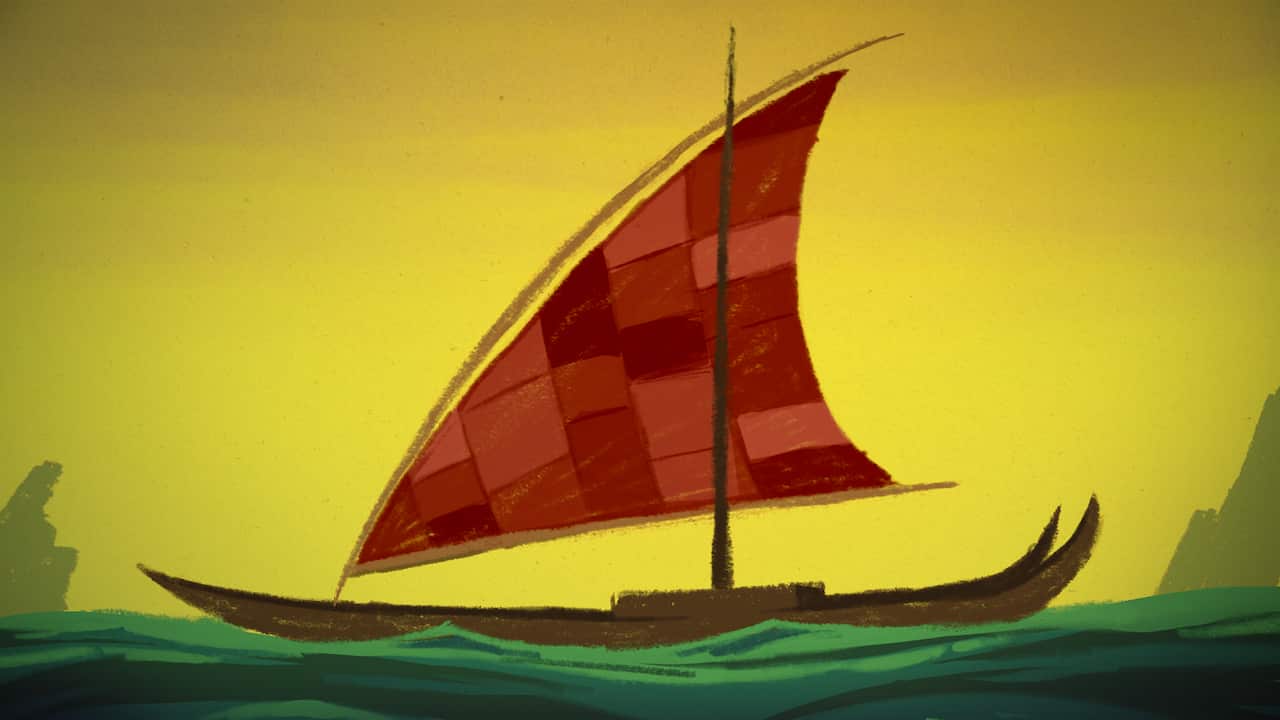
Long ago, the story goes, a great double-hulled canoe called the Kaunitoni came from the west, carrying the first ancestral chiefs of the iTaukei (indigenous Fijians). At its head, in one version of the tradition, stood their leader, Lutunasobasoba.
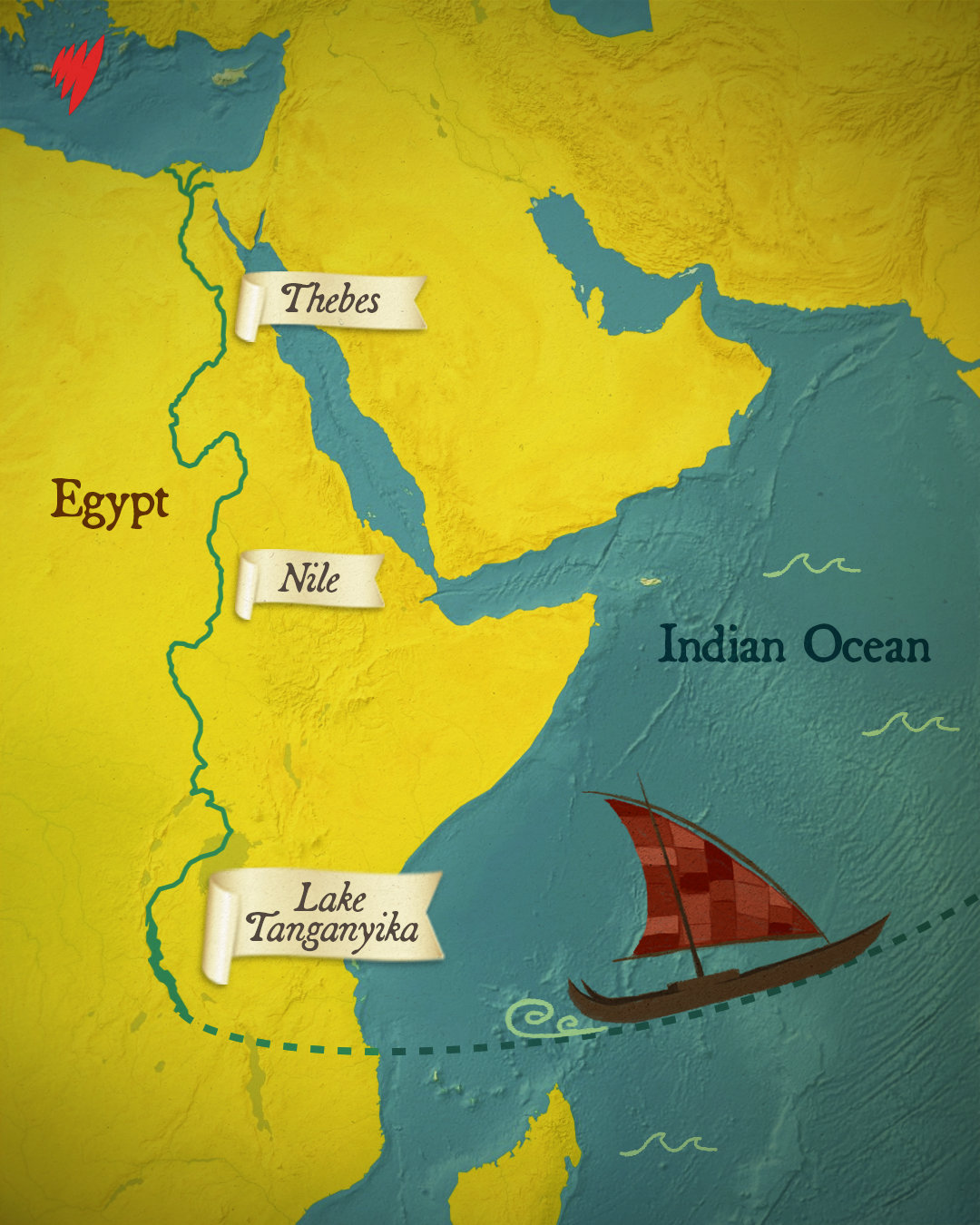
The voyagers had come a seemingly impossible distance: from Thebes in ancient Egypt — earlier still, some say, from a place farther west, via Israel — down the Nile to Lake Tanganyika, across the Indian Ocean, and finally to Vuda, on the western coast of Viti Levu, Fiji's largest island.
Somewhere in that crossing, a sacred box went over the side.
In some tellings, it carried the written record of the people's laws and genealogies — lost, like the canoe's other cargo, somewhere in the churning sea.
For most of the past century, this has been one of the best-known versions of Fiji's national origin story. The mission schools taught it; so did the primary schools. Radio carried it further still, until it became part of the way generations of Fijians understood their ancestry.
News that makes sense
Your trusted source for staying up-to-date with the world around you. Get free daily news updates and analysis, straight to your inbox.
Only, much of it was invented in the 1890s — set down for the first time in a newspaper.
The colonial government's Fijian-language paper, Na Mata, ran a competition at the time, inviting readers across the archipelago to send in the definitive account of where the Fijian people had come from, with the best to be printed.
The winning entry ran over 17 instalments, centring on a forgotten tribe. Within a few decades it had acquired the weight of history.
The shape of the belief
The story of the Kaunitoni is only one part of the overall narrative.
Behind the claimed migration sits a larger conviction, still widely held in some iTaukei communities and church groups: that Fijians descend from a Lost Tribe of Israel — one of 10 the Hebrew Bible describes as carried into exile and never heard from again.
The belief has no support in mainstream science or archaeology. Yet it has helped foster a distinctive affinity with Israel.
The particulars shift from place to place. On Mana Island, in the Yasawa group off western Viti Levu, the Ark of the Covenant — the gold-covered chest that, in the Book of Exodus, held the Ten Commandments — is said to lie buried.
In a village in Ba, in Viti Levu's north-west, an elder once pointed to a rock and told Reverend Marika Baleidelabaci, a Fijian historian and Methodist minister, that Jesus had been born exactly there.
In the Navosa highlands, markings cut into a cave wall are read by some as ancient Hebrew — an interpretation, Baleidelabaci says, that came back with Fijian soldiers who had served in the Middle East and recognised the shapes.
"Nobody knows the origin of that writing," he tells SBS News of the unverified petroglyphs.
They assumed that it must be Jewish.
Believers offer corroborations: circumcision is said to predate the missionaries; Fiji is read as an acronym for Father of Israel, Jewish Island; the tanoa, the carved bowl in which the yaqona (kava) drink is served, is claimed to take its name from a phrase meaning "built by Noah".
Anthropologist Lynda Newland, writing in 2015, described the idea that certain iTaukei clans descend from a Lost Tribe as "very strong among some contemporary clans and church groups". Her research traces the belief through the intersection of Christianity, Fijian traditions and ideas about ancestry.
Edwin Jones, who spent a year in the highland district of Nabobuco, found it had "gained currency" among Methodists of the interior — held there alongside their own belief that the ancestors emerged from the Nakauvadra hills.
Christians make up around two-thirds of Fiji's population, and more than half of them are Methodist — a church whose preaching draws heavily on the Hebrew Bible. One former president of the Methodist Church in Fiji estimated 95 per cent of sermons were taken from the Old Testament.
Beyond Fiji, iterations of the same idea have taken root across Melanesia.
In western Papua New Guinea, the Gogodala have been reported to perform Hebrew prayers and incorporate biblical-Israelite ideas into religious practice.
On Malaita, the most populous island of Solomon Islands, the late Anglican visionary George Umai taught that his ancestors had fled Jerusalem in the first century and buried the Ark in the bush at Kwara'ae. There, Israeli flags still hang in village churches, a visible expression of the close ties some Pacific communities have developed with their perceived motherland.
Why the Pacific votes with Israel
In the past three years, that connection has become visible in foreign policy.
When the United Nations General Assembly voted in October 2023 on a ceasefire in Gaza, 14 countries opposed it. Six were Pacific Island states: Fiji, Papua New Guinea, Nauru, Tonga, the Marshall Islands and Micronesia — among the smallest nations on Earth and together accounting for nearly half of the votes against the resolution.
The resolution called for an immediate humanitarian truce but did not explicitly mention Hamas' October 7 attacks, an omission several countries, including Fiji, cited in explaining their objections.
Fiji's position is also shaped by domestic politics.
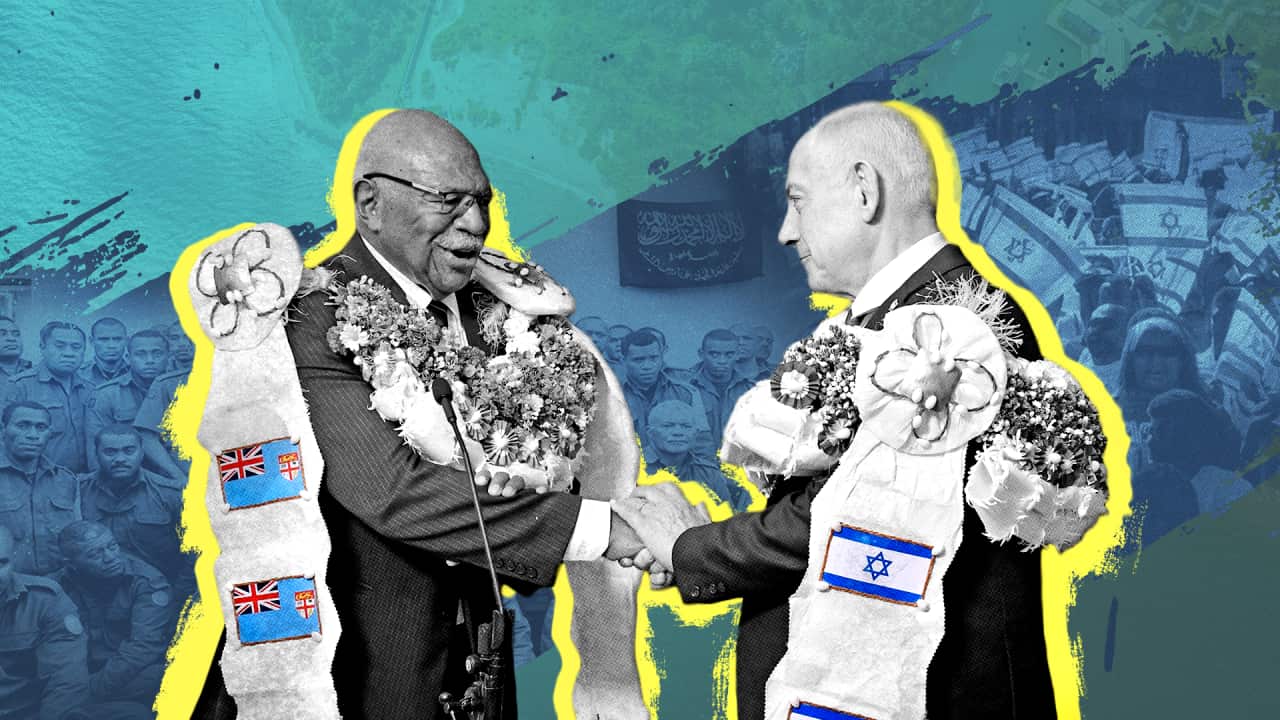
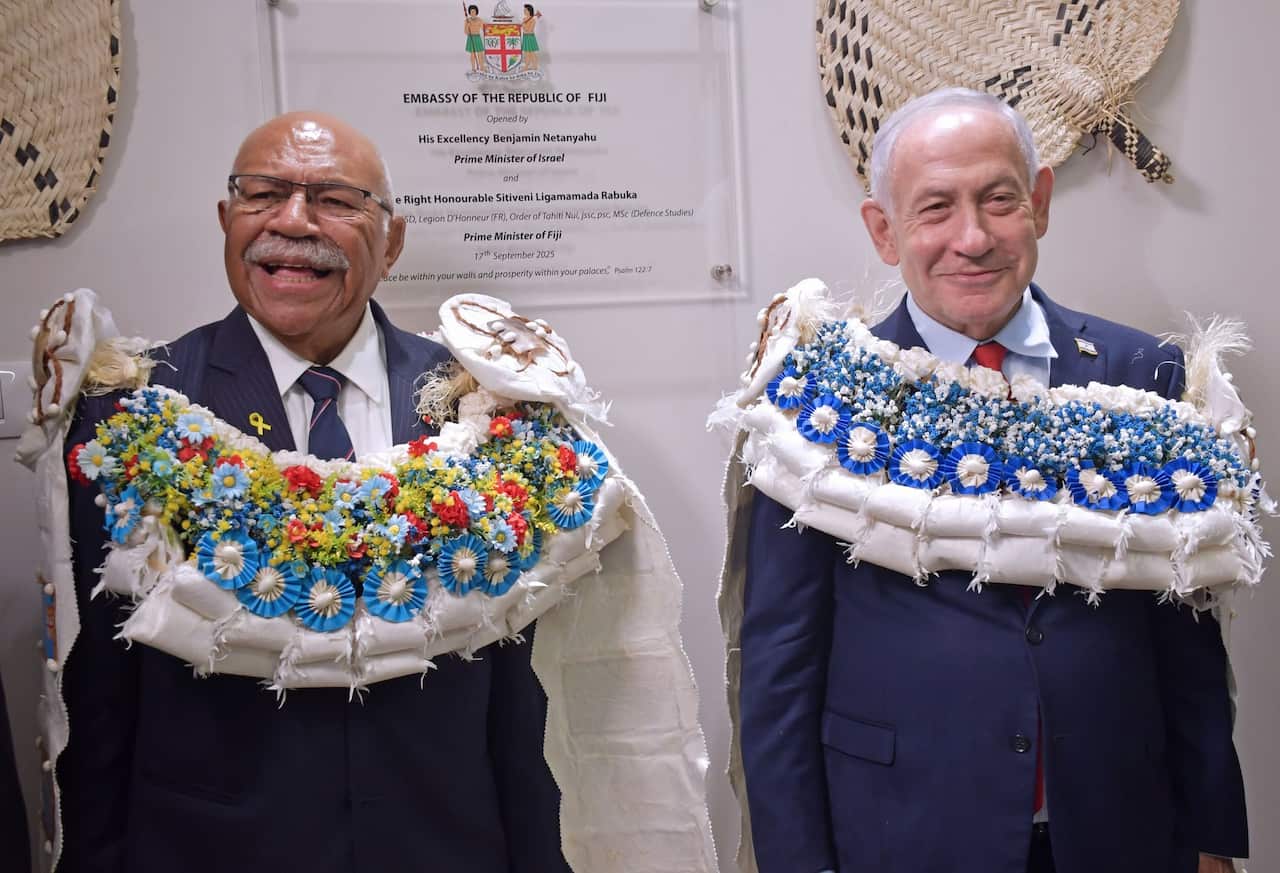
The country's Jerusalem embassy, opened in September 2025, has its roots in a 2022 election that left parliament deadlocked and gave the nationalist Social Democratic Liberal Party (SODELPA) the balance of power in coalition talks. SODELPA leader Viliame Gavoka had campaigned on a promise to establish an embassy in Jerusalem. Sitiveni Rabuka, who became prime minister after forming a coalition with SODELPA, agreed to the proposal, with Gavoka becoming his deputy.
Meanwhile, Papua New Guinea opened an embassy in Jerusalem in 2023, with Israel underwriting the running costs. Samoa announced its own in early 2026, and in July, Nauru became the latest Pacific country to announce plans to do so.
Jerusalem's status remains sensitive and complex, as it is contested between the Israelis and the Palestinians. The Israelis claim it as their capital, and Israel's parliament, the Knesset, is based there. For many Jewish people, it holds ethnoreligious significance as the site of King David's ancient capital and Temple Mount, the holiest place in Judaism.
For Palestinians, the city is also their historical, religious and cultural capital. It is home to the Al-Aqsa Mosque, considered the third holiest site in Islam, and the Church of the Holy Sepulchre, the most sacred site in Christianity – also recognised by Christian and Muslim citizens of Israel.
Israel has occupied East Jerusalem since 1967, annexing the area in 1980.
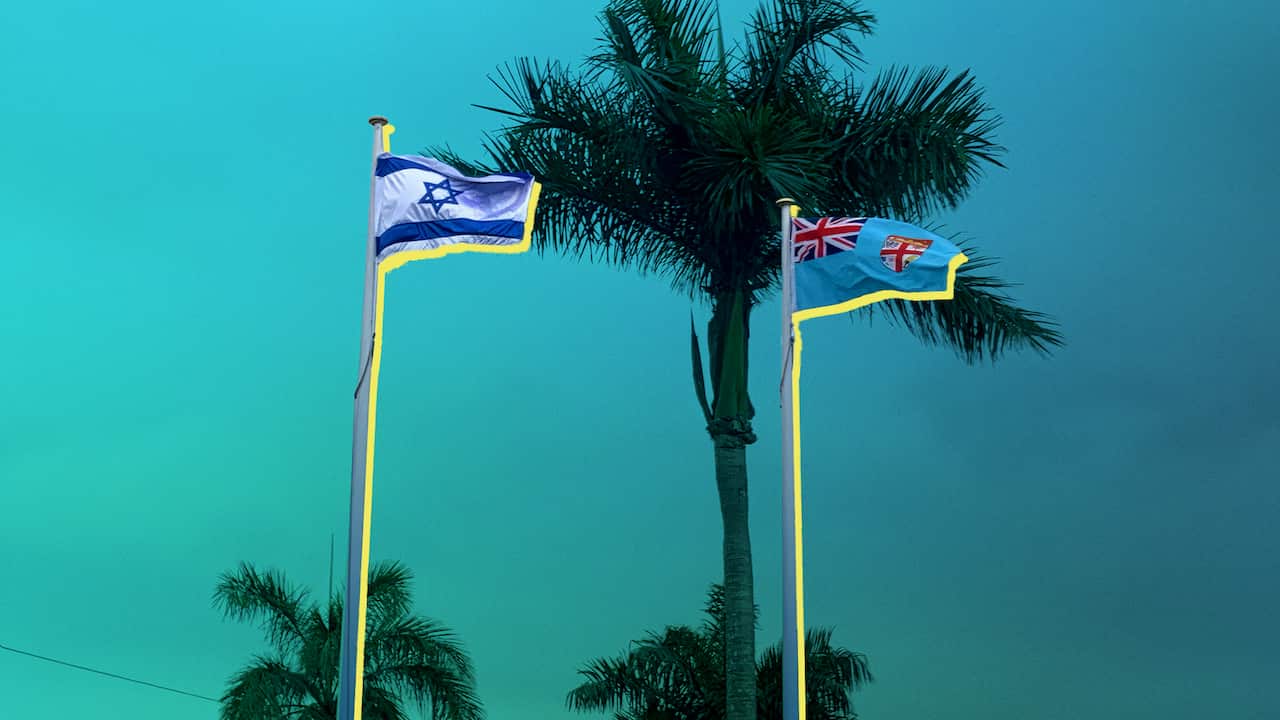
Israel has been expanding in the other direction too, opening an embassy in Fiji's capital Suva in June — a regional hub intended to deepen ties with Fiji and across the wider Pacific.
But the political relationship has another layer. Behind the growth in political ties is decades of work by the International Christian Embassy Jerusalem (ICEJ), an evangelical Christian Zionist group founded in 1980 that has campaigned in Pacific churches for years, and whose Fiji branch its leadership has praised as a model for pro-Israel Christians worldwide. SBS News contacted the ICEJ for comment but received no response.
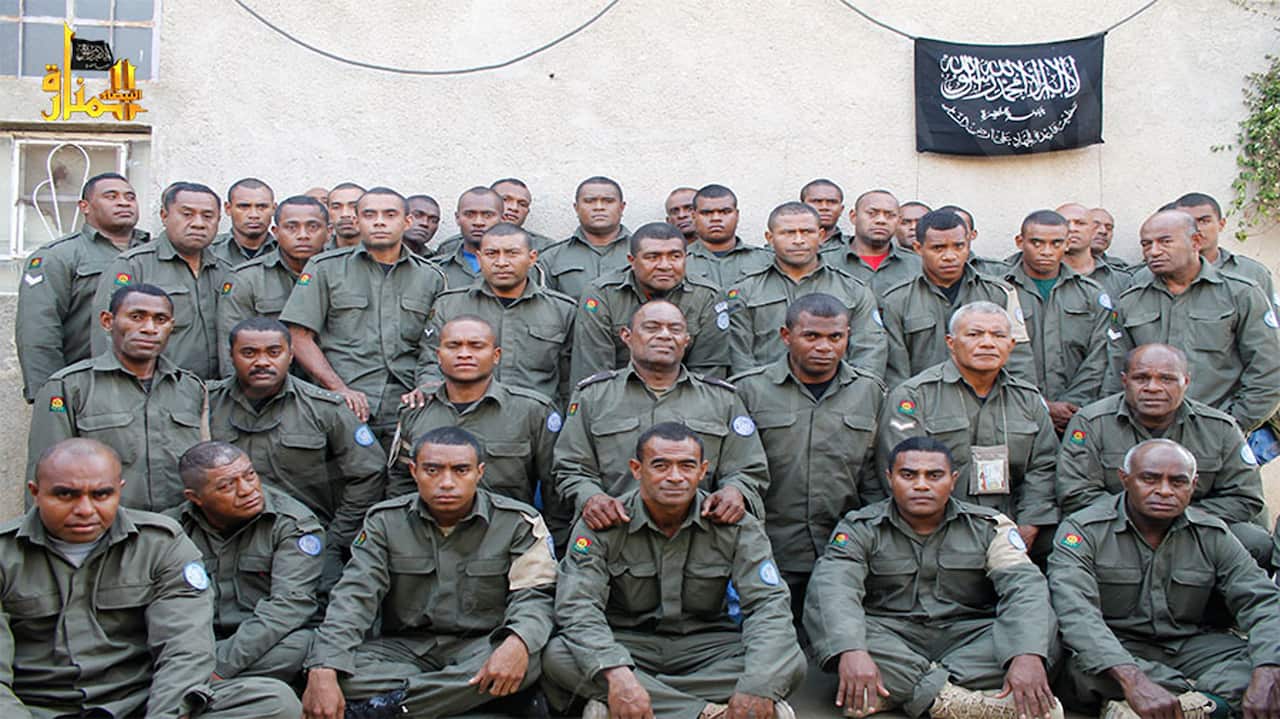
The attachment to the holy land is expressed in other ways too. Relative to its population, Fiji has sent more soldiers to UN peacekeeping missions than any other country in the world — many of which have been carried out in the Middle East. Believers of the Kaunitoni origin story also make regular pilgrimages to Israel.
In early October 2023, Fijian pilgrims stood in the Negev desert near the Gaza border, planting oak seedlings in the dry yellow dirt and watering them from a bottle of Fiji Water. They had travelled for Sukkot, the Jewish harvest festival, believing themselves to be returning to ancestral land.
Two days later, Hamas militants led the coordinated October 7 attack into southern Israel, leading to Israel's invasion of the now-devastated enclave.
Brian Dunn is a church historian who emigrated to Fiji from Canada in mid-2023 and is now the head of history at Pasifika Communities University. He says many of those who have returned from peacekeeping tours describe them in unexpectedly personal terms.
"Some even looked at their tour of duty as a pilgrimage," Dunn tells SBS News.
"I hadn't really noticed until October 7 just how fully and completely it seems like the vast majority of Fijians were putting their support behind the nation state of Israel."
How Fiji's Kaunitoni origin story came to be
To understand how a newspaper entry came to shape Fiji's origin story, we have to go back 40 years before it ran — to two Wesleyan missionaries, William Cross and David Cargill, who landed in 1835 on the island of Lakeba, in Fiji's far east, carrying the Old Testament.
Fijians heard of a people chosen by God and organised into 12 tribes, each descended from a common ancestor — and Fijian society was built the same way, in clans tracing descent from a founding ancestor, each with its own plant or animal totem.
"They tried to assimilate themselves with the Jews," Baleidelabaci says.
The idea took written form in the mission schools. In a 2003 doctoral thesis, the Fijian Methodist minister Tevita Baleiwaqa traces it to the seminary that trained Fiji's first indigenous ministers, where students schooled in the Old Testament began reading their own past through biblical narratives.
Anthropologist Lynda Newland finds no trace of the Lost Tribes idea in Fiji before Cession in 1874 — when sovereignty was handed to Britain — and argues it surfaces a decade or two later — once Christianity and Victorian science had supplied "a grammar for it".
That science was diffusionism: the belief that complex cultural practices could not have developed independently in different places, and must instead have spread from a common ancient source, often located somewhere in the biblical world.
Its method was wordplay. The missionary Jesse Carey, working under the amateur anthropologist Lorimer Fison, gathered resemblances between Fijian and African place names — among them a Vunda near Lake Tanganyika as well as the Vunda in Fiji — and concluded Fijians had come from Africa, and before that from Egypt.
"He homologised these names, though they have no relation whatsoever," Dunn says.
The colonial administration had its own reason to want a single origin story. Fiji had never been one country, but a patchwork of chiefdoms with no paramount ruler — and Britain preferred to govern indirectly, through an existing hierarchy.
A shared ancestry was easier for colonial administrators to govern than a society of hundreds of clans.
Which brings the story back to the newspaper. In 1892 the editor of Na Mata announced a competition to select a definitive version of the people's legendary history. No criteria for judging were ever published.
The winning entry ran in seventeen monthly instalments, and its author signed himself Denicagilaba — or Hurricane Clouds.
Three years later Basil Thomson, a colonial official who would go on to chair the Native Lands Commission — the body that decided which clan owned what — translated the story and published it in London.
The identity behind the pseudonym went unrecorded for 70 years. When the historian Peter France established it, on Thomson's authority, Hurricane Clouds turned out to be Ilai Motonococoka — Thomson's own clerk.
"It was like fan fiction," Dunn says.
The ultimate agenda was to bring the land resources under control.
That interpretation is contested, but the story was produced at a time when the colonial government was formalising systems of land ownership and political authority.
Then the empire added a layer. Fiji was expected to pay for itself, and sugar was the crop to do it — but iTaukei land could not be sold, and iTaukei labour could not be easily commandeered for the plantations. So, Britain shipped in workers instead: more than 60,000 Indian indentured labourers arrived between 1879 and 1916, under contracts known as girmit.
To explain two peoples in one colony, missionaries turned to the story of twin brothers Jacob and Esau from the book of Genesis, casting Indo-Fijians as the younger brother Jacob and the iTaukei as Esau the hunter. In the story, the brothers share a lifelong rivalry that culminates in Jacob deceiving his father to gain a blessing intended for his older brother. Missionaries leant on the tale to share a hidden message: the older shall serve the younger.
The 1987 Fiji coups and the politics of identity
In April 1987, an election ended 17 years of rule by the iTaukei-led Alliance Party.
The winning coalition drew its support largely from Indo-Fijians, who by then made up roughly half the population; its prime minister, Timoci Bavadra, was an iTaukei commoner, but most of his cabinet was not.
Within a month, Lieutenant Colonel Sitiveni Rabuka — a Methodist lay preacher — walked into parliament with 10 masked soldiers and removed the government at gunpoint. When a negotiated settlement threatened to restore it in September, he seized power a second time and declared Fiji a republic.
Inside the Methodist Church, the country's largest denomination, a parallel struggle over the church's direction was under way.
For two decades its presidents had been moderates who preached ecumenism (unity among Christian denominations) and multiracialism; the church had elected an Indo-Fijian president as recently as 1977. Manasa Lasaro, its general secretary, moved against that tradition.
Baleidelabaci, who was in Fiji during those years, remembers the language exactly.
"He said the coup was the will of God to free the Fijians, the chosen people, from bondage and from heathen races," he recalls.
"That refers to the Indians."
Lasaro declared Fiji a holy land and its people a holy people, who demanded holy government for all. From the pulpit, Rabuka's soldiers became Joshua, the general who seized Canaan, and the ministers Moses, who brought the people out of bondage.
"The Fijians at that time were only fighting for the rights of the iTaukei," Baleidelabaci says.
"The dominance of iTaukei in Fiji."
Underneath the scripture was a narrative the empire had helped build: one assembled to make Fiji legible to its administrators that had, a century later, been taken up by a nationalist movement — and turned against a population the same empire had brought to the colony.
The Fijian histories left out of the archive
When Dunn repeated the Kaunitoni story to elders in the highland village of Rewasau, deep in the interior and far from the coastal centres where the mission first took hold, they brushed it aside.
"That's not our story," they told him.
We didn't come from anywhere. We've always been here.
Archaeological evidence points to human settlement around 3,000 years ago, associated with the Lapita people, whose distinctive pottery has been found across the Pacific — a very different account from the Kaunitoni story of migration from ancient Egypt.
Baleidelabaci, a Methodist minister himself, is collecting what the archive left out — accounts that survived in the far-flung villages, and nowhere else.
"When they arrived, they said that our stories of our origin were regarded as myths and legends," he says.
"There's a lot of things in my church that need to be reinvestigated. What we are doing now is still new to us."
For Dunn, the correction has to come from the same place the stories do.
"The voice of the communities has really unsettled the text. Most of what actually happened never got written," he says.
Just a tiny sliver made it into the archive — and the very act of writing it into an archive is a power move.
Clarification: This story has been updated to include additional context about the significance of Jerusalem within Judaism.
For the latest from SBS News, download our app and subscribe to our newsletter.







