In brief
- A protester could be heard shouting "Stop, stop the genocide", and "Free, free Palestine" as Israel's contestant took the stage.
- The contest, usually a good-natured celebration of pop music and European diversity, has been plunged into crisis over Gaza.
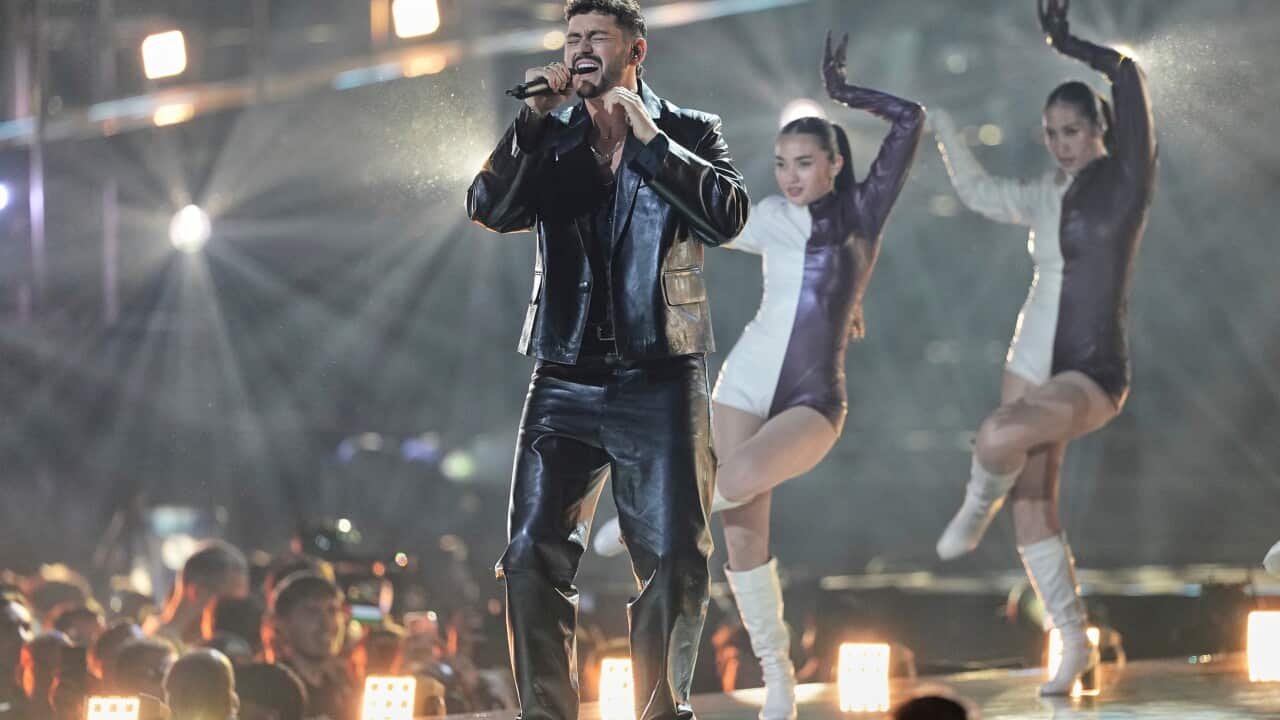
Four people have been thrown out of the first Eurovision Song Contest semi-final, which saw attempts to disrupt Israel's performance.
As 28-year-old Israeli singer Noam Bettan began his performance of Michelle during Tuesday's live show, a protester could be heard shouting "Stop, stop the genocide", and "Free, free Palestine".
Israel's participation in Eurovision 2026 has led to five countries pulling out of the world's biggest live televised music event.
In a joint statement, Austrian host broadcaster ORF and the European Broadcasting Union (EBU) said: "An audience of 10,000 fans in the Wiener Stadthalle at the first semi-final of the 70th Eurovision Song Contest in Vienna greeted every artist enthusiastically."
News that makes sense
Your trusted source for staying up-to-date with the world around you. Get free daily news updates and analysis, straight to your inbox.
"ORF is broadcasting a clean audio feed live from audience microphones before and during every performer's song.
"One audience member, close to a microphone, loudly expressed their views as the Israeli artist began his performance, and during the song, which was heard on the live broadcast. They were later removed by security for continuing to disturb the audience.
"Three other people were also removed from the arena by security for disruptive behaviour."
Bettan told BBC television on Wednesday he was "aware" of what was happening in the audience.
"I heard there was booing and everything, and there was a moment of, like, a wow effect, you know? A little bit of shock," he said.
Five countries boycotting Eurovision
Five EBU broadcasters — from Iceland, Ireland, the Netherlands, Slovenia and Spain — have boycotted this year's song contest over Israel's military action in Gaza.
Israel launched an offensive in Gaza after an assault led by Hamas — the political and military group that rules the Palestinian territory — in the south of the country on 7 October 2023 that killed 1,200 people, according to Israeli tallies.
More than 72,500 Palestinians have been killed in Gaza since October 7, according to local health authorities.
Dean Vuletic, an academic and expert on Eurovision history, told SBS Croatian that while boycotts are not new to the competition, this year's anti-Israel protests demonstrate the need for better regulation of political influences on the event.
"The first boycott happened in 1969, when Austria boycotted Eurovision because the contest was being held in Spain while dictator Francisco Franco was ruling the country. Eurovision has a history when it comes to boycotts, but this is still the largest political boycott, and that is why the situation is concerning," he said.
"I think the politicisation of Eurovision needs to be controlled in some way."
SBS — an associate member of the EBU and Australia's official Eurovision broadcaster — says it will continue its participation in and coverage of the contest this year, arguing that withdrawing would compromise its editorial independence and impartiality.
"SBS recognises and respects the deeply held views and concerns about the war in the Middle East and its impact, both locally among our audiences and internationally as reflected by other broadcasters," an SBS spokesperson previously said. "Our responsibility is to provide comprehensive, trusted and impartial coverage for Australians across our network, and we will continue to do so."
Some 95,000 tickets have been sold for this year's song contest — now in its 70th year — with fans travelling from 75 countries and territories, according to the EBU, which expects the event to attract its largest live audience in several years.
Award-winning singer-songwriter Delta Goodrem is representing Australia with her song Eclipse in Eurovision 2026.
Some of the five boycotting broadcasters also raised concerns that the televoting system was being manipulated to boost Israel last year.
Israel comfortably topped the public voting in Basel, Switzerland, at Eurovision 2025, and in the semi-finals scored maximum points in 13 out of 19 country votes.
In September, Dutch public broadcaster AVROTROS said there was "evidence of interference by the Israeli government during the most recent edition".
In November, the EBU changed the voting system, with Eurovision director Martin Green saying: "We've listened and we've acted."
Under the new rules aimed at assuaging broadcasters' concerns, the maximum number of votes per payment method was halved from 20 to 10.
The EBU announced an expansion of the contest's security systems, which "detect and prevent fraudulent or coordinated voting activity, and strengthen monitoring of suspicious patterns".
The new rules discourage "disproportionate promotion campaigns", particularly those done or backed by third parties, including governments and state agencies.
"Participating broadcasters and artists are not permitted to actively engage in, facilitate or contribute to promotional campaigns by third parties that could influence the voting outcome," the EBU said at the time.
On Saturday, Green said a formal warning had been issued to Israeli public broadcaster KAN on Friday after Bettan released videos "with an on-screen instruction to 'vote 10 times for Israel'."
This was "not in line with our rules nor the spirit of the competition", Green said, adding that the videos were swiftly removed.
Fifteen countries were competing in the first semi, with Israel among the 10 who progressed to Saturday's final.
How to watch Eurovision in Australia
The second semi-final will be broadcast in Australia at 5am AEST on Friday 15 May.
SBS will also broadcast the grand final live at 5am AEST on Sunday 17 May, with the SBS News online team covering all the action in a live blog.
For those who want a sleep-in — or to relive the excitement — SBS will air prime-time 'access all areas' broadcasts from 15–17 May at 7.30pm AEST.
You can watch the broadcasts live on SBS and SBS On Demand.
For the latest from SBS News, download our app and subscribe to our newsletter.







