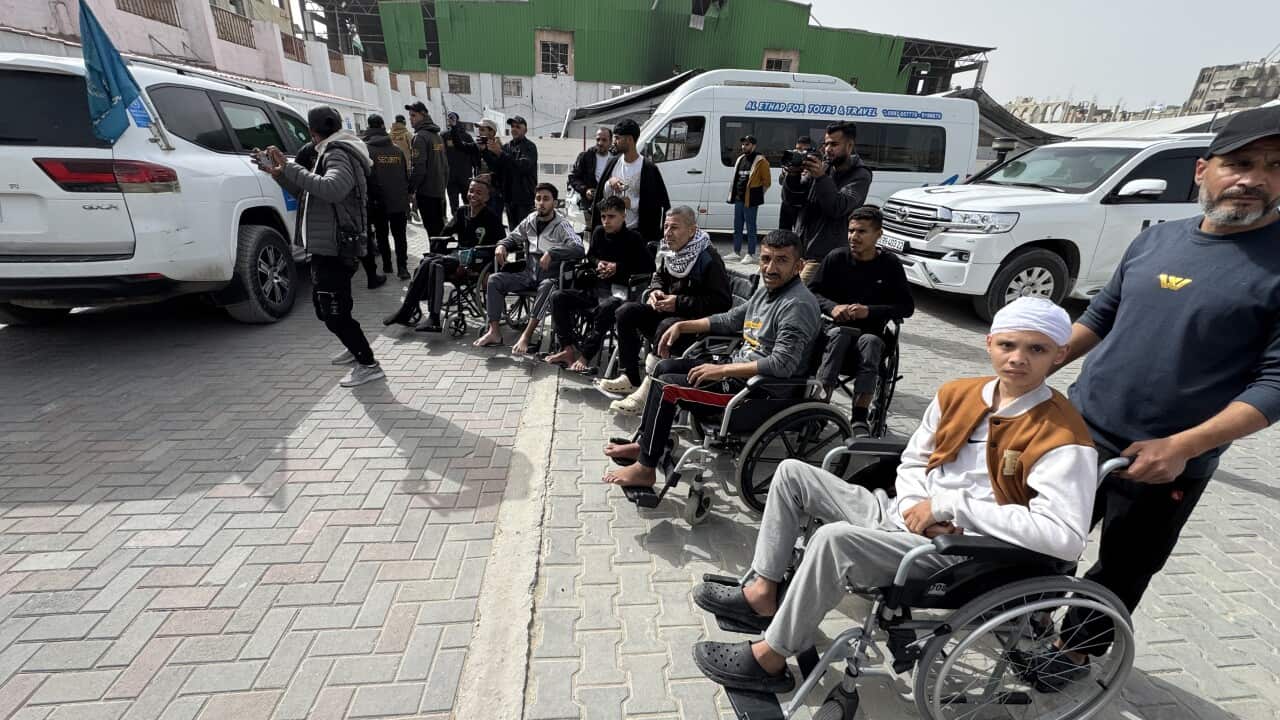
Fresh Israeli strikes killed dozens of people in Gaza overnight, in a significant escalation of attacks during the ceasefire period, as Palestinian officials reported Israel had halted the passage of patients through the Rafah border crossing.
It comes just days after the crossing partially reopened under a US-brokered ceasefire.
The strikes marked one of the deadliest days since a nearly four-month ceasefire began, despite the truce entering its second phase last month. Violence has continued across the Gaza Strip, with Israel and Hamas accusing each other of breaching the agreement.
Gaza's health ministry said seven children were among 24 people killed, with at least 38 others wounded.
News that makes sense
Your trusted source for staying up-to-date with the world around you. Get free daily news updates and analysis, straight to your inbox.
The Israeli military said it had launched strikes after "terrorists opened fire on troops" on Wednesday, seriously wounding an officer.
The latest bloodshed comes just three days after Israel partially reopened the Rafah crossing between Gaza and Egypt — Gaza's only gateway to the outside world that does not pass through Israel — a step envisaged under the US-backed ceasefire deal.
Who has been allowed to pass through the Rafah crossing?
Israel reopened the Rafah border crossing on Monday for pedestrian passage, primarily to allow Palestinians needing urgent medical care to leave Gaza and a limited number of people to return.
Israeli forces seized control of the border in May 2024, after which it remained mostly closed.
More than 18,000 Palestinians in Gaza need medical treatment abroad and hope to leave through Rafah, according to Médecins Sans Frontières.
Thousands of others who were stranded outside the territory are also seeking to return home.

However, only a small number of people have been permitted to cross since the reopening.
A spokesperson for the Palestinian Red Crescent Society said 46 people were set to cross into Egypt on Wednesday, but only 20 were allowed to travel. The remaining 26 were returned to Gaza, according to Reuters.
On Tuesday, 16 patients from Gaza and 40 of their escorts crossed into Egypt, Gazan medics told Reuters. A Hamas police source said at least 40 people crossed from Egypt to Gaza late on the same day.
Israeli Prime Minister Benjamin Netanyahu said the reopening was limited to "pedestrian passage only" and wouldn't be used to bring aid into Gaza.
Speaking last week, Netanyahu did not specify how many people would be allowed to cross, but estimated it would be "50 people plus family members coming in".
"We are not going to prevent anyone from leaving," he added.
Why have crossings been disrupted?
Palestinian health authorities said patients preparing to cross through Rafah on Wednesday were told that Israel had postponed their passage through the border.
Israel's military liaison agency, Coordination of Government Activities in the Territories, said the crossing remained open, but that it had not received the necessary details from the World Health Organization to facilitate the crossings.
An Egyptian security source told Reuters that Israel had cited security issues in the Rafah area as the reason for the temporary disruption, but said those issues had since been resolved and work had resumed at the border.
Reopening the Rafah crossing was one of the requirements under the October ceasefire agreement, which set out the first phase of a US-backed plan to halt fighting between Israel and Hamas.
The partial reopening raised hopes among Palestinians seeking medical treatment or hoping to return home, but expectations have since cooled amid the limited number of crossings and repeated disruptions.
The United Nations Office for the Coordination of Humanitarian Affairs (UNOCHA) described the reopening as an "important milestone", emphasising that civilians must be able to leave and return voluntarily and safely under international law.
"Humanitarian needs in Gaza remain immense. Supplies must be allowed to enter in sufficient quantities and with far fewer restrictions, through Rafah and all available crossings, so that aid can reach people wherever they are needed most," UNOCHA said in a statement on Wednesday.
Shahram Akbarzadeh, a professor of Middle East and Central Asian Politics at Deakin University, told SBS News earlier this week the reopening would also be "very important" for rebuilding Gaza, but said aid needed to enter the territory.
"Forcing people to leave Gaza for medical aid instead of allowing the assistance to come into Gaza is a problem," he said.
"It's a poisoned chalice, as many people who leave may struggle or not be allowed by Israel to return to Gaza."
80 per cent of Gaza's buildings have been destroyed or damaged, according to the UN.
Some Gazans say they are torn between remaining in exile without formal status or returning to a land in ruins.
"Return to Gaza for what? To live in a tent?" Mohamed, a 78-year-old poet from Beit Lahia in northern Gaza, told Agence France-Presse.
"We have not turned our backs on Gaza, we will return. But right now, we cannot go back under these conditions."
— With reporting by Reuters and Agence France-Pesse.
For the latest from SBS News, download our app and subscribe to our newsletter.







