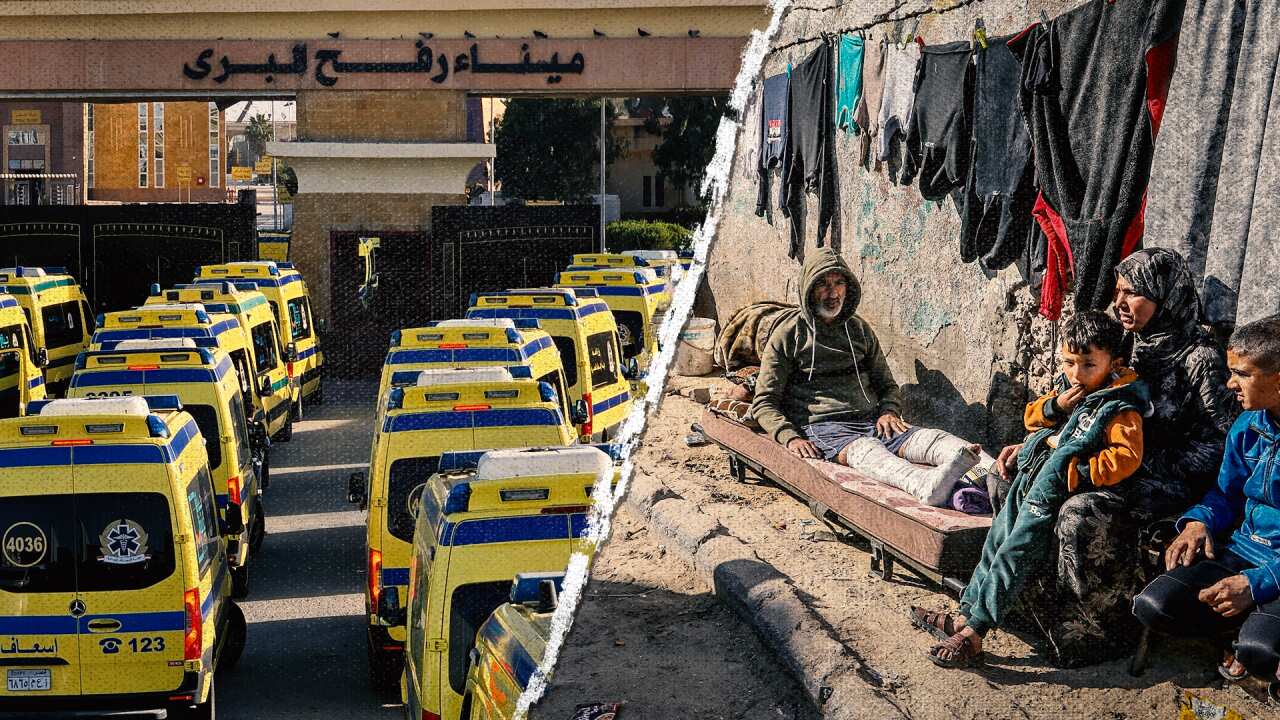
The partial reopening of the Rafah crossing between Gaza and Egypt has raised hopes for desperately needed medical access for Palestinians, even as experts question the long-term impact of the move.
Israel partially reopened the Rafah crossing between the devastated enclave and Egypt on Monday, following months of appeals from aid groups.
"[The Rafah crossing] is the lifeline for us, the patients. We don't have the resources to be treated in Gaza," Moustafa Abdel Hadi, a kidney patient in a central Gaza hospital awaiting a transplant abroad, told the Reuters news agency.
Reopening the border crossing was a key requirement of the first phase of United States President Donald Trump's plan to end two years of violence and destruction, after Hamas' October 2023 attack on southern Israel and Israel's subsequent military offensive in Gaza.
News that makes sense
Your trusted source for staying up-to-date with the world around you. Get free daily news updates and analysis, straight to your inbox.
What is the Rafah crossing?
Before the conflict, the Rafah crossing was the only direct exit point for most Gazans to reach the outside world, as well as a key entry point for aid into the territory. It's Gaza's only border point that does not pass through Israel.
However, for Palestinians seeking to pass through the crossing, it has long been a process marked by heavy restrictions and only intermittent access.
It was established by Israel after its peace treaty with Egypt in 1979. Israel controlled who went through the crossing for decades until, in 2005, control was transferred to Egypt, the Palestinian Authority and European Union (EU).
Egypt, alongside Israel, imposed a blockade after Hamas seized power in Gaza in 2007, severely restricting the movement of people and goods. It has intermittently opened and been closed down again several times since, with Egypt gradually allowing the crossing to open in recent years.
To bypass the blockade, smugglers dug tunnels underneath the border, allowing for the passage of goods like food, fuel and clothing, as well as weapons, to pass through, and serving as an economic lifeline. Hamas collected tens of millions of dollars a month in taxes and customs on goods passing through the crossing.
The Rafah crossing has been largely shut since May 2024 when the Israeli military took control on the Gaza side.
How will its reopening work?
The Coordinator of Government Activities in the Territories (COGAT), the Israeli military unit that oversees humanitarian coordination, had said the crossing would reopen in both directions for Gaza residents on foot only, and its operation will be coordinated with Egypt and the European Union.
Israel will still have control over who enters or exits, with COGAT saying Israel and Egypt would vet Palestinians for entry and exit. The crossing itself will be overseen by European border patrol agents.

It's unclear how many people will be permitted to use the crossing each day. Preparations are underway to let a limited number of medical evacuees leave Gaza first.
Eyal Mayroz, a senior lecturer in peace and conflict studies at the University of Sydney, told SBS News the Rafah crossing presents a "significant security risk" to Israel.
Mayroz said the crossing — and its below-ground areas — had allowed Hamas to smuggle weapons for "many years".
"So, Israel rightfully points out why it should have some control on allowing who can and cannot enter," he said.
Despite the risk of arms smuggling, Israel has agreed to reopen the crossing largely due to pressure from the US, Mayroz said.
Why has the crossing reopened?
The opening of the border was an aspect of the US-led peace plan for Gaza, which also calls for an Israeli military withdrawal from the Gaza Strip and for Hamas to disarm.
"Israel has tried quite hard for a long time to prevent the reopening from happening, insisting Hamas must disarm first," Mayroz said.
"But I think this has a lot to do with American pressure on Israel that [Benjamin] Netanyahu couldn't resist."
Shahram Akbarzadeh, a professor of Middle East and Central Asian Politics at Deakin University, said the rules Israel has placed on the crossing could force Gazans to make a tough choice.
"Forcing people to leave Gaza for medical aid instead of allowing the assistance to come into Gaza is a problem," he said.
"It's a poisoned chalice, as many people who leave may struggle or not be allowed by Israel to return to Gaza."
"The population are desperate for aid and will leave to seek medical attention; it fits Israel's grand strategy of emptying Gaza ... It's a policy of ethnic cleansing."
A United Nations special rapporteur report in March 2025 said: "Palestinians face serious risk of mass ethnic cleansing as Israel advances its long-held plan to take Palestinian lands and evacuate them of Palestinians under the fog of war."
The Israeli government has consistently denied claims that its two-year military operation in Gaza seeks to ethnically cleanse Gaza of Palestinians and has strongly criticised Francesca Albanese, the UN special rapporteur who authored the March report.
Medical assistance
While critical of Israel's motives, Akbarzedah said the opening of the border would bring "significant relief" to Gazans.
Many of those expected to leave are sick and wounded Gazans in need of medical care abroad.
The Palestinian health ministry has said around 20,000 patients are waiting to leave Gaza to access medical care abroad.
Mayroz said the assistance people receive will be a "drop in the ocean" compared to what was needed to ease suffering in Gaza, adding that the most effective way to assist the injured and wounded there would be to also allow humanitarian groups access to the enclave.
The Gaza Strip remains in need of vital aid that humanitarian organisations say has been stymied by Israeli restrictions.
"Many people in Gaza are still living in the rubble without basic services, struggling to stay warm amid harsh winter conditions," International Committee of the Red Cross (ICRC) president Mirjana Spoljaric said in a statement on Friday.
Long-term access
Akbarzeadeh said the reopening of Rafah would also be "very important" for rebuilding Gaza, where the vast majority of buildings have been partially or fully destroyed since 7 October 2023, according to the UN.
"It's a key transit route, so when reconstruction in Palestine begins, you will be able to have the movement of machinery and supplies he said.
The opening will also facilitate the movement of the thousands of workers needed to rebuild Gaza's infrastructure.
Construction workers and machinery will be required as part of the agreed-upon peace plan, but other international organisations will still have a hard time entering the enclave.
"I don't think there will be any difference for international media agencies, some like Al Jazeera are banned in Gaza by Israel," he said.
"I don't think Israel sees opening the crossing as an opportunity for allowing international scrutiny and verification."
International journalists have been banned from Gaza since October 2023.
Some UN aid agencies are also now banned from entering Gaza, with the UN's agency for Palestinian refugees banned by Israel for alleged anti-Israel bias and failing to address Hamas' infiltration of its staff — allegations the organisation has denied.
Dozens of humanitarian organisations working in Gaza and the occupied West Bank also face a looming ban under new Israeli registration rules.
Israeli airstrikes continue
Meanwhile, Israeli attacks in Gaza have killed more than 500 Palestinians since the ceasefire began in October last year, local health officials have said, and Palestinian militants have killed four Israeli troops, according to Israeli authorities.
On Saturday, Israel launched some of its most intense airstrikes since the ceasefire began, killing at least 30 people, in what it said was a response to Hamas militants emerging from a tunnel in Rafah in violation of the truce.
The next phases of Trump's plan for Gaza foresee governance being handed to Palestinian technocrats, Hamas laying down its weapons and Israeli troops withdrawing from the territory while an international force keeps the peace and Gaza is rebuilt.
Hamas has so far rejected disarmament, and Israel has repeatedly indicated that if the Islamist militant group is not disarmed peacefully, it will use force to make it do so.
Mayroz said international pressure will act as an incentive for Hamas and Israel to follow through with the peace plan, despite the sustained violence.
"The funders of these billions of dollars' worth of reconstruction will have to be assured that the war is not going to go backwards," he said.
"But the risk of a resumption of large-scale violence is not out of the question."
— With additional reporting by the Associated Press via the Australian Associated Press.
For the latest from SBS News, download our app and subscribe to our newsletter.







