
This article contains references to family and domestic violence.
Women escaping violence, young people, and First Nations Australians are increasingly relying on support services and going through a "horrendously difficult" time seeking shelter.
Specialist Homelessness Services (SHS) are now receiving on average 350 requests for help each day that they can't meet, and over seven in ten are women and children.
The data is part of the Australian Institute of Health and Welfare's (AIHW) annual SHS report for 2024-2025, which estimated that just under 289,000 Australians asked for help in the year.
Of those people seeking homelessness support, 19,000 more went unassisted, likely due to a lack of available shelter or resources.
News that makes sense
Your trusted source for staying up-to-date with the world around you. Get free daily news updates and analysis, straight to your inbox.
Julie Jasprizza-Laus, the Western Sydney area manager for community service and housing providers, Mission Australia, told SBS News that deciding who to prioritise for assistance is an "extremely difficult task" and takes an emotional toll on support workers.
"We have to try to have the most humane conversation possible," Jasprizza-Laus said.
"Because often they've exhausted those family or friendship pathways. We can sometimes get temporary accommodation, but it's extremely limited."
She said it can be a "huge burden" for staff who don't always have the solutions people in crisis need.
"Staff are talking to people going through a horrendously difficult time, and they can be asking all sorts of questions, which can't always be answered," she said.
Prioritising safety
Jasprizza-Laus said determining who they prioritise ultimately comes down to risk.
"We ask, 'Whose safety is most in danger in this moment?' And that can change per day. So, each day as the people come through, we assess who's going to be at the most risk tonight," she said.
As more women and children seek support to exit an unsafe home or get off the street, the risk becomes "twofold".
Women and children made up 73 per cent of those seeking help from SHS, according to the AIHW, and people who had experienced domestic and family violence accounted for 40 per cent of all SHS clients — the largest cohort seeking help.
"If that family is escaping family domestic violence and they're transient, they are more exposed and they are more likely to be in more dangerous situations," she said.
"They're at risk of being spotted or seen by the perpetrator or the person that they're at risk from, and they're already vulnerable.
"And we need to be able to find them a safe place to get refuge, to be able to go, 'Okay, we can breathe now', and then we can look at what else needs to happen."
Nearly 29 per cent of all people seeking SHS assistance are Indigenous.
Jasprizza-Laus said the demand for help is at an "epidemic level" and that Australia needs more houses to help people at risk.
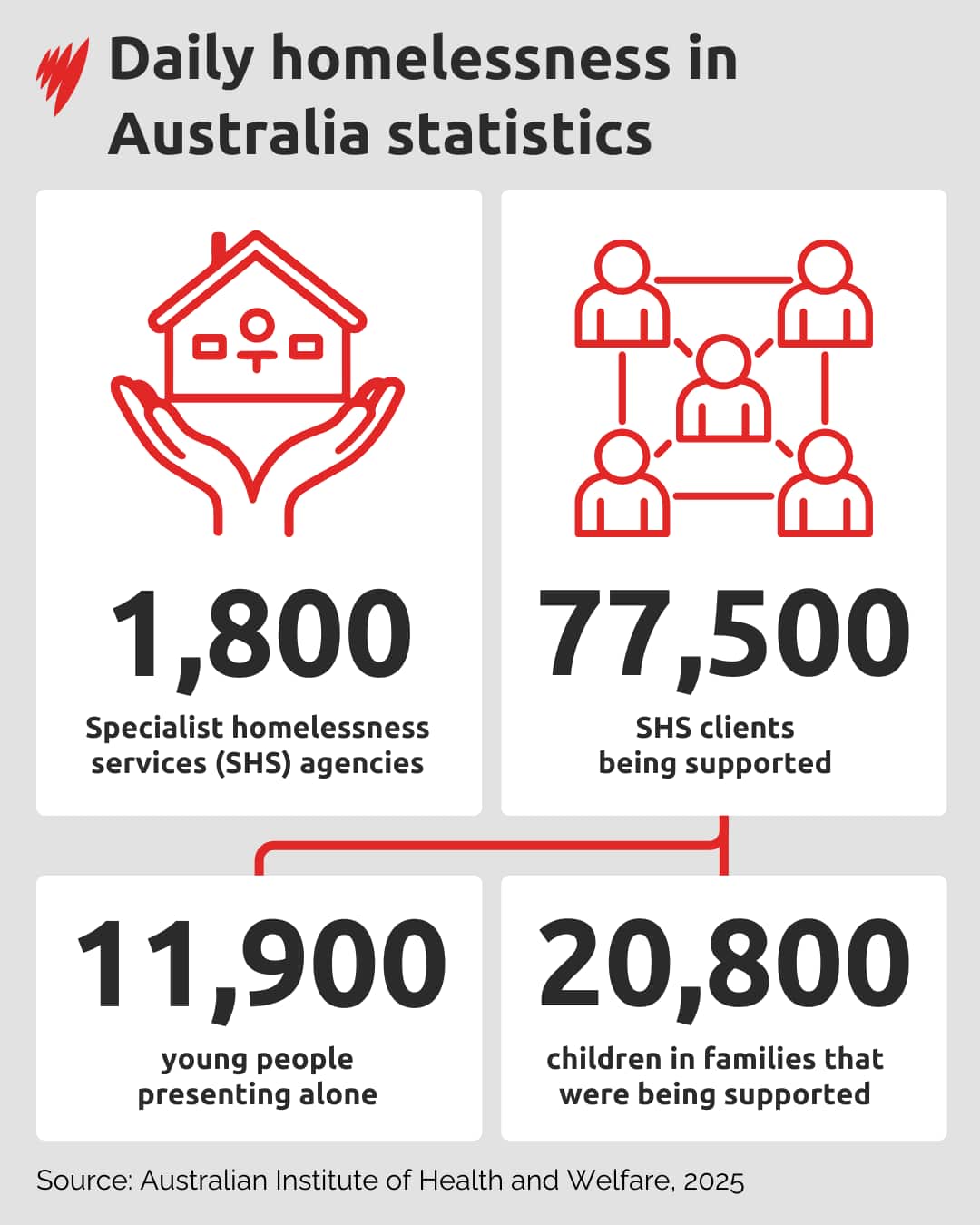
Each day, 77,500 SHS clients are supported by 1,800 agencies, with 11,900 of those being young people presenting alone.
At least 290 of those people will be seeking support from an SHS agency for the first time.
"The lack of affordable, stable housing is such a barrier for us to find exit pathways for people who are homeless," Jasprizza-Laus said.
Housing affordability stress on the rise
In the 2024–25 period, 9.1 per cent of people going to SHS (26,200 people) reported housing affordability stress as their main reason for seeking assistance, compared with 2014–15, when the number was 12,500.
The proportion of affordability-stressed clients who were experiencing homelessness when support started increased from under one-third in 2014–15 to over half in 2024–25.
Over the past 10 years, since the 2014-2015 report, housing affordability stress has been the fastest-growing primary concern affecting people.
Older clients aged 65 and over were more likely than other age groups to experience housing affordability stress, followed by those aged 18 to 24.
Around 7.7 per cent or 6,400 First Nations people seeking help were facing affordability stress, up from 2,200 in the decade before.
Kate Colvin, the CEO of Homelessness Australia, said the data shows there is increasing pressure on the under-resourced homelessness system.
"There is a huge increase in people missing the support they need," she told SBS News.
"People may be couch surfing, or have some kind of roof over their head, but they're not able to stay in that unsafe environment."
She said when SHS are unable to accommodate at-risk people, they often feel they have to stay in violent homes or take their luck to the streets.
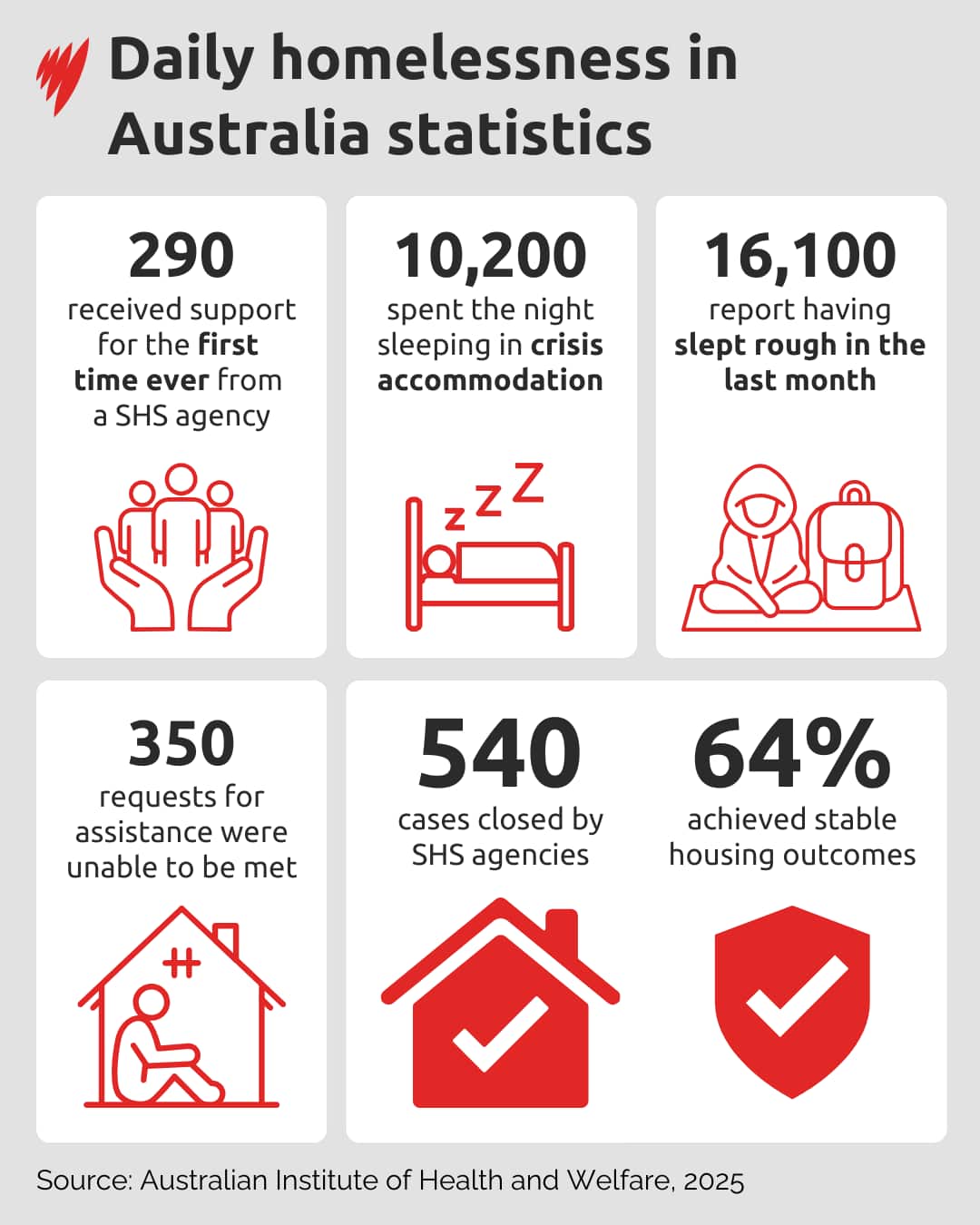
According to the AIHW, 16,100 people reported sleeping rough in the last month, while a further 10,000 spent the previous night in crisis accommodation.
Homelessness Australia is advocating for a Homelessness Prevention Fund, which would focus on assisting people before they lose their stable accommodation.
"It's often, it's a lot more difficult to rehouse someone than it is to avoid them becoming homeless in the first place," Colvin said.
"We want to be able to provide early intervention support."
This can include helping negotiate with landlords before an eviction and supporting a young person in reaching out to family.
"Homelessness across Australia has got worse. And so, this really needs to be a wake-up call for the government to deliver the investment that's needed to drive down homelessness."
If you or someone you know is impacted by family and domestic violence, call 1800RESPECT on 1800 737 732, text 0458 737 732, or visit 1800RESPECT.org.au. In an emergency, call 000.
The Men's Referral Service, operated by No to Violence, can be contacted on 1300 766 491.
Support for people experiencing homelessness can be found at homelessnessaustralia.org.au
For the latest from SBS News, download our app and subscribe to our newsletter.







