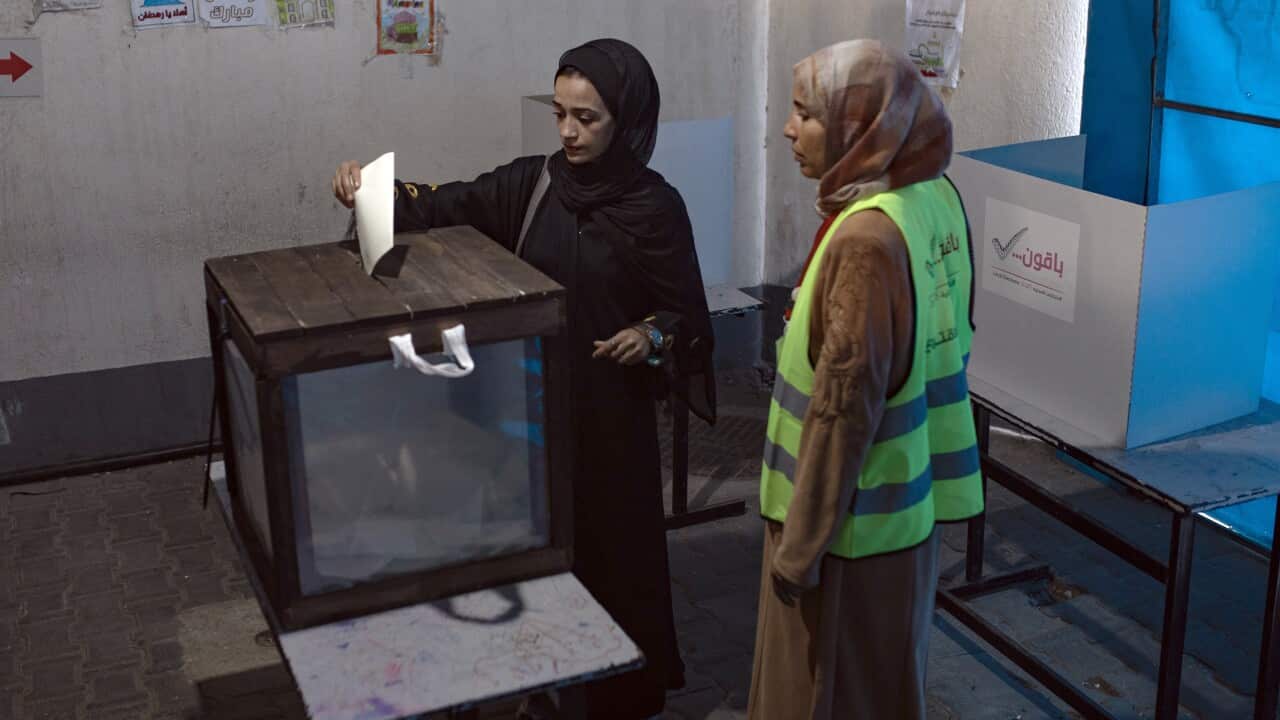
For the first time since 2006, a small pocket of Gaza has returned to the ballot box.
In Deir al-Balah — a central city known for the date palms from which it derives its name — residents voted for a municipal council alongside elections held more widely across the occupied West Bank.
The ballot was tightly contained, drawing participation from less than a quarter of registered voters in a city marred by Israeli strikes and a ground offensive, where entire families had been displaced or wiped from the civil registry.
Voting did not extend across the devastated enclave but still marked the first election of any kind in Gaza in nearly two decades, and the first Palestinian poll since the war began more than two years ago.
More than 71,000 Palestinians have been killed and more than 171,000 injured over two years of war, which erupted after the 7 October 2023 attack led by Hamas — the political and military group that rules Gaza — on southern Israel.
News that makes sense
Your trusted source for staying up-to-date with the world around you. Get free daily news updates and analysis, straight to your inbox.
Held in tandem with elections across 183 West Bank municipalities, the ballot provided a limited but rare indication of political sentiment at a time when Gaza's future governance is being actively negotiated.
What the numbers show
Turnout figures reflected the vastly different conditions under which voting took place in Gaza and the occupied West Bank.
In Deir al-Balah, just 22.7 per cent of roughly 70,000 registered voters, or 15,890 people, cast a ballot. Election officials pointed to an outdated civil registry — still listing thousands of people killed in the war — alongside the displacement of entire families out of the city.
Across the West Bank, participation reached 53.4 per cent across 183 municipalities, broadly in line with previous local elections, with around 522,000 people voting overall.
The results pointed to a largely familiar political landscape, with only marginal variation at the local level.
In Gaza, the Nahdat Deir al-Balah list of candidates — backed by Fatah, the secular nationalist movement that dominates the Palestinian Authority — secured six of the 15 contested seats. Under the voting system, voters must number a vote for each candidate on the list.
A rival list widely seen by residents and analysts as aligned with Hamas won two seats, with the remaining positions split between Future of Deir al-Balah and Peace and Building.
Hamas, which has controlled much of Gaza since 2007, did not formally field candidates after being barred under a Palestinian Authority decree requiring contenders to commit to Palestine Liberation Organisation agreements with Israel, though candidates perceived to be aligned with the group were present on some lists.
Still, the Government Information Office in Gaza declared full support for the vote, writing in a statement that more than 500 government employees helped organise and secure polling in Deir al-Balah.
In the West Bank, Fatah's official Steadfastness & Giving list led in major centres including Hebron, Tulkarem and Salfit, with about 95 per cent of ballots counted at the time of publishing.
In several cities — including Ramallah and Nablus — no vote was held because only a single list had registered, effectively handing victory to Fatah-aligned candidates.
Elsewhere, results were more mixed. In Jenin, Fatah won six of the 15 available seats, tying with an independent list also named 'Jenin', while in Qalqilyah no list was registered, leaving the Palestinian Authority responsible for appointing a municipal council.
Cautious optimism on the ground
For Palestinian officials, the story of the vote was less about turnout and more about the fact it happened at all.
"Thanks to God, we were able to carry out elections. The turnout was not high [in Deir al-Balah], at 23 per cent, but there are many reasons for this 23 per cent," said Rami Hamdallah, chair of the Ramallah-based Central Election Commission and former Palestinian prime minister.
He cited the civil registry inaccuracies and widespread displacement, adding that "simply holding them … was a major achievement."
Hamdallah said the vote carried "a political message that national unity is possible, and that general elections are also possible".
Prime Minister of the State of Palestine Mohammad Mustafa described the elections as taking place "at an extremely important time, amid complex challenges and exceptional circumstances," calling it "a first and important step within a national framework and path aimed at consolidating democratic life".
"Gaza is an integral part of the State of Palestine, and our people in Gaza are an integral part of our Palestinian people. Our main goal is the swift return of Gaza to the fold of legitimacy so that our people may be unified, our lands may be unified, and our institutions may be unified," he said on Sunday.
Among those in the West Bank, sentiment was measured but broadly positive, with many focusing on the smooth conduct of the vote.
Resident Adel Saad told the Associated Press the municipal elections "were fine, they went well and passed safely without any problems. Praise be to God, they were democratic and good, and the turnout was good".
Hussein Mohammad, another resident, said the results were "satisfactory for everyone, and people are convinced by them".
Beyond the ballot box
Municipal councils in occupied Palestinian territories are responsible for essential services such as water, sanitation, roads and electricity, but do not have legislative authority.
With no presidential or legislative elections held since 2006, they have become one of the few remaining mechanisms for formal political participation, even as many voters say local governance is increasingly shaped by Israel's siege on land, movement and resources.
In the West Bank, that refers to the expansion of Israeli settlements and restrictions affecting access to services, with around 1,000 gates installed in 2025 at the entrances of towns and villages, which, when closed, can cut off residents from nearby municipalities.
The vote also comes as international efforts to reshape Gaza's governance gather pace.
Under a US-backed plan endorsed by the UN Security Council, a 'Board of Peace' has been established as a transitional body tasked with overseeing governance and security in Gaza during the post-war period.
Chaired by US President Donald Trump, the board sits above a broader Gaza Executive Board made up of international representatives, including leaders and foreign ministers from across multiple regions.
More than sixty countries were invited to participate, though only about twenty-seven have accepted, with several European nations declining over concerns about its scope and relationship to the United Nations.
Despite these invitations, no Palestinian representatives have been placed on the Board of Peace or the parallel Gaza Executive Board. The only Palestinian representation sits within a separate National Committee for the Administration of Gaza, a technocratic body tasked with overseeing day-to-day services in what has been described as a proposed 'New Gaza'.
Among Palestinians in Gaza, the initiative has been met with deep scepticism, with some viewing it as a mechanism that could entrench Israel's occupation, while reiterating demands for self-determination and locally-led governance.
For the latest from SBS News, download our app and subscribe to our newsletter.







