
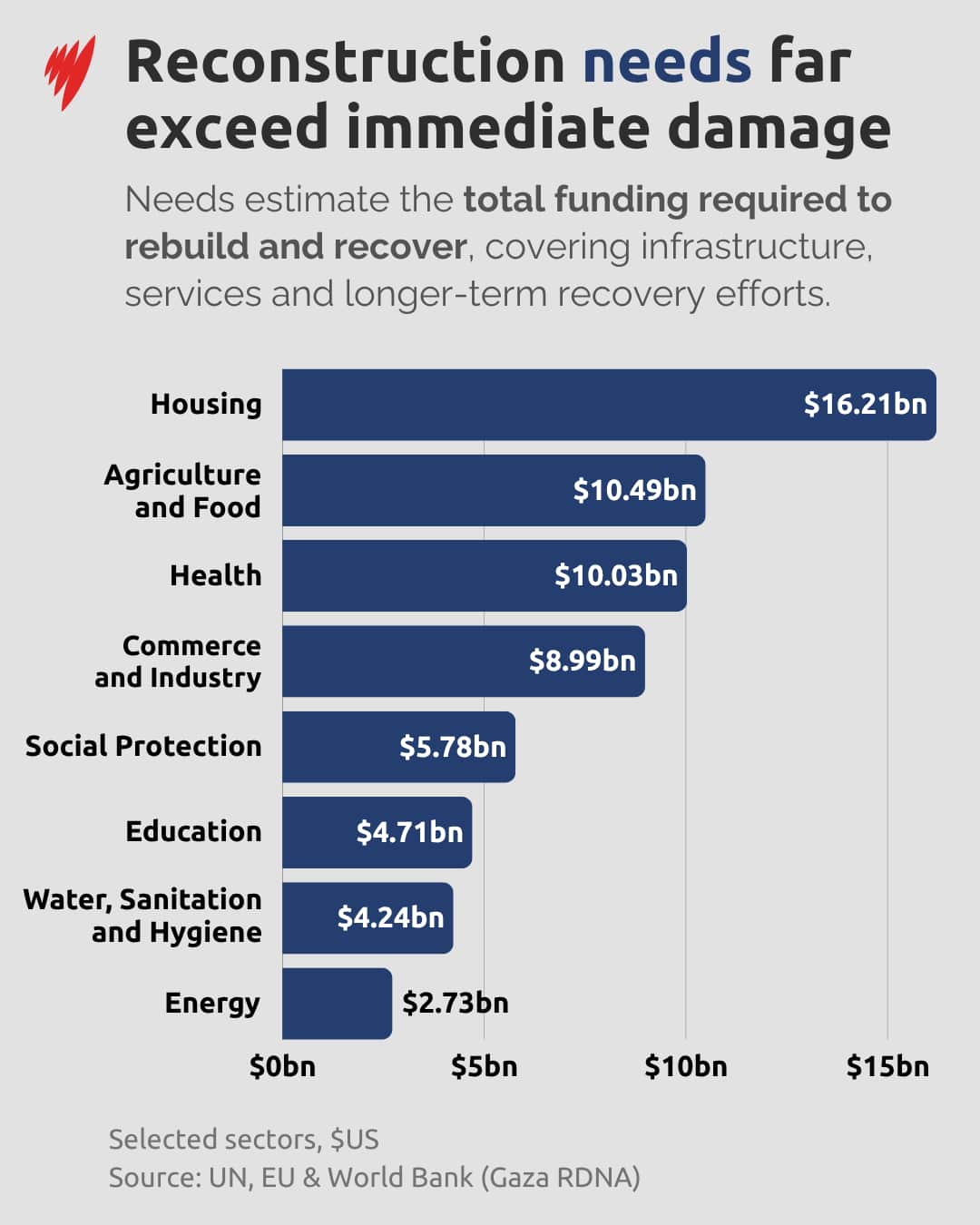
Human development across Gaza has been set back by 77 years, with more than US$71 billion ($99.62 billion) needed over the next decade for the territory to recover, according to a new United Nations and European Union report.
The Gaza Rapid Damage and Needs Assessment (RDNA), developed in coordination with the World Bank, examined the physical, social, economic, and human toll of more than two years of conflict from October 2023 through to October 2025.
Recovery and reconstruction needs are estimated at US$71.4 billion ($99.62 billion), with US$26.3 billion ($36.7 billion) required in the first 18 months alone to restore essential services, rebuild critical infrastructure and support economic recovery.
The scale of destruction
Over 371,888 homes, equivalent to 76.6 per cent of all units, have been destroyed or damaged during the war, according to the report.
News that makes sense
Your trusted source for staying up-to-date with the world around you. Get free daily news updates and analysis, straight to your inbox.
More than half of Gaza's hospitals are non-functional.
Nearly all schools have been destroyed or damaged — with the majority remaining repurposed as shelters for the displaced.
The economy contracted by 83 per cent year-on-year in 2024.
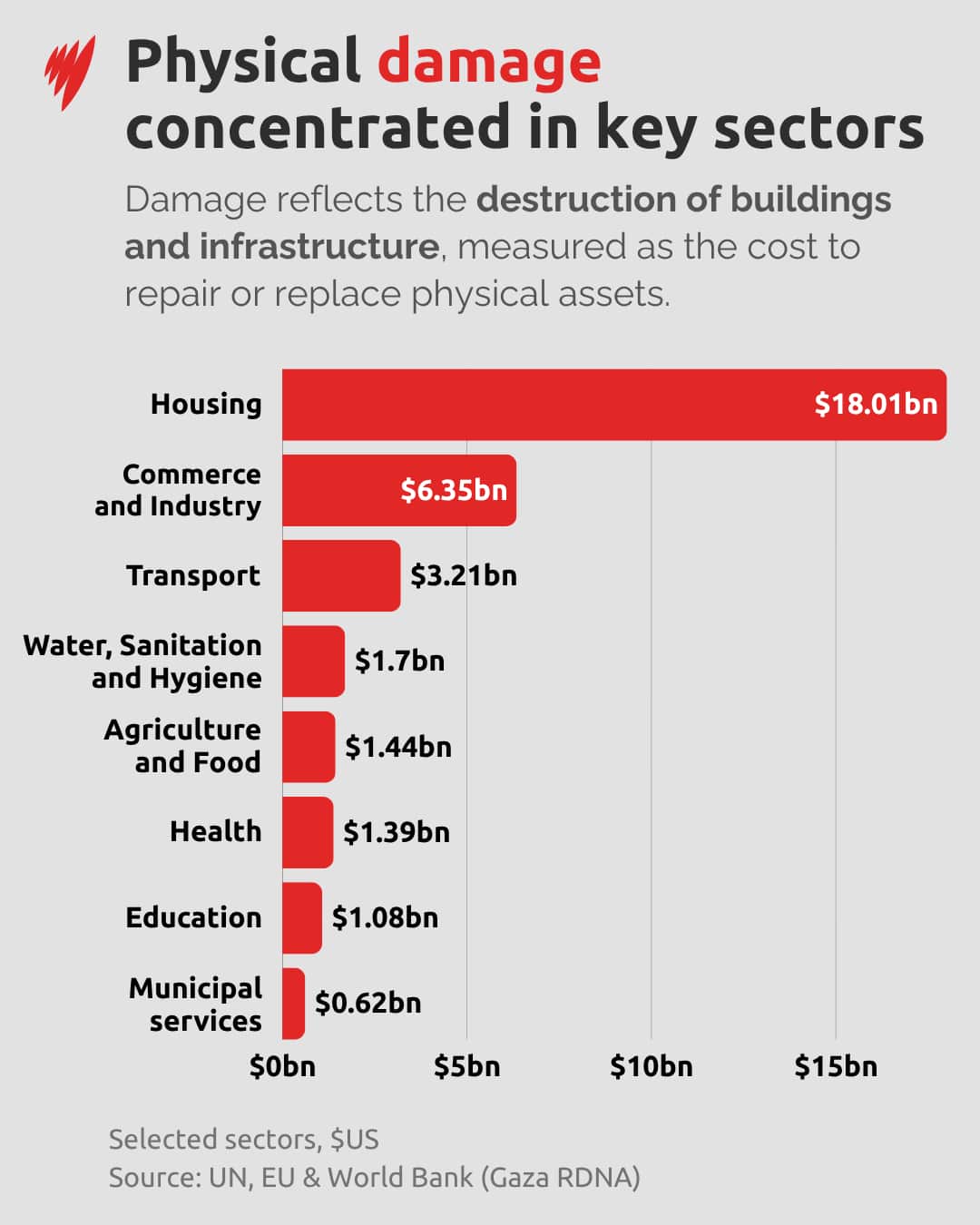
Physical damage to infrastructure is estimated at US$35.2 billion ($49.07 billion), with housing accounting for more than half of that figure at US$18 billion ($25 billion) — followed by commerce and industry, transport, and water and sanitation.
Gaza and North Gaza governorates have suffered the most.
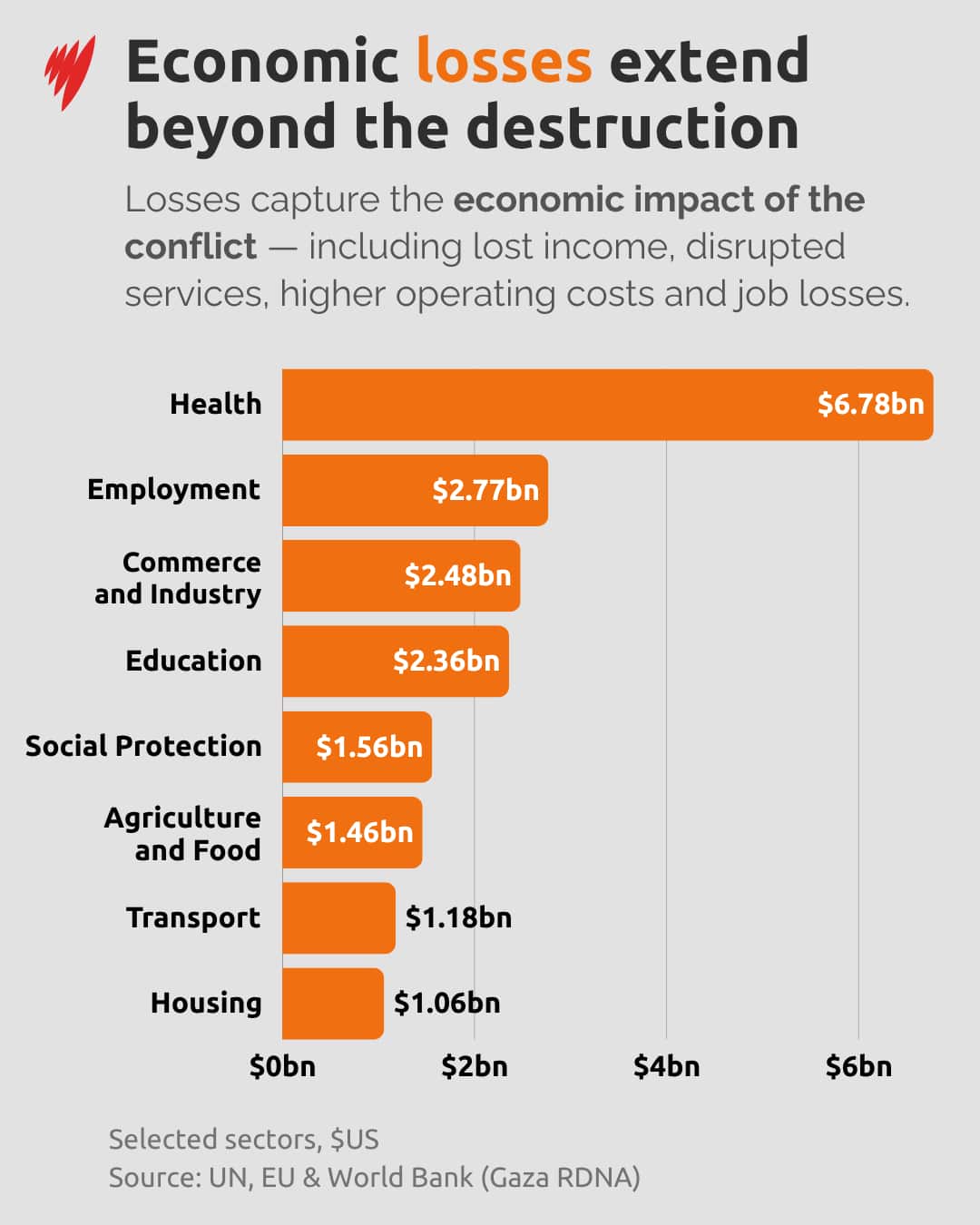
The separate US$22.7 billion ($32.7 billion) in economic losses captures the impact beyond bricks and mortar — lost wages, collapsed healthcare revenue, and suspended trade. The sectors hit hardest by losses were health, employment and commerce and industry.
The human toll
Beyond the dollar figures is what the report calls a "catastrophic humanitarian impact".
It says more than 71,000 Palestinians have been killed and more than 171,000 injured over two years of war, which erupted after after the 7 October 2023 attack led by Hamas — the political and military group that rules Gaza — on southern Israel.
Many Palestinians are also missing.
Some 1,671 Israeli and foreign nationals have also been killed, the majority on October 7, according to the report.
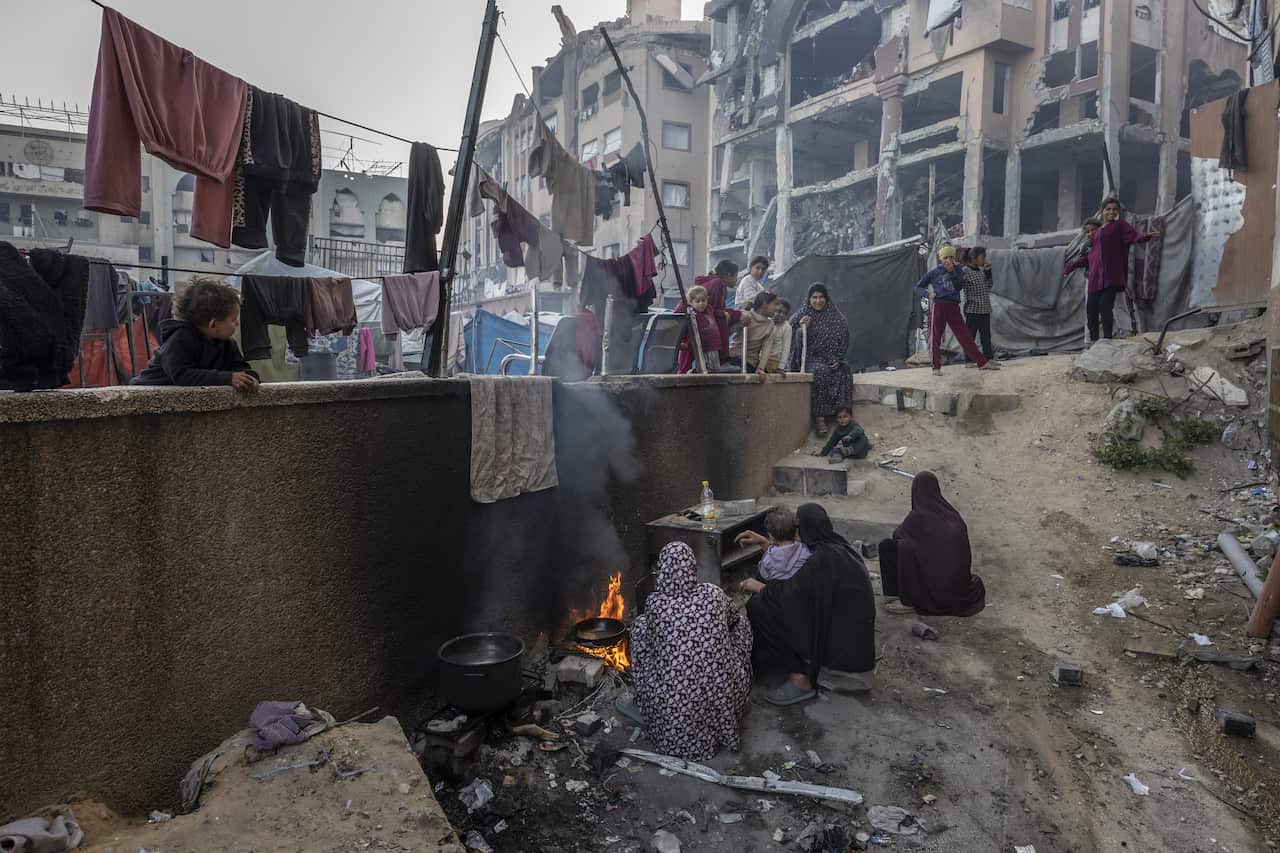
Nearly 1.9 million people in Gaza have been displaced, many of them multiple times, and more than 60 per cent of the population has lost their homes entirely.
The report also documents a particularly devastating impact on children.
Some 728,000 school-aged children have been out of formal schooling for more than two years, at least 792 teachers and school personnel have been killed, and an estimated 7,000 young people have lost limbs.
The conflict has resulted in a high number of "wounded children with no surviving family", the report said. Almost all children require mental health and psychosocial support.
Violence continues
Despite a fragile US-brokered ceasefire agreed to in October, attacks on Gaza have not stopped.
Israeli strikes on Monday killed at least five Palestinians in separate incidents, Palestinian health officials said.
More than 750 Palestinians have been killed since the deal took effect, according to local medics, while Israel says militants have killed four of its soldiers.
Israel and Hamas have traded blame for ceasefire violations.
Israel says it aims to thwart attacks by Hamas and other militant factions.
Amnesty International Australia says the shift in global attention toward the US and Israel's war on Iran has provided cover for an escalation.
"The situation in Iran has enabled Israel to continue to commit its crimes more openly and brazenly, with full impunity," Mohamed Duar, the organisation's Occupied Palestinian Territory spokesperson based in Sydney, told SBS News.
"We've witnessed Israel murder aid workers, journalists and healthcare workers, amounting to the commission of war crimes under the Geneva Conventions.
"Yet, no one has ever been held to account, and the response from the international community, including Australia, has remained grossly inadequate."
Amnesty has determined that Israel's conduct amounts to genocide — a characterisation Israel strongly rejects — and says the campaign has continued " in breach of binding orders issued by the International Court of Justice", including through what it describes as continued attacks on the United Nations Relief and Works Agency for Palestine Refugees (UNRWA) and the banning of international aid organisations.
Separately, Amnesty said Israeli military, police and illegal settlers have "continued, if not, escalated" their violence against Palestinians in the occupied West Bank and East Jerusalem.
Israel says it minimises civilian casualties in Gaza by issuing warnings ahead of military operations. It has also consistently denied war crime allegations, saying it does not deliberately target non-combatants and upholds international law.
Israel rejected Amnesty's genocide accusation as a "fabricated report entirely false and based on lies" when the rights body released its determination in December 2024, denouncing the group at the time as a "fanatical organisation" whose report "failed to account for the operational realities" its military faced.
In the occupied West Bank, Israeli ministers gathered on Sunday to celebrate the re-establishment of a settlement at Sa-Nur — evacuated under a 2005 disengagement plan — while the following day, a neighbouring Palestinian village received demolition orders for 15 shops.
Israel has approved 102 new settlements under the current government, an 80 per cent increase according to Israeli rights group Peace Now.
Since the start of 2026, at least 580 settler attacks against Palestinians have been recorded, with at least 1,800 people displaced as a result of violence and access restrictions, according to UN figures.
Human Rights Watch has described the intensifying violence and displacement of Palestinians in the West Bank as ethnic cleansing enabled by the Israeli state, a charge Israel rejects.
Israeli indictments of settler violence are rare, according to Israeli rights group Yesh Din.
A $71 billion question: who rebuilds and how?
With recovery and reconstruction needs sitting at over US$71 billion ($99.62 billion), the question of how — and by whom — Gaza is rebuilt has become as contested as the conflict itself.
The UN and EU believe reconstruction must be Palestinian-led and co-exist alongside a sustained ceasefire, unimpeded aid access, and a credible politcal pathway to Palestinian statehood.
But a rival framework is already taking shape.
The Board of Peace — a United States-led body proposed and chaired by President Donald Trump to oversee Gaza's reconstruction and governance — has been recognised by the UN Security Council, though many major powers have not joined.
But Amnesty's Duar is critical, labelling it a "plan without Palestinians" that he said denies "them any form of justice".
Trump's Gaza plan, to which Israel and Hamas agreed in October, sees Israeli troops withdrawing from Gaza and reconstruction starting as Hamas lays down its weapons.
The Board of Peace’s lead envoy for Gaza said on Monday that he was "fairly optimistic" a plan for disarmament of Hamas and other militant groups in Gaza can be agreed, but cautioned that it will still take time.
"We've had some very serious discussions with Hamas over the last few weeks, they're not easy," Nickolay Mladenov told Reuters.
"I'm fairly optimistic that we will be able to come up with an arrangement that works for all sides and, most importantly, works for the people in Gaza."
Meanwhile, the Financial Times is reporting that representatives of the Board have held talks with state-owned Dubai multinational DP World about managing supply chains and infrastructure projects in Gaza.
Citing three people familiar with the matter, the paper said the efforts would cover humanitarian aid and other goods entering Gaza, including warehousing, tracking systems and security.
— With reporting by Reuters and Agence France-Presse.
For the latest from SBS News, download our app and subscribe to our newsletter.







