
In brief
- Global defence spending has reached a record $4 trillion, marking the 11th year of consecutive growth.
- Research by the Stockholm International Peace Research Institute found the growth rate slowed due to lowered spending by the United States.
Global military spending has reached a record $4 trillion — equivalent to almost $500 for every person on Earth — as countries ramp up defence budgets in response to escalating geopolitical tensions.
Data published by the Stockholm International Peace Research Institute (SIPRI) on Monday found global defence expenditure rose by 2.9 per cent last year, marking the 11th consecutive year of growth.
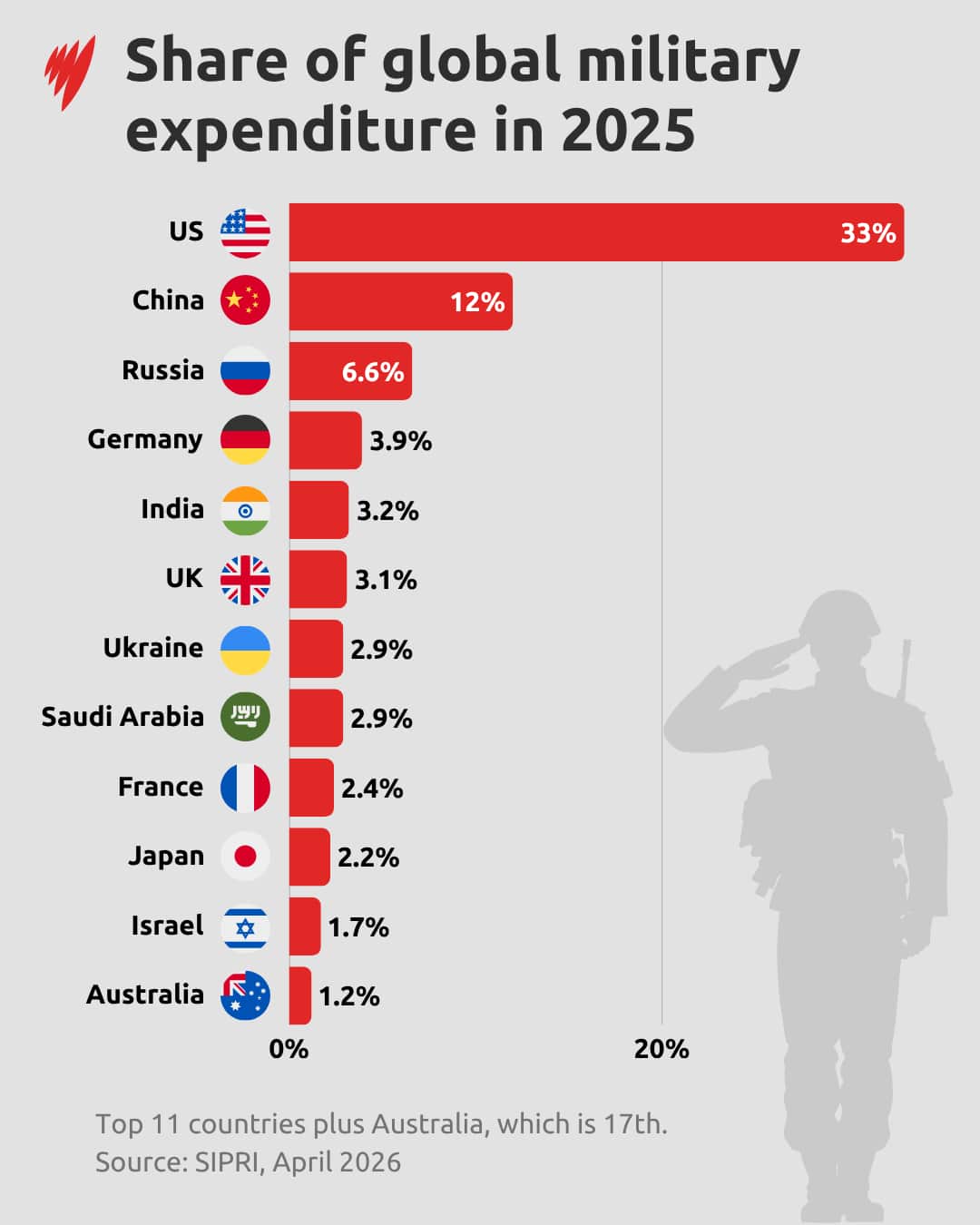
Spending was dominated by three countries — the United States ($1.33 trillion), China ($468 billion) and Russia ($265 billion) — which together accounted for 51 per cent of the global total.
Germany ($159 billion), India ($128 billion), the United Kingdom ($124 billion), Ukraine ($117 billion), Saudi Arabia ($116 billion), France ($95 billion) and Japan ($87 billion) rounded out the top 10.
Australia spent $49 billion and ranked 17th in the world — down two places from the previous year — accounting for 1.9 per cent of national GDP and 1.2 per cent of global expenditure.
News that makes sense
Your trusted source for staying up-to-date with the world around you. Get free daily news updates and analysis, straight to your inbox.
The federal government this month said Australia's current defence spending was 2.8 per cent of GDP and would rise to 3 per cent by 2033, using North Atlantic Treaty Organization (NATO) calculations.
SIPRI noted NATO figures were calculated differently from its own.
Global military spending has increased by 41 per cent in the past decade, with approximately $491 spent for every person on the planet, according to SIPRI's figures.
"Global military spending rose again in 2025 as states responded to another year of wars, uncertainty and geopolitical upheaval with large-scale armament drives," SIPRI researcher Xiao Liang said.
"Given the range of current crises, as well as many states' long-term military spending targets, this growth will probably continue through 2026 and beyond."
US spending drops after aid to Ukraine slashed
Despite reaching a record high military expenditure, the annual growth rate of 2.9 per cent was the lowest since 2021, and a sharp fall from the 9.7 per cent recorded the previous year.
SIPRI attributed that to the US — the world's largest military spender — which did not approve new military aid to Ukraine last year following US President Donald Trump's return to office.
By comparison, the US has approved $177 billion in military assistance to Ukraine over the previous three years.
As a result, US military spending fell by 7.5 per cent, bucking a decade-long average annual growth rate of 11 per cent.
Researchers noted the US had increased investment in both nuclear and conventional military capabilities.
"The decline in US military expenditure in 2025 is likely to be short-lived," SIPRI program director Nan Tian said.
"Spending approved by the US Congress for 2026 has risen to over US$1 trillion ($1.4 trillion), a substantial increase from 2025, and could rise further to US$1.5 trillion ($2.1 trillion) in 2027 if President Trump's latest budget proposal is accepted."
SIPRI's figures do not account for the war in the Middle East — launched by the US and Israel against Iran in February — which is estimated to have cost the US tens of billions of dollars.
Of the top 15 military spenders, all but three — the US, the United Kingdom and Israel — increased their spending.
Growth in Asia driven by China's rise
Sharp spending increases in Europe (14 per cent) and Asia and Oceania (8.1 per cent) more than offset the decline in US expenditure.
In Asia and Oceania, military spending reached $949 billion, with the region recording its highest annual growth since 2009.
China’s military expenditure — second behind the US — grew by 7.4 per cent, its 31st consecutive year of growth as it continues a modernisation drive.
Taiwan (14 per cent) and Japan (9.7 per cent) also recorded big jumps in spending as they increased defence budgets in response to China.
Australia's military spending grew by 3 per cent last year and 18 per cent in the decade to 2025.
"US allies in Asia and Oceania such as Australia, Japan and the Philippines are spending more on their militaries, not only due to long-standing regional tensions but also due to growing uncertainty over US support," SIPRI senior researcher Diego Lopes da Silva said.
"As in Europe, US allies in Asia and Oceania are also under pressure from the Trump administration to spend more on their militaries."
Military expenditure in the Middle East was stable at $303 billion last year, an increase of 0.1 per cent. The figures do not account for the war in the Middle East.
Israeli military spending fell by 4.9 per cent due to a reduction in the intensity of the war in Gaza. A fragile ceasefire between Israel and Palestinian militant group Hamas has been in effect since October, though both sides accuse each other of breaching it.
Iran’s military spending fell by 5.6 per cent, but SIPRI attributed that to inflation rising by 42 per cent, with nominal spending increasing.
Global growth driven by European rearmament
Between 2016 and 2025, European military spending more than doubled (102 per cent), which SIPRI attributed to "geopolitical instability" caused by the Russia-Ukraine war and growing uncertainty over US security guarantees.
Russia — which launched a full-scale invasion of Ukraine in 2022 — increased its military spending by 5.9 per cent last year to reach $265 billion or 7.5 per cent of GDP.
Ukraine's military expenditure rose by 20 per cent to reach $117 billion or 40 per cent of GDP, the highest military spending share of GDP of any country.
Despite a freeze in US aid, Ukraine still received $73 billion in support from other allies, primarily European NATO members.
"[Russia's and Ukraine's] spending is likely to keep growing in 2026 if the war continues, with revenues from Russia's oil sales increasing and a major European Union loan expected by Ukraine," SIPRI researcher Lorenzo Scarazzato said.
The 29 European NATO members spent a combined total of $779 billion last year.
Germany was the biggest spender among them, recording annual growth of 24 per cent to reach $159 billion or 2.3 per cent of GDP — the first time it has exceeded 2 per cent since 1990.
Spain's spending rose by 50 per cent to $56 billion, pushing it above 2 per cent of GDP for the first time since 1994.
"In 2025 military spending by European NATO members rose faster than at any time since 1953, reflecting the ongoing pursuit of European self-reliance alongside increasing pressure from the United States to strengthen burden sharing within the alliance," SIPRI researcher Jade Guiberteau Ricard said.
Trump has been highly critical of NATO, labelling the alliance a "paper tiger" and threatening to pull out after European allies declined to join US and Israeli strikes on Iran.
In June last year, NATO members agreed to increase military spending to 5 per cent of GDP by 2035.
Of that figure, 3.5 per cent is to go towards core military spending while 1.5 per cent can be allocated to broader security-related expenses, such as improving critical infrastructure.
SIPRI noted there were "substantial divergences" between its figures and NATO’s, saying the latter's calculations were becoming harder to verify because NATO did not publish disaggregated data or technical details.
"Blurring the lines between the core military and military-related spending categories brings with it the risk of inconsistent reporting and reduced transparency, limiting effective public scrutiny," the report stated.
"It may also incentivise NATO members to reclassify nonmilitary activities as military to meet politicised targets," it added, citing Italy’s reported attempt to include a proposed bridge to Sicily as part of its military-related expenditure.
For the latest from SBS News, download our app and subscribe to our newsletter.







