Muhammad, whose name has been changed to protect his identity, said he lived out the most traumatic years of his life in Australia's immigration detention system.
He was detained on arrival and held for six years, when his boat from Pakistan touched Australian shores more than a decade ago.
He told SBS News he was "humiliated" and treated like a high-risk criminal while on Christmas Island, even though he had never committed a crime.
"I've seen ten to 13 years people stay in Australian immigration detention. And then on the other hand, there is Australian people who did armed robbery, assault on people, and even second-degree killed and they're released five to eight years," Muhammad said.
"It really breaks my heart and somehow I feel like we still don't have that justice."
News that makes sense
Your trusted source for staying up-to-date with the world around you. Get free daily news updates and analysis, straight to your inbox.
Over six years in detention, Muhammad said he was psychologically tormented by a lack of certainty.
"Immigration and Border Force … they transferred me mostly everywhere in Australia, like from Darwin to Perth, then to Christmas Island, then to Melbourne. This journey, you never know where you will be," he said.
On Christmas Island, Muhammad said he was denied the chance to study and recalled being forced to eat food that was expired by up to seven months.
"I realise Australian dog is better than a human being, if you are not Australian," he said.
"I wished I was a dog in Australia so I can have at least respect."
UN to assess Australia's detention processes
For people like Muhammad, Australia's immigration detention regime facing United Nations scrutiny is a welcome development.
This week, the UN working group on arbitrary detention has started a 12-day mission to assess Australia's detention practices. This includes assessments of prisons, police stations, and institutions for juveniles, migrants and people with psychosocial disabilities.
The arbitrary nature of detention and alleged mistreatment at detention facilities has sparked renewed calls from a national coalition of legal, academic and advocacy organisations for Australia to overhaul its detention scheme. The issue has been well documented by UN bodies and human rights organisations in Australia and overseas.
Refugee Advice & Casework Service (RACS) centre director and principal solicitor Sarah Dale is a contributor to the joint submission.
"Australia is one of the very few countries, if the only country in the world, that mandates detention on arrival for unlawful non-citizens. That principle of mandatory detention is one that we have long stood against," she told SBS News.
"We are also deeply concerned by the securitisation of immigration detention," she said, referring to the banning of mobile phones in immigration detention.
Madeline Gleeson, another contributor from the Andrew & Renata Kaldor Centre for International Refugee Law, said for her organisation, concerns start at the decision to detain.
"These decisions are made by government officials. And so one of the main concerns raised in the submission is that we need a better system, a fairer system, and a more independent system, which allows us to have more confidence that people are not being detained in the first place except where it is lawful to do so," she said.
International law allows deprivation of liberty only as a last resort after all viable alternatives have been considered, and only when detention is reasonable, necessary and proportionate to a legitimate purpose.
Yet in Australia, detention is automatic for all unlawful non-citizens.
"Detention shouldn't interfere with the right of all people to be treated with humanity and dignity. It shouldn't interfere with children's rights or tear apart families. It shouldn't interfere with the universal right to seek and enjoy asylum," Gleeson said.
"In other contexts, Australia does enforce them (global standards) to a certain extent, but we've sort of got a blind spot when it comes to immigration detention."
Indefinite immigration detention overturned
The working group's visit to the country comes amid the ongoing fallout from the High Court's NZYQ decision.
In 2023, the court ruled indefinite immigration detention is unlawful when there is no real prospect of removing a person from Australia in the reasonably foreseeable future.
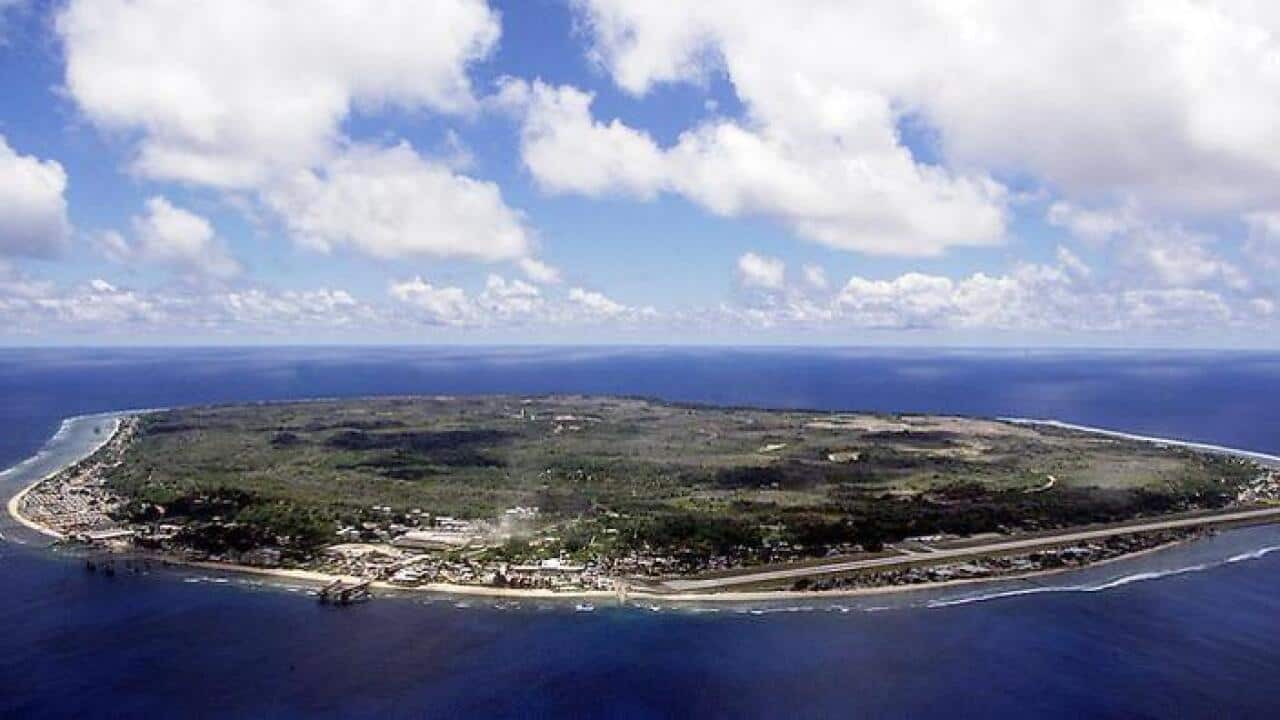
The judgment led to the release of around 140 people, including some convicted criminals. The government has since made a secretive $400 million deal to resettle them in Nauru.
But it also prompted new legislation tightening visa conditions and enabling preventative detention orders in limited cases.
Human Rights For All director and principal Alison Battison addressed the working group in Geneva last year.
She told SBS News many people remain in detention who should already have been released.
"People who have committed no crime in relation to their visa or immigration status are warehoused in what effectively are prisons for an unknown period of time," she said.
"What occurs at the moment is that on a monthly basis, a case manager looks at a person's file like a desktop review, doesn't actually read any documents, and then determines with a very basic checklist whether a person's detention is lawful or not."
When asked about its offshore detention program, a spokesperson for the Department of Home Affairs recently told SBS News in a statement: "The Australian government is committed to resolving the transitory persons caseload temporarily in Australia through third country migration outcomes and continues to work with resettlement partners to identify resettlement opportunities."
The national coalition recommends ending mandatory detention and introducing procedural safeguards to ensure detention is lawful and subject to effective, periodic and independent review.
Gleeson said mechanisms for reform already exist.
"They just need the law that gives them the ability to make those decisions.
"We also have bodies such as the Commonwealth Ombudsman and the Australian Human Rights Commission, which have long histories of overseeing immigration detention."
She said if these were properly resourced, they could "play an important role in ensuring detention is not arbitrary or unlawful".
The working group will deliver its preliminary findings on 12 December, and will present a full report to the UN Human Rights Council in September 2026.
For the latest from SBS News, download our app and subscribe to our newsletter.







