
In brief
- Donald Trump has backed down on his threat that Iranian civilisation would "die" today.
- A two-week "double sided" ceasefire could see the Strait of Hormuz opened.
Iran's 10-point peace plan is expected to underpin peace talks with the United States after more than a month of war.
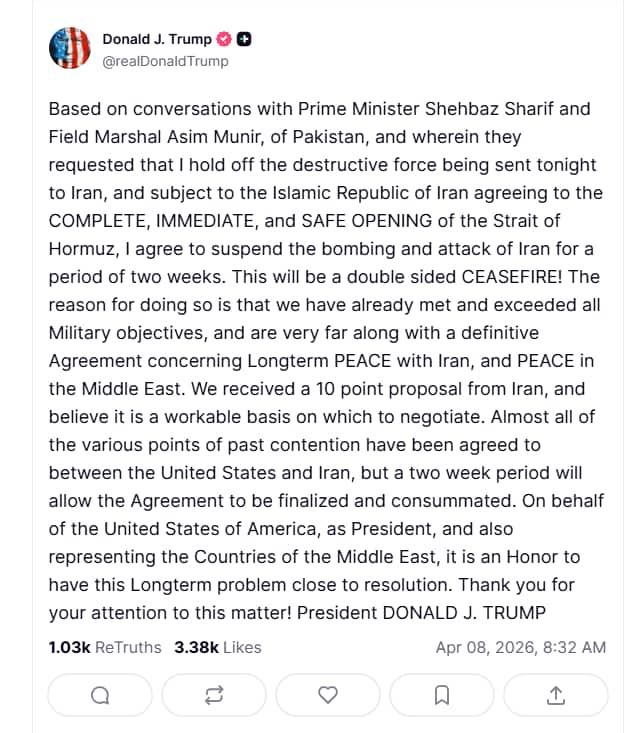
On Wednesday morning, just over an hour before a US deadline to open the Strait of Hormuz was set to pass, US President Donald Trump announced a snap two-week ceasefire.
"... subject to the Islamic Republic of Iran agreeing to the COMPLETE, IMMEDIATE, and SAFE OPENING of the Strait of Hormuz, I agree to suspend the bombing and attack of Iran for a period of two weeks", Trump wrote on Truth Social.
"We received a 10 point proposal from Iran, and believe it is a workable basis on which to negotiate", Trump continued, adding that the two-week military pause would allow agreements to be "finalised" and that the military conflict is close to being resolved.
Iran's foreign affairs minister Abbas Araghchi echoed Trump's sentiment. In a statement, he said the country would move forward with peace talks on the basis of its 10-point plan as well as a 15-point proposal from the United States.
"If attacks against Iran are halted, our Powerful Armed Forces will cease their defensive operations," Araghchi said.
"For a period of two weeks, safe passage through the Strait of Hormuz will be possible via a coordination with Iran's Armed forces and with due consideration of technical limitations".
Iran's Supreme National Security Council portrayed the deal as a victory over the US, claiming Trump had accepted Iran's conditions for ending hostilities.
In response, White House press secretary Karoline Leavitt said: "This is a victory for the United States that President Trump and our incredible military made happen."
The war, now in its sixth week, has claimed more than 5,000 lives in nearly a dozen countries, including more than 1,600 civilians in Iran, according to tallies from government sources and human rights groups.
A source briefed on the talks expressed wariness about the two-week ceasefire holding, saying the US side believed Iran might be trying to buy time, the Reuters news agency reported.
It was a "trust-building exercise," the source said.
Iran's 10-point peace plan
Pakistan has played a key role in mediation between the US and Iran. On Monday, a 45-day ceasefire was reportedly proposed and ultimately rejected by Iran, which instead put forward a 10-point plan that seeks a permanent end to hostilities.
Speaking to reporters on Monday, Trump said the Iranian plan was "not good enough, but they have made a very significant step". He urged the country to go further or "they will have no bridges and no power plants", later threatening that "a whole civilisation will die" unless an agreement was made by 10am Wednesday AEST.
However on Wednesday morning, about an hour and 20 minutes before the deadline was due to expire, Trump said that "almost all of the various points of past contention" had already been agreed to as he announced a pause to the fighting that has engulfed the Middle East.
It is unclear whether the 10-point plan Trump has now shown support for is the same as the one initially proposed.
Wednesday's plan has not been officially confirmed by the US, however Iranian state broadcasters have claimed that it is as follows:
- Complete cessation of the war on Iraq, Lebanon, and Yemen
- Complete and permanent cessation of the war on Iran with no time limit
- Ending all conflicts in the region in their entirety
- Reopening the Strait of Hormuz
- Establishing a protocol and conditions to ensure freedom and security of navigation in the Strait of Hormuz
- Full payment of compensation for reconstruction costs to Iran
- Full commitment to lifting sanctions on Iran
- Release of Iranian funds and frozen assets held by the United States
- Iran fully commits to not seeking possession of any nuclear weapons
- Immediate ceasefire takes effect on all fronts immediately upon approval of the above conditions
However, other reports have claimed that Iran is not directly asking for US-Israeli compensation but has demanded the right to charge $2 million per ship transiting through the strait. The money would be used to fund reconstruction in the country and the funds will be split with Oman.
America's 15-point peace proposal
Iranian state government and state media are portraying the US ceasefire proposal as a major victory for the regime. In a statement, the Supreme National Security Council of Iran (SNSC) has said that almost all of its objectives in the war have been reached and that its enemies were facing a historic failure.
Conversely, Trump also claimed that US military objectives have already been "met and exceeded" and that the talks will lead to "longterm PEACE with Iran, and PEACE in the Middle East".
The US' 15-point plan, which Iran has also acknowledged as the basis of peace negotiations, was reportedly delivered to Iran via Pakistan two weeks ago. It is reported to include:
- A one-month ceasefire and the opening of the Strait of Hormuz
- A commitment from Iran to never develop nuclear weapons as well as the dismantling of its nuclear facilities in Natanz, Isfahan, and Fordow. Iran to be banned from enriching uranium and will have to hand over its stockpile of the material used to make nuclear weapons to the International Atomic Energy Agency
- Iran to end its support for its extensive network of regional proxies like Hezbollah and Hamas. It will also have to limit the number of missiles and the range of the missiles in its military arsenal. Iran to stop its attacks on regional energy facilities in neighbouring countries
- In return, the US is reportedly willing to support the suspension of all sanctions imposed on Iran as well as the ending of a UN mechanism that would allow sanctions to be reimposed. It will also support electricity generation at the Bushehr civil nuclear plant
The SNSC said in a further statement on Wednesday that direct, face-to-face peace talks will be held in Islamabad on Friday so that details can be finalised.
Iranian state media has cautioned that the ceasefire talks "do not mean the end of war" and that a permanent end to hostilities could only occur on the terms of its peace plan.
— With reporting by the Reuters news agency.
For the latest from SBS News, download our app and subscribe to our newsletter.





