In Brief
- The International Energy Agency has agreed to release 400 million barrels of oil.
- Iran's Revolutionary Guards said their forces had fired on three ships in the Gulf that had disobeyed their orders.
Iran's military said the world should be prepared for oil to hit $US200 a barrel as its forces attacked merchant ships in the blockaded Gulf.
Iran also fired at Israel and targets across the Middle East on Wednesday, amid strikes on Iran by the United States and Israel that the Pentagon described as its most intense yet.
Oil prices that shot up earlier this week have eased and stock markets have rebounded, with investors betting for now that US President Donald Trump will find a quick way to end the war he began alongside Israel nearly two weeks ago.
Trump, who has repeatedly tried to reassure markets this week that the campaign will end soon, told Axios in a telephone interview that there was "practically nothing left" to target in Iran.
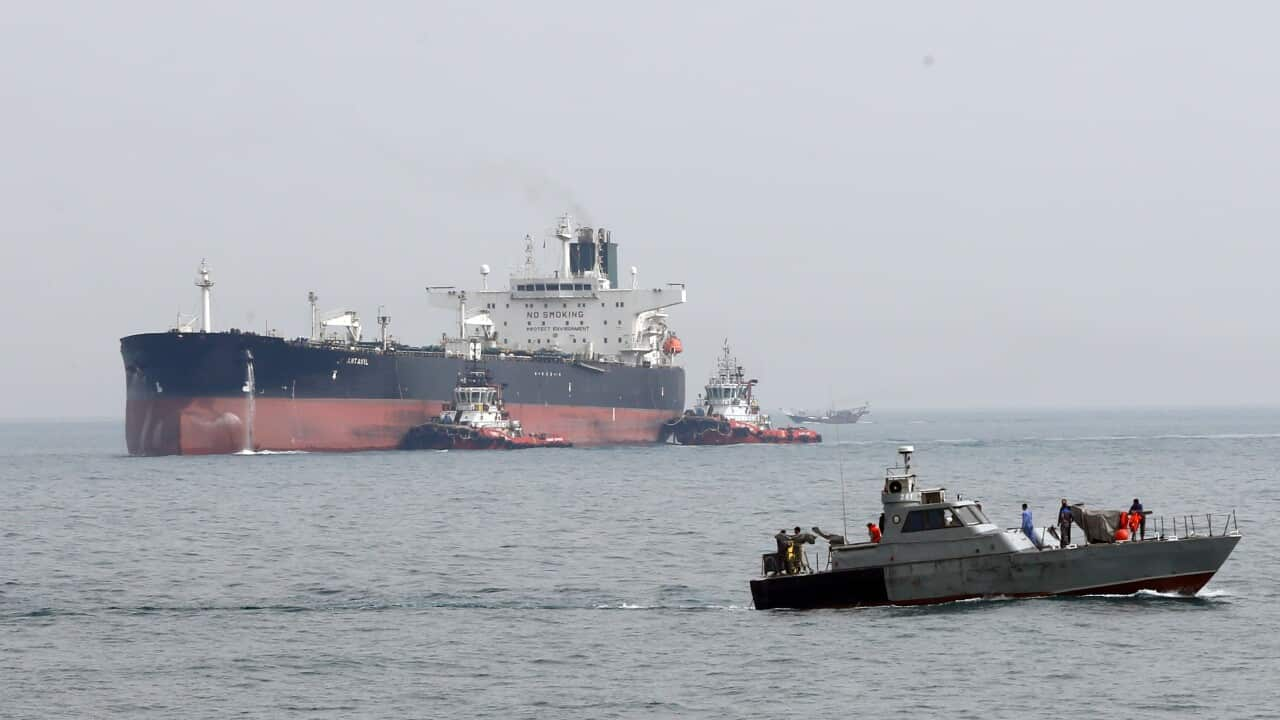
But so far there has been no let-up on the ground or any sign that ships can safely sail through the Strait of Hormuz, where a fifth of the world's oil has been blockaded behind a narrow channel along the Iranian coast in the worst disruption to energy supplies since the oil shocks of the 1970s.
News that makes sense
Your trusted source for staying up-to-date with the world around you. Get free daily news updates and analysis, straight to your inbox.
The International Energy Agency (IEA) has agreed to release 400 million barrels of oil, the largest such move in its history, to try to rein in crude prices.
The IEA said the release had been backed unanimously by 32 member countries, including Australia, in the sixth such move it has made since its creation in the 1970s.
It is aimed at preventing a further rise in oil prices on fears that Iranian attacks will continue to block Middle East oil exports from reaching markets.
"Get ready for oil to be $US200 a barrel because the oil price depends on regional security, which you have destabilised," Ebrahim Zolfaqari, a spokesperson for Iran's military command, said in comments addressed to the US.
Oil prices, which shot up briefly to nearly $US120 a barrel on Monday, have since settled around $US90, suggesting investors are betting on a swift end to the war and reopening of the strait.
After offices of a bank in Tehran were hit overnight, Zolfaqari also said Iran would respond with attacks on banks that do business with the US or Israel.
People across the Middle East should stay 1,000 metres from those banks, he added.
Iran's Revolutionary Guards (IRGC) said their forces had fired on three ships in the Gulf that had disobeyed their orders.
One, a Thai-flagged bulk carrier, was set ablaze, forcing the crew to leave, with three people reported missing and believed trapped in the engine room.
Reuters could not verify another second incident described by the IRGC, involving what they described as a Liberian-flagged ship.
The strikes raised the number of merchant ships that have been hit since the war began to 14.
A senior Israeli official told Reuters that Israeli leaders now privately accept that Iran's ruling system could survive the war.
Two other Israeli officials said there was no sign the US was close to ending the campaign.
The Iranian military said on Tuesday it had launched missiles at targets including a US base in northern Iraq, the US naval headquarters for the Middle East in Bahrain and at targets in central Israel.
In Tehran, residents said they were growing accustomed to nightly air strikes that have sent hundreds of thousands of people fleeing to the countryside and contaminated the city with black rain from oil smoke.
For the latest from SBS News, download our app and subscribe to our newsletter.







