Key Points
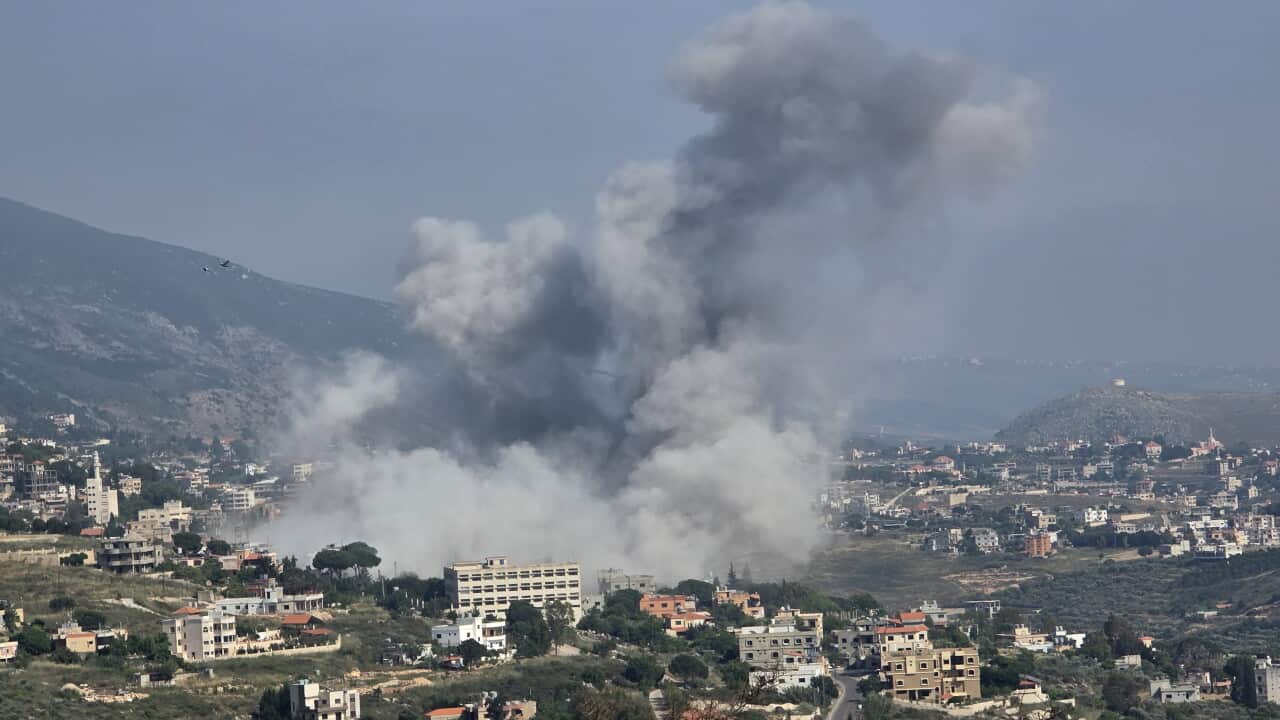
- Israel has launched strikes on Lebanon, which it says are in response to Hezbollah drones.
- A ceasefire is currently in place, but both sides have targeted each other since it came into effect.
Mass evacuation orders have returned to southern Lebanon, as more and more Hezbollah drones appear over northern Israel — a potential ceasefire breakdown some experts say may serve both sides.
On Wednesday, the Israeli military announced a new major military action in southern Lebanon, warning it would act "with great force" against the Iran-backed Lebanese group Hezbollah.
The Israeli military has told residents in an area of southern Lebanon covering about 2,000 square kilometres, around 15 per cent of the country, to move north.
It is considered to be the largest evacuation order since a fragile ceasefire took place between the countries in mid-April, and comes a day after Israel launched 120 airstrikes on Lebanon's south and east.
Israel says the strikes are in response to Hezbollah's drone attacks against the country in the past weeks, with far-right Israeli finance minister Bezalel Smotrich threatening "for every explosive drone, 10 buildings in Beirut must fall".
News that makes sense
Your trusted source for staying up-to-date with the world around you. Get free daily news updates and analysis, straight to your inbox.
The Lebanese capital Beirut, pummelled by Israeli attacks in March and April, has been spared new strikes, although Israeli surveillance drones are heard buzzing above the city every day and a warplane was heard flying low on Wednesday, according to Reuters reporters there.
In response, Hezbollah, the Iran-backed militant group, has accused Israel of "violation of the ceasefire", attacking various targets in northern Israel.
An initial 10-day ceasefire agreed between Israel and Lebanon was announced on 17 April by United States President Donald Trump. It has been extended twice since, most recently by 45 days a couple of weeks ago.
A ceasefire that has 'lost its meaning'
The ceasefire was introduced seeking to halt the latest conflict between Israel and Hezbollah that started on 2 March, when Hezbollah fired rockets at Israel in response to Iran's supreme leader being killed by US-Israeli strikes on Iran.
More than 1.2 million Lebanese have been displaced by Israeli strikes and evacuation orders since March 2, as Israeli strikes have pummeled Lebanon's south, east and its capital Beirut, killing more than 3,200 people, according to Lebanon's health ministry.
The tension between Israel and Hezbollah, however, has been high since the ceasefire agreement came into effect, with both sides targeting each other occasionally.
"Even though there were moments of ceasefire, there were continuous military strikes between the two," Mariam Farida, a lecturer in terrorism and counterterrorism studies and Middle East politics at Macquarie University, told SBS News.
"The whole notion of ceasefire has lost its meaning, to be honest, because even though both parties agree on a ceasefire, they do not actually abide by the ceasefire."
Since the ceasefire, at least 608 people in Lebanon have been killed in Israeli attacks, according to the World Health Organization, while the Israeli military reports 10 of its soldiers being killed during the same time, six by Hezbollah drones.
In the meantime, Israel has occupied a further several kilometres into southern Lebanon, describing it as a "buffer zone" between the country and Hezbollah.
Why now?
It seems like the new wave of attacks, which started with 120 strikes on south and east Lebanon on Tuesday, could mark an official end to the ceasefire.
Farida says Israel has launched the attacks as it believes it has not reached its military targets.
"Hezbollah is still able to launch missiles and drones against Israeli targets in southern Lebanon. So [Israel] still see it as an imminent threat, hence the fighting continues," she said.
Israeli Prime Minister Benjamin Netanyahu said on the same day as the strikes that Israel needed to take further action in Lebanon to protect communities in northern Israel from Hezbollah.
Ian Parmeter, a former Australian ambassador to Lebanon and a research scholar at the Australian National University's Centre for Arab and Islamic Studies, believes one reason for the recent tensions may lie within Israel's national politics.
"We are now in a pre-election period in Israel, and Prime Minister Netanyahu is very anxious to fully reestablish his security credentials in the eyes of the Israeli public," he told SBS News.
"Netanyahu has been directly involved in making clear that he personally has ordered the strikes on Lebanon. It's part of the current Israeli government's re-election campaign," he said.
"That's very hard for him to do if there are attacks from Hezbollah that are preventing residents of northern Israel from returning to their homes."
Israel's election is currently scheduled for the end of October, but according to local reports, it might be moved to September.
Parmeter said that Hezbollah, a Lebanese Shia Islamist political party and militant group founded in 1982, backed by Iran's Islamic Revolutionary Guard Corps, also "benefits" from the rising tensions.
"It shows that it is still relevant as far as Iran is concerned," he said.
"It doesn't make it popular among non-Shia in Lebanon, but Hezbollah's main focus is not on the Lebanese themselves, but on the way in which it can help Iran."
'Stuck' between Israel and Hezbollah
US and Lebanese government officials have held peace talks in the US over the past few weeks, with Trump saying he looks forward to hosting Netanyahu and Lebanese President Joseph Aoun in the near future.
One of the main demands of negotiations with Lebanon's government has been the disarmament of Hezbollah, something Farida explains as a "deadlock".
"There needs to be a mechanism, a realistic mechanism for how this can be achieved and how this is possible without a direct military confrontation internally," she said.
"That will only have catastrophic repercussions both for Lebanon and the neighbouring countries because it brings back memories of the Lebanese civil war, back in the '70s."
This has also been an aim of the Lebanese government, with its president pledging during his January 2025 inaugural speech to take away Hezbollah's weapons. In early March, Lebanese Prime Minister Nawaf Salam announced a ban on Hezbollah's military activities.
On the other side, Hezbollah secretary-general Naim Qassem denies the group's disarmament, saying: "There is no such thing as exclusivity of weapons or disarming Hezbollah."
"The Lebanese Army is not equipped, able, or willing to stand against Hezbollah and to disarm it, technically," Farida said.
"The Lebanese government is quite stuck in the middle between what Israel and Hezbollah are doing, because after all, it's the Lebanese government that's involved in the peace and negotiations with, directly with Israel. It's not Hezbollah."
Farida said it's not possible for the Lebanese government to disarm Hezbollah while it's also being occupied by Israel and bombarded by deadly strikes.
"What the Lebanese people are seeing and are reacting to is that Hezbollah, in fact, is the only able military organisation to fight Israel and to try to not stop but at least limit or create that sort of military engagement and balance of power."
For the latest from SBS News, download our app and subscribe to our newsletter.







