
in brief
- A recent RedBridge/Accent survey saw One Nation surge to 31 per cent of the primary vote, ahead of Labor at 28 per cent.
- Those figures were similar among millennial respondents, but the picture looked much different among gen Z voters.
Just weeks after a reform-laden federal budget, a recent poll suggests One Nation has overtaken Labor as the nation's most popular political party — even among a generation who normally skews to the left.
Experts suggest the result may be explained by an interplay of education, trust and difficulty explaining complex reforms.
Thirty-one per cent of respondents to the RedBridge/Accent survey said they'd put a one next to One Nation on the ballot box, ahead of Labor at 28.
Among the youngest Australian voters, however, the picture looks very different, with primary support for One Nation among gen Z voters (18-29-year-olds) sitting at 10 per cent. That was far below Labor at 35 per cent, the Greens at 27 and the Coalition at 18 per cent.
However, among millennials — those currently aged between 30 and 45 — One Nation came out on top with 30 per cent to Labor's 28. The Greens trailed far behind at 18 per cent and the Coalition was even lower at 16 per cent.
News that makes sense
Your trusted source for staying up-to-date with the world around you. Get free daily news updates and analysis, straight to your inbox.
Until now, millennials have seemed to buck the trend of previous generations to shift rightward as they age — something noted by the last two Australian election studies, possibly the nation's most in-depth barometer of shifting political currents.
The authors of the 2025 Australian election study said ageing millennials shifting to the left, rather than the right, was a "portentous" development for Australian politics.
An educational divide
Australian National University political scientist Ian McAllister, one of the authors of the 2025 Australian Election Study, said the split among millennials found by the RedBridge survey was likely reflective of an "educational divide".
"The younger people who are going to One Nation tend not to have educational qualifications, and the younger people going to the Greens — and also to a lesser extent, the major parties — do tend to have educational qualifications," McAllister told SBS News.
"We've seen this huge expansion in university education over the last 20 years, and that generation sits at the core of all of that ... you've got younger people who've got university education vot[ing] very differently from other people that don't have university education."
As a result, McAllister said, generation, gender and educational status had superseded socioeconomic status and income as the major predictors of individual voting choices in the 21st century.
Simon Welsh, RedBridge Group's research director, told SBS News that education was "very much a reasonable part of the picture" that emerged from his organisation's recent survey, especially given One Nation's "quite geographically-defined" vote.
"So, it is still very much a regional vote first and foremost, and it is a vote that is increasing and creeping into outer suburban Australia as well. And those are also the regions where you do see lower levels of particularly university attainment."
Complexity and communication
Another headline finding from the RedBridge survey was that the federal government's 2026 budget was not particularly well-received by younger generations, despite capital gains tax and negative gearing changes being sold on the premise of addressing intergenerational inequity in housing.
Only 12 per cent of millennials and 21 per cent of gen Z said the budget's impact on them would be "good", while 28 per cent of gen Z and 26 per cent of millennials said it would have "no impact". Twenty-seven per cent of gen Z and 34 per cent of millennials said it would be "bad".
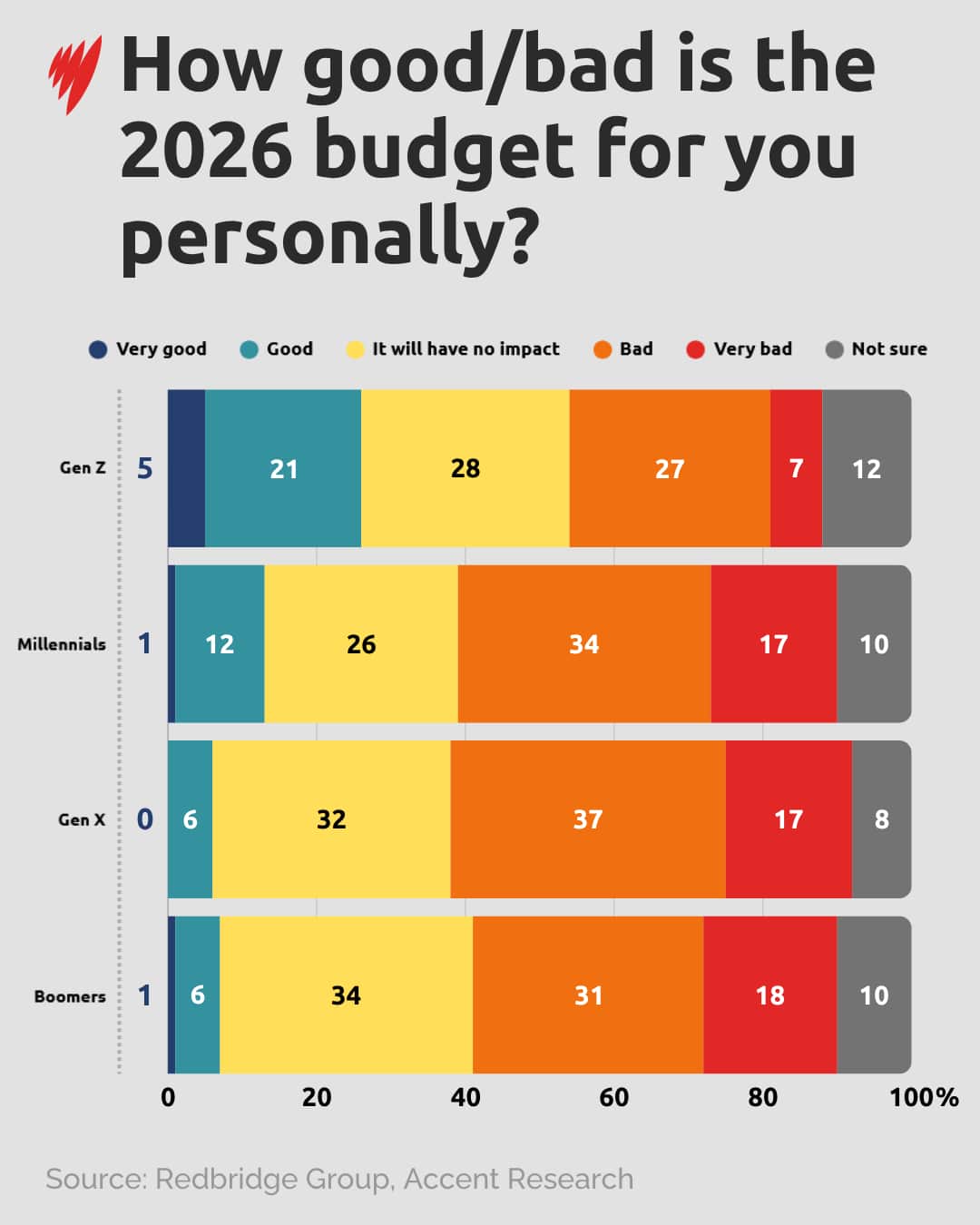
Monash University researcher Lucas Walsh — the lead author of a report showing that housing affordability was one of the key concerns for young people in the 2025 federal election — said Labor's 2026 budget reforms were possibly too technical and abstract for many voters to grasp.
In the current media landscape, in which "everything is reduced to soundbites and grabs and posts", it's become "much harder to explain complexity and nuance", he said.
"The ability to explain complex reform has become far more challenging for every political stripe."
The RedBridge/Accent survey found that only 6 per cent of gen Z had heard "a great deal" about the budget, 33 per cent had heard "a fair amount", 47 per cent had heard "not very much" and 14 per cent had heard "nothing at all", Welsh told SBS News.
Engagement among millennials was notably higher, with 27 per cent of that cohort saying they had heard "a great deal", 39 per cent "a fair amount", 26 per cent "not very much" and 8 per cent "nothing at all".
However, he said it was important to note that the findings did not indicate anything about the specific content people had consumed, and much of this may have been negative commentary.
While 27 per cent of millennials had heard "a great deal" about the budget, "it doesn't necessarily mean that they've heard both sides, and that's the government's real problem", he said.
'Not policy ideas, policy results'
If the budget hasn't been received particularly well among younger people, one reason might be that people on the pointy end of Australia's housing affordability crisis were yet to feel the impacts of any policy changes, and disillusioned by older policies.
"It doesn't matter whether you're Greens or ALP or One Nation or the Liberal-National Coalition ... you have to start delivering results on policy — not policy ideas, policy results," Walsh told SBS News.
"I think the proof of the pudding will be in the tasting — what it actually ends up doing to improve young people's access to affordable accommodation."
"We're already seeing some decrease in housing prices even on the back of recent discussions, and maybe that will be able to be converted into 'See, we created more housing opportunities for young people.'"
New research from property research firm Cotality found that auction clearance rates — considered a key indicator for property prices in major-city markets — had recently hit lows not seen since the COVID-19 pandemic.
Although analysts believe much of the downturn has been driven by higher interest rates and the broader property price cycle, it's also possible that some investors have turned away from buying existing homes, which will be caught by Labor's tax changes.
A question of trust
The inability to get into the housing market may also be playing into millennial support for One Nation in another way — trust in the political system.
"One of the things we've noticed in the last few [Australian election] surveys is that trust has been noticeably low among millennials," McAllister said.
"And when we drill down a bit into that, we find a lot of it is to do with housing — that they're not able to get into the housing market, and that's driving a lot of the distrust they have in the political process."
He said that an "interesting" pattern in the data was that people were often more trusting when in their late teens and first eligible to vote.
"They think it's a very positive process and so on. And then they get into their 20s, early 30s and they get a bit more jaded."
The 2025 Australian Election Study showed that One Nation voters were far and away the most distrustful of government, with 74 per cent of them saying politicians "usually look after themselves".
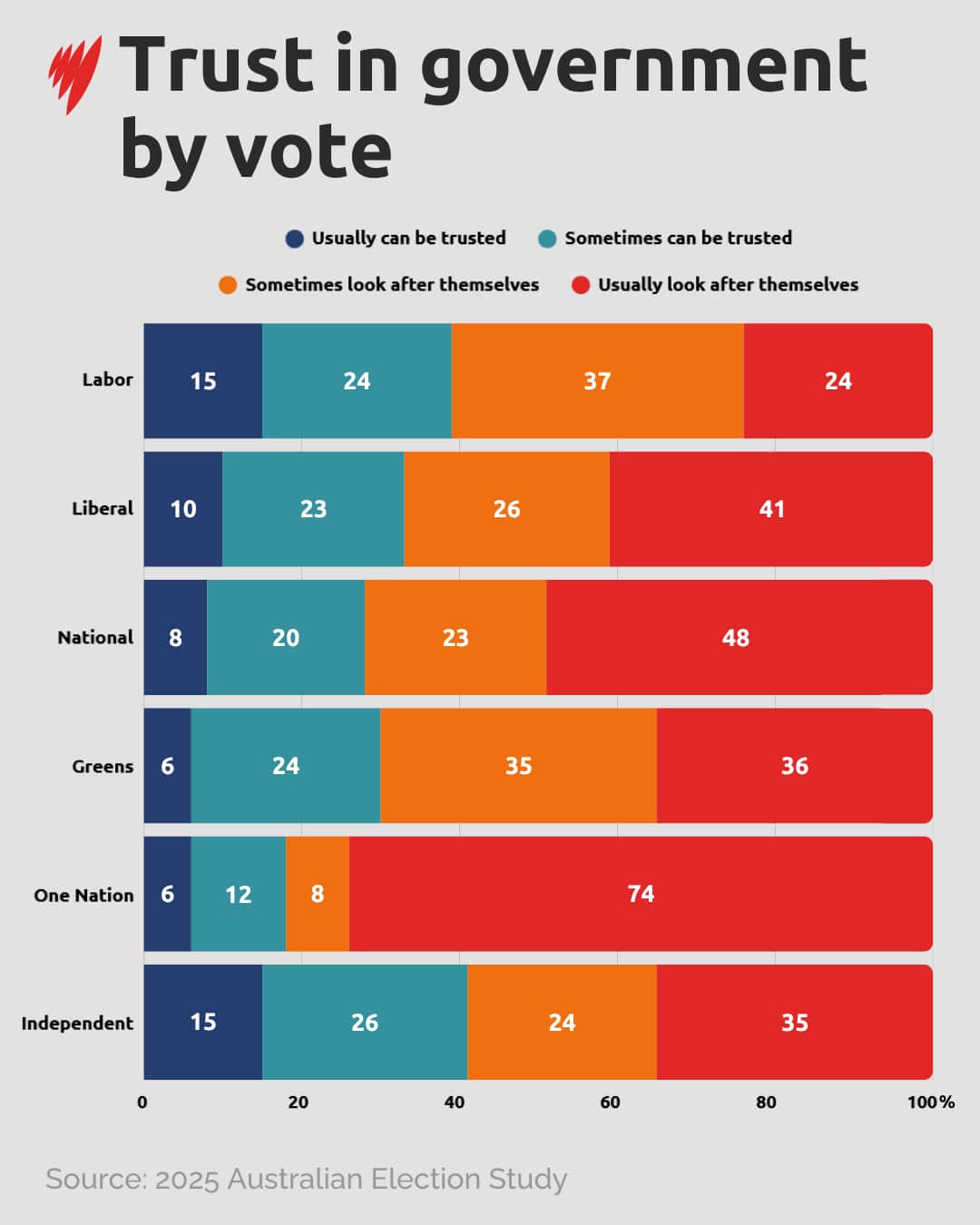
Welsh says growing support for One Nation is an "expression of the frustration and the anger that these voters are experiencing because of a material decline over a number of years in living standards".
"So, it's not that they are lurching to the right. It's that what they're looking for is an authentic vehicle for that anger, that frustration, that anxiety that they're feeling in their lives. And what One Nation is doing is matching that emotional need."
— With additional reporting by the Australian Associated Press.
For the latest from SBS News, download our app and subscribe to our newsletter.







