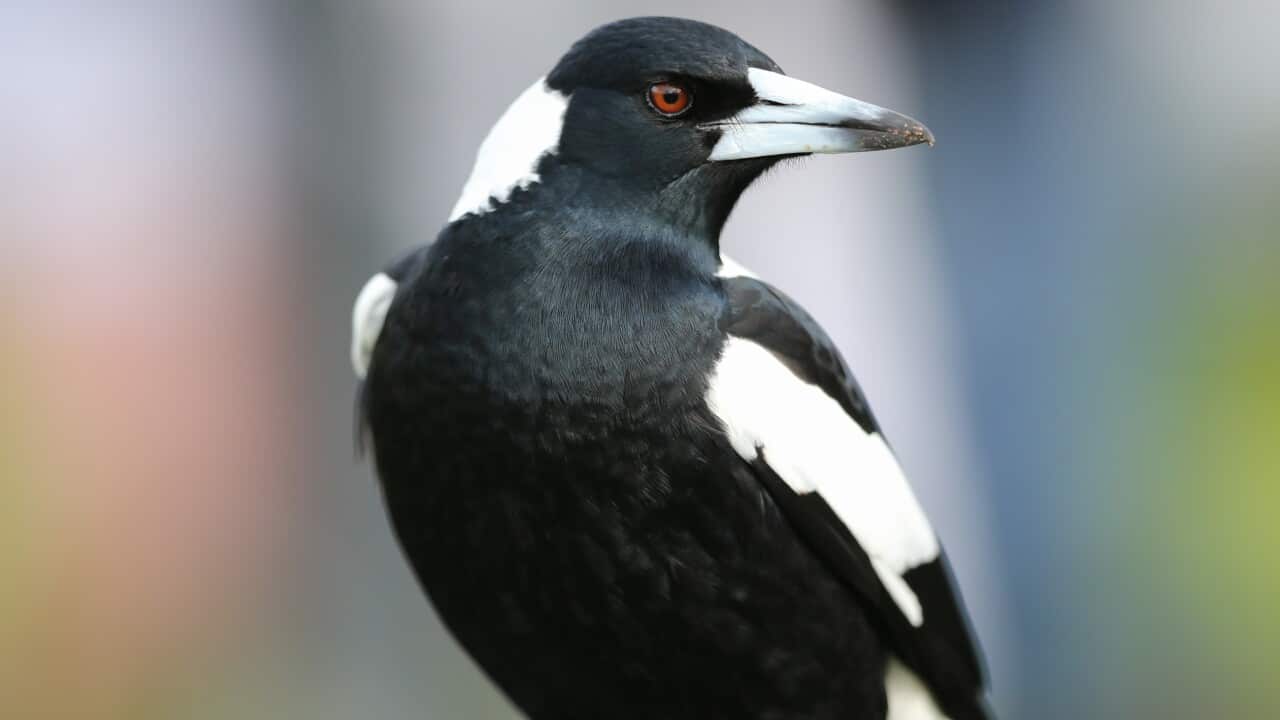
Every spring, staff at a Perth animal hospital prepare themselves for magpie season.
The wards are packed with sick songbirds suffering from a mystery illness dubbed magpie paralysis syndrome.
WA Wildlife CEO Dean Huxley said there's barely enough room for them all.
"We've got multiple birds in the same enclosures out of necessity," he told the Australian Associated Press.
The magpies are affected by a condition that causes symptoms of paralysis including the inability to stand, fly or even lift their heads.
News that makes sense
Your trusted source for staying up-to-date with the world around you. Get free daily news updates and analysis, straight to your inbox.
Cases have been reported from Perth and its surrounds since 2018, stretching from Augusta in the southwest corner all the way to Geraldton.
But in the spring of 2024-25, there was an alarming spike in presentations that has carried over into this summer, with 65 birds currently in care.
Meanwhile, on the opposite side of the country, more than 30 magpies have died in a single suburban backyard in Brisbane.
Kylie Conroy has seen 34 magpies die in and around her Inala backyard from mid-December, prompting her to post images on social media in search of answers.
She said when she first contacted the RSPCA, she was initially told that because the birds were already dead, they were unable to help.
Later, after Conroy's story went viral, an animal ambulance was dispatched to her house to collect the sick and dying birds to be taken to a biosecurity facility for testing.
RSPCA Queensland has since ruled out the presence of HN51, or bird flu, which has spread across every continent except Australia.
The pathogen has killed hundreds of millions of birds worldwide.
Nonetheless, it's a development that has Huxley watching closely.
"To date, we've only seen this in the southwest of WA," he said.
"The fact that we're now seeing it on the east coast is quite alarming."
But there's no evidence to suggest the birds in Brisbane are falling victim to the same illness that's paralysed the Western Australia birds.
There's also not enough evidence to link it to so-called black and white bird neurological syndrome, outbreaks of which occurred on Australia's east coast in 2003 and the summer of 2005 to 2006.
That disease caused similar symptoms but was not confined to magpies, affecting other black-and-white species from the closely related pied currawong to the completely unrelated magpie lark.
Ongoing investigation
Despite ongoing research by Murdoch University, in collaboration with Wildlife Health Australia and others, it seems more is known about what the illness is not, than what it actually is.
"They've ruled out some things but that doesn't mean they're any closer to identifying what's causing it," Huxley said.
He said phosphate and other types of heavy metal poisoning have already been ruled out.
For a while, it was suggested a brain parasite was responsible — but not all of the affected birds had it.
It's a process of elimination, and for now, the best Huxley can say is that the scope of possibilities has been narrowed.
Otherwise, he said, "we're still no closer to identifying what it is".
And while poisoning hasn't been completely ruled out, he said it would be unlikely for magpies to have been impacted across such a broad area as they have been in Western Australia.
That's not the case in Brisbane, where the deaths have been concentrated in a tight cluster at and around Conroy's address.
She said the situation has now stabilised, with no more sick magpies, and suspects other birds on her block had been poisoned.
She says further up the street, a neighbour messaged her to say the magpies on her property were exhibiting no signs of distress or illness.
Recovering birds
Huxley said with time and care, the magpies coming in to his hospital have a good chance of survival, despite there being no known antibiotic or antiviral treatment for the birds.
"We just provide a nice place for them to rest," he says.
"We give them fluids, vitamins, and generally, from five to 12 days, they tend to resolve on their own.
"So it's something that their bodies can fight, given time, but left in the wild they just get predated upon or succumb to the elements."
In a statement, RSPCA Queensland advises anyone observing unusual bird deaths to contact the Emergency Animal Disease Hotline on 1800 675 888.
It says people should avoid contact with sick or dead wildlife and ensure their pets don't touch or consume affected animals.
Signs of avian influenza to look out for include lack of co-ordination, tremors, or swimming in circles; twisted necks or unusual posture, and the inability to stand or fly.
For the latest from SBS News, download our app and subscribe to our newsletter.







