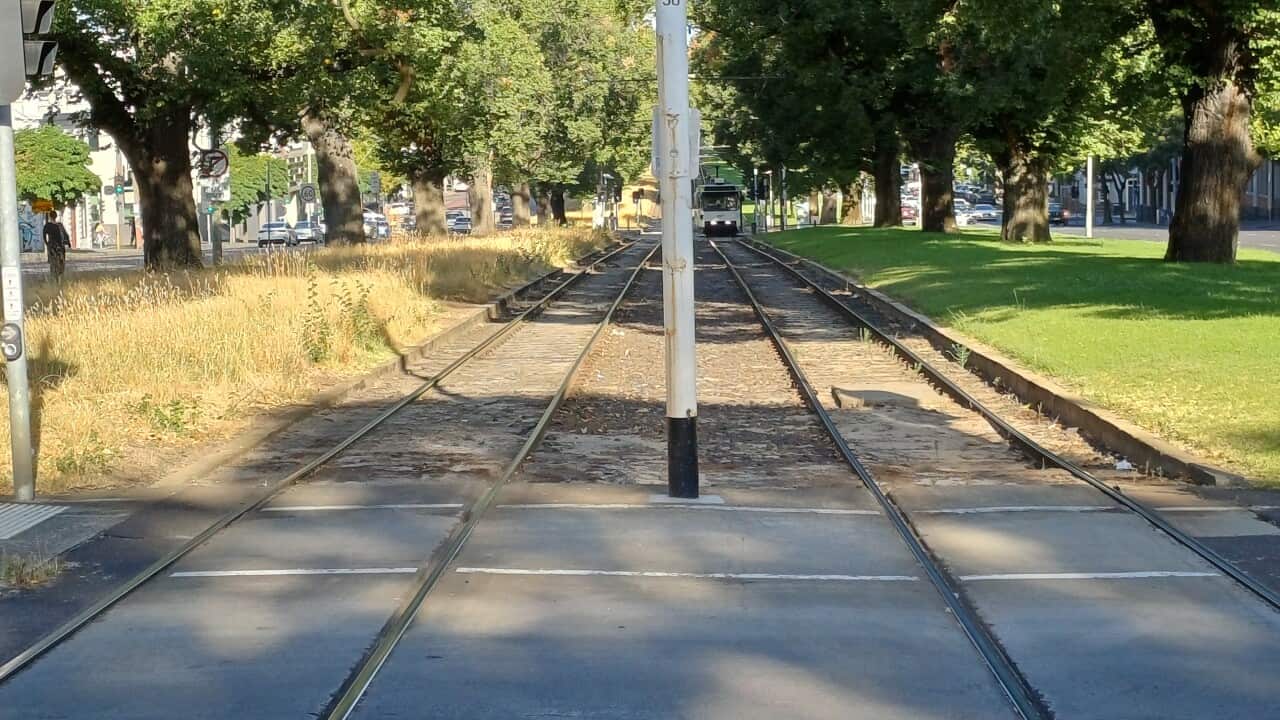
They say the grass isn't always greener on the other side — but on Victoria Parade in Melbourne's inner city, it quite literally is.
A tram line runs down the centre of Victoria Parade. On one side of the tracks, in East Melbourne, the grass is green and neatly managed by the City of Melbourne, one of Victoria's wealthiest councils.
On the other side, in Fitzroy, the median strip is dry, overgrown and unmowed.
That strip has become the centre of a growing dispute between local and state government over who is responsible for maintaining the road — and a fresh flashpoint in broader criticism of the Victorian Labor government, led by Premier Jacinta Allan.
Divided road, divided responsibilities
News that makes sense
Your trusted source for staying up-to-date with the world around you. Get free daily news updates and analysis, straight to your inbox.
While Victoria Parade and its median strip are state-managed assets, the City of Yarra — which the road runs through — has refused to continue footing the bill for maintenance, arguing the responsibility sits squarely with the state government.
City of Yarra mayor Stephen Jolly has likened the stalemate to a geopolitical stand-off.
"Either we give in and spend hundreds of thousands of dollars of ratepayers' money doing Jacinta Allan's job or we keep pressuring them to actually do their job," Jolly told radio station 3AW recently.

As a form of protest, the City of Yarra stopped mowing the Victoria Parade median strip, saying it has not received additional funding to cover the work.
"It is embarrassing. It's like North and South Korea kind of thing. That's where we are at the moment."
Jolly has argued the dispute is part of a broader pattern of "cost shifting" from the state government, which he says is costing local councils close to $24 million.
Opposition seizes on grass dispute
Victorian Opposition leader Jess Wilson has seized on the dispute, releasing a social media video on the weekend showing Opposition MPs mowing part of the median strip.
"This is the grass the Labor Government can't afford to mow," Wilson says in the video. "It seems Jacinta Allan can't do her job, so we're here to do it for her."
The video shows several members of the Opposition wearing high-visibility vests and protective eyewear, claiming the job took "only thirty minutes".
When SBS News visited Victoria Parade on Monday, it appeared a small section of the median strip had been mowed.
Asked about the issue at a press conference on Monday, Transport and Infrastructure Minister Gabrielle Williams said the Opposition's weekend grass cutting was a "stunt".
"I think it’s fair to say the Liberal party is embracing stunts as they head into an election year," Williams said. "It is a slight sidestep from their usual practice of fighting with each other either through the courts or through the media."
SBS News has contacted Premier Jacinta Allan's office for comment.
Cost-shifting a 'major concern'
Cost-shifting refers to situations where one level of government transfers responsibility for services or infrastructure to another — often without providing enough funding to cover the cost.
A spokesperson for the Australian Local Government Association (ALGA) said it was an issue of "major concern for councils".
"Every new Commonwealth policy or strategy has cost implications for other levels of government — most of which local governments aren’t compensated for," ALGA told SBS News.
It says the practice is challenging the long-term financial sustainability of councils in Australia.
"Cost-shifting is having a real effect on communities across Australia. Every service shifted to local government without compensation reduces the services the council can provide."
Local Government NSW's latest cost-shifting report revealed a total cost shift to councils of $1.36 billion in 2021-22, equivalent to more than $460 per ratepayer annually.
In Queensland, that figure amounted to $360 million in 2021-22 — a 378 per cent increase from $47 million in 2002.
"The impact of this cost-shifting isn’t academic. Cuts to councils are cuts to community liveability," the ALGA said.
"Every service shifted to local government means that people miss out because funding, policies and legislation from federal and state governments haven't kept pace with the needs of every local community."
'Being bled', says local council
The City of Yarra has pointed to other major arterial roads within its boundaries — including Bridge Rd, Alexandra Pde, Burnley St and Hoddle St — which it says also require maintenance from the state government.
That last one was mowed last week "at last" by the state government, Jolly said.
Jolly has also said the council has been forced to pick up responsibility for services such as school crossing supervision and needle collection near a safe injecting room — tasks he argues should be funded by the state.
"We're being bled," he said.
In late 2023, the City of Yarra stopped monthly maintenance on state-managed roads after receiving $88,000 from the state government for work it says costs more than $1 million a year, according to The Age newspaper.
The City of Melbourne maintains its side of the median strip under an agreement with VicRoads and the Department of Transport and Planning.
A spokesperson for the City of Yarra told SBS News that the City of Melbourne has a revenue and budget surplus "three times the size of ours".
Across Victoria, responsibility for road maintenance is split between different levels of government. The Department of Transport and Planning manages about 11 per cent of the road network, largely freeways and major arterial roads, while the Department of Energy, Environment and Climate Action and Parks Victoria are responsible for a further 28 per cent, mostly roads through parks and forests.
Local councils manage around 60 per cent, primarily local roads.
For the latest from SBS News, download our app and subscribe to our newsletter.







