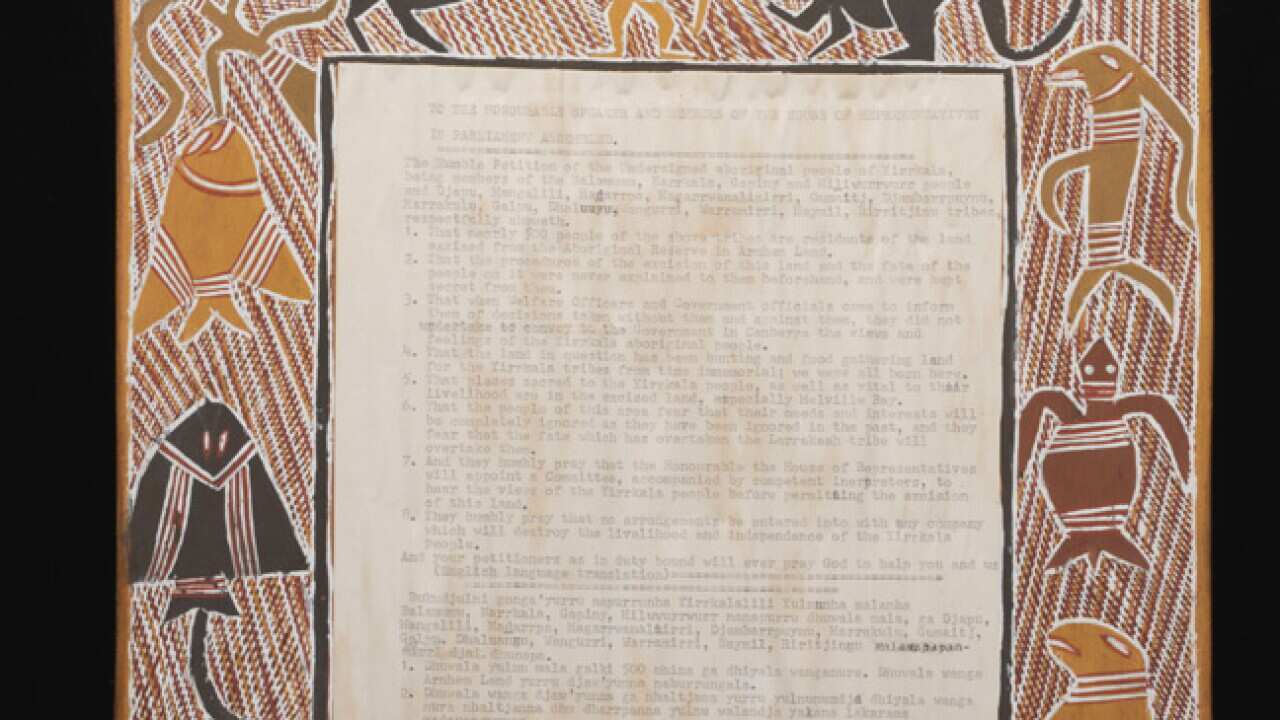
NAIDOC Week this year is celebrating 50 years since the historic Yirrkala Bark Petitions were presented to Federal Parliament in Canberra.
(Transcript from World News Australia Radio)
More than a dozen Yolngu clan leaders, from Arnhem Land in the Northern Territory, signed the petitions, upset the government planned to lease their land to mining companies.
The petitions became a catalyst for change.
News that makes sense
Your trusted source for staying up-to-date with the world around you. Get free daily news updates and analysis, straight to your inbox.
They led to the constitutional recognition of Indigenous Australians and, ultimately, to the acknowledgement of Aboriginal land rights.
The Yirrkala Bark Petitions are two typed documents calling on the House of Representatives to reconsider its decision to excise part of Arnhem Land for mining purporses.
Surrounding the pieces of paper are bark frames painted in rich ochre.
The petitions are considered the first documents bridging Commonwealth law and the Indigenous laws of the land.
National Aboriginal and Islander Day Observance Committee (NAIDOC) chairwoman Anne Martin says they were also the first documents of their kind acknowledged by the Australian government.
"When you go in and you see what surrounds the words on the petition, then you just think how much thought and energy and passion went into sending this down to a government to say, 'Hey, we want you to take seriously what we are asking. We don't want our land excised. And we are now putting it in these words, but, also, surrounded by our designs, which are representative of our people, to you, to take note of.'"
Each petition is written in one of two different Yolngu languages, and both are translated into English.
Kim Beazley Senior helped with the wording of the texts, but the message was clearly from the Yolngu people.
In the eight-point letter, they politely asked the government to send a committee to Arnhem Land to listen to the Yirrkala people before excising more than 300 square kilometres of their land.
Australian National University law researcher Ernst Willheim says it was an innovative idea.
"They were a combination of modern and Western forms, in a sense, and the concept of a petition to the parliament is, of course, a modern Western concept. With the traditional presentation of a bark petition with ochre, paintings, clan designs and so on, it was an innovative and significant step forward on behalf of the Aboriginal people."
The petitions had little immediate effect on protecting sacred sites in Yirrkala and stopping bauxite mining in the area.
As Mr Willheim says, public opinion at the time was not in their favour.
"By and large, there was not a great deal of appreciation of the interests of Aboriginal people, very little appreciation of their traditional attachment to the land -- things which we now, I think, understand much better than we did at that time."
But Anne Martin, with the NAIDOC Committee, says, in hindsight, the documents slowly triggered a reaction that can still be felt today.
"What they did was set into motion a long process of, you know, both constitutional and legislative reforms for Aboriginal and Torres Strait Islander people. It was a catalyst in advancing change, in particular around the constitution in the 1967 referendum."
In 1971, the Yolngu people took their argument for land rights to the Northern Territory Supreme Court.
The Gove land-rights case failed.
But it succeeded in getting the judge to acknowledge the Yolngu people's ritual and economic use of the land, as well as their established system of law.
That acknowledgement paved the way for the High Court's ultimate recognition of Aboriginal land rights.
In pursuit of that recognition, the shift in Australian public sentiment was important.
Ernst Willheim, from the ANU's College of Law, says the Yirrkala Bark Petitions were one of the first high-profile demonstrations of Indigenous peoples' claims to their land.
"It's a very big, arguably first, step. It's a big public demonstration to the parliament of the claims of the Yolgnu people in Yirrkala to their traditional claim to their land and to their objection to the granting of mining rights over what they saw as their land without any consultation. That concept, of course, led over time to a totally new approach to recognition of Indigenous rights, particularly in the Mabo decision."
This NAIDOC Week, the significance of the Yirrkala Bark Petitions will be felt particularly keenly in Arnhem Land.
The NAIDOC celebrations coordinator for the Yirrkala community, Rosealee Pearson, says four elders involved in making the petitions are still alive and living in the area.
Mr Pearson says they have been hugely inspirational.
"They were the first ones to really stand on the forefront politically, not just with blackfellas but with the whitefellas, as well. I mean, it's just huge to even think that they knew that there was a possibility that their voice could be heard in such a way, and I can't even imagine what those conversations were like."
The four elders, Nananu and Wali Wunungmurra, Gawirrin Gunana and Thunggala Mununggurr will all be attending celebrations.
Anne Martin says she wants to personally thank the men for their gifts to all Indigenous Australians.
"We think about the legacies they have left us, and that is why it's really critically important that we never forget the steps that our people have taken to try and right the wrongs across the decades. I would say, 'Thank you for your foresight, for your strength, for your wisdom, for leading us into a future where we have been able to follow in your footsteps because you paved the way.' Thank you is not enough to all of those that, 50 years ago, started a journey that is still going on."
As part of NAIDOC Week celebrations, the young descendents of many of the original petitioners will be putting their own requests in writing to the Australian government.
Rosealee Pearson says it is a fitting tribute 50 years on.
"We have children who are going to be presenting the Prime Minister with kind of a list of requests of what they'd like to see within their communities. I mean, it's a lot less formal, but I think this time before was about, you know, the elders' voice being heard, but, this time around, it's actually about the children speaking and saying, 'We want to be heard, and this is what we want to say.'"







