
Iranian officials say they are keeping communication channels with the United States open as President Donald Trump considers how to respond to the Middle Eastern nation's crackdown on protests.
Adding to threats of military action, Trump announced any country doing business with Iran will face a new tariff of 25 per cent on its exports to the US.
"This Order is final and conclusive," he said in a social media post.
While Trump provided little detail, the move may have more of a symbolic than a practical effect since Iran, a major oil producer, already faces extensive US and international trade sanctions.
Top export destinations for Iran include China, the United Arab Emirates and India.
News that makes sense
Your trusted source for staying up-to-date with the world around you. Get free daily news updates and analysis, straight to your inbox.
US vice president JD Vance, secretary of state Marco Rubio and key White House National Security Council officials started meeting on the weekend to develop a "suite of options", from a diplomatic approach to military strikes, to present to Trump in the coming days, according to a US official familiar with the internal administration deliberations.
Trump has said the US may meet Iranian officials, and he was in contact with Iran's opposition, while piling pressure on its leaders over violence against protesters.
Iran's leaders are facing fierce demonstrations that evolved from complaints about dire economic hardships to defiant calls for the fall of the deeply entrenched clerical establishment.
US-based rights group HRANA said by late Monday it had verified the deaths of 646 people, including 505 protesters, 113 military and security personnel and seven bystanders, and was investigating 579 more reported deaths.
Since the protests started on 28 December, 10,721 people have been arrested, the group said.

While airstrikes were one of many alternatives open to Trump, "diplomacy is always the first option for the president", White House press secretary Karoline Leavitt told reporters.
Iranian foreign minister Abbas Araqchi said Iran was studying ideas proposed by the US, though these were "incompatible" with US threats.
"Communications between [US special envoy Steve] Witkoff and me continued before and after the protests and are still ongoing," he told Al Jazeera.
The flow of information from the Islamic Republic has been hampered by an internet blackout since Thursday, although some Iranians still have access to the internet via Elon Musk's Starlink satellite service, three people inside the country told the Reuters news agency.
Iran's intelligence ministry said it had detained "terrorist" teams responsible for acts, including killing paramilitary volunteers loyal to the clerical establishment, torching mosques and attacking military sites, according to a statement carried by state media.
Addressing a large crowd in Tehran's Enqelab Square on Monday, parliament speaker Mohammad Baqer Qalibaf said Iranians were fighting a war on four fronts — "economic war, psychological warfare, military war against the US and Israel, and today a war against terrorism".
Declaring the situation "under total control", Araqchi said 53 mosques and 180 ambulances had been set on fire since the protests erupted.
'A meeting is being set up'
Trump said on the weekend Iran had called to negotiate about its disputed nuclear program. Israel and the US bombed Iranian nuclear sites in a 12-day war in June.
The Iranian regime has always denied claims it's pursuing nuclear weapons, saying its program is aimed at "developing civilian nuclear power".
"A meeting is being set up, but we may have to act because of what is happening before the meeting," he told reporters on Air Force One.
Trump was to meet with senior advisers on Tuesday to discuss options for Iran, a US official told Reuters.
The Wall Street Journal reported those included military strikes, using secret cyber weapons, widening sanctions and providing online help to anti-government sources.
In an interview with CBS News, Reza Pahlavi, son of Iran's last shah, who lives in exile in the US, urged Trump to intervene "sooner".
Iranian state media has said dozens of members of the security forces have been killed, with their funerals turning into large pro-government rallies. The government has declared three days of national mourning for those killed.
'Respect for their rights'
Prime Minister Anthony Albanese has expressed support for the protesters, saying the Iranian government was an "oppressive regime" which should be replaced by democracy.
"We stand with the people of Iran in fighting against what is an oppressive regime, one that has oppressed its people. One that is, I hope... removed by the people," he told reporters at Parliament House on Tuesday.
"We want to see a functioning, democratic Iran in which human rights are respected," Albanese said.
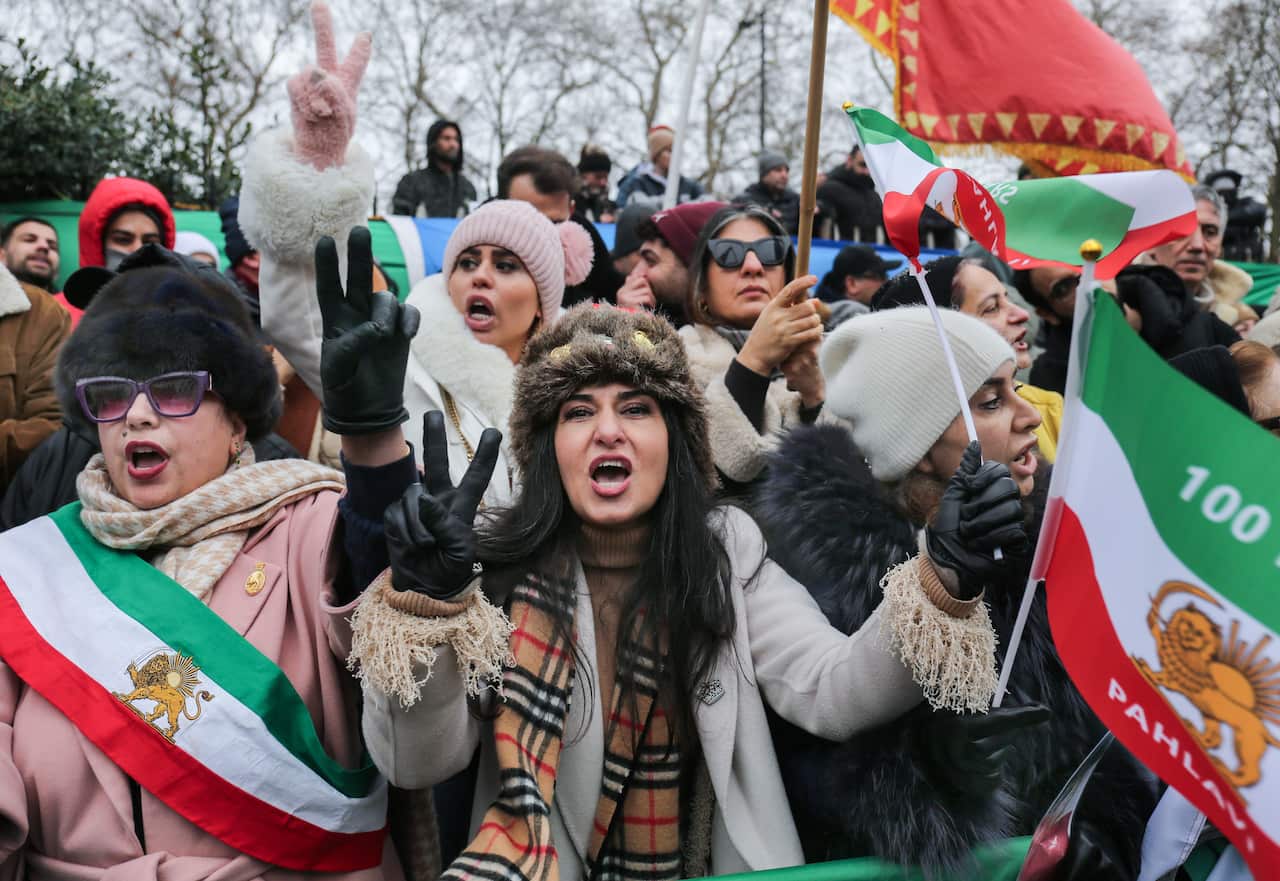
Foreign Minister Penny Wong said Iran's crackdown on protests had become increasingly brutal as Ayatollah Ali Khamenei tried to retain power.
"What I would say to that regime is, not only is the world calling on you to stop killing your people, but a regime that requires the murder of its own people to maintain authority is not a regime with any legitimacy," she said, speaking alongside the prime minister.
The European Union has also voiced support for the protesters and said it was "looking into" imposing additional sanctions on Iran over the alleged repression of demonstrations.
The European Parliament also announced it had banned all Iranian diplomats and representatives from the assembly's premises.
The Iranian foreign ministry said it had summoned diplomats in Tehran representing France, Germany, Italy and the United Kingdom, demanding they "withdraw official statements supporting the protesters".
French President Emmanuel Macron, however, issued a statement later condemning "the state violence that indiscriminately targets Iranian women and men who courageously demand respect for their rights".
Iranian President Masoud Pezeshkian has pledged to address mounting economic grievances in the country, saying his government is "ready to listen" to protesters while also urging them to prevent "rioters" from wreaking havoc.
For the latest from SBS News, download our app and subscribe to our newsletter.







