
IN BRIEF
- Goods and services that retirees spend most on rise faster than inflation, a peak body says.
- A comfortable retirement is becoming more expensive as a result.
Australians now need a little bit more in their super to retire comfortably, with the rising cost of living driving up the latest retirement standard.
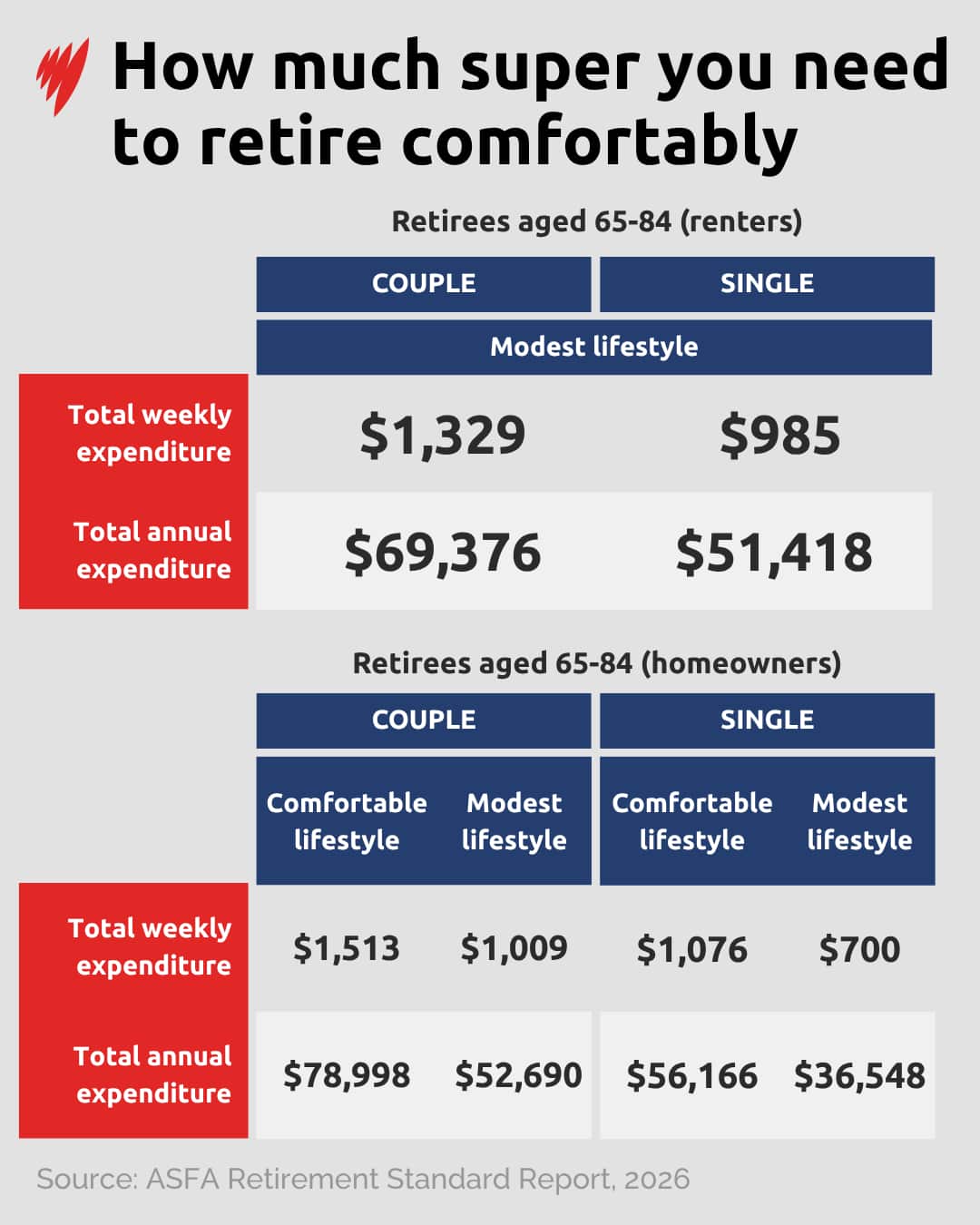
A couple who own their home and are seeking a comfortable retirement will need $78,998 a year, or $1,513 a week. A single homeowner will need $56,166 a year, or $1,076 a week.
Those figures were released on Tuesday by the Association of Superannuation Funds of Australia (ASFA), the peak body for the super industry.
It showed for homeowners aged 65 to 84, the budget for a comfortable retirement rose 0.5 per cent for couples and 0.4 per cent for singles in the June quarter.
For a modest retirement, their budget rose 0.4 per cent for couples and 0.3 per cent for singles, to $52,690 and $36,548 a year respectively.
News that makes sense
Your trusted source for staying up-to-date with the world around you. Get free daily news updates and analysis, straight to your inbox.
For retirees aged 85 and over, a comfortable retirement will cost $74,484 per year for couples and $53,964 per year for singles. For retirees who rent privately, a modest budget is now $69,376 per year for a couple and $51,418 per year for a single.
ASFA CEO Mary Delahunty says retirees are being affected by the soaring cost of living more than others because the things they buy are rising quicker than the inflation rate of 3.8 per cent.
These include electricity, which the group said rose 22.4 per cent after federal and state rebates ended (22 per cent), car costs (6.5 per cent), medical services (5 per cent), insurance (almost 5 per cent) and meals out (4 per cent).
"Retirees are among the groups hit hardest by the cost of living crisis because their budgets are weighted towards the things going up in price the most," Delahunty said.
What's a comfortable retirement compared to a modest one?
AFSA defines a comfortable retirement as being able to afford quality private health insurance, eat out most weeks, and go on a yearly holiday in Australia or overseas every few years.
A modest retirement includes basic health cover, such as a hospital-only plan, domestic-only holidays, and occasional eating out.
On the age pension alone, it's a much slimmer budget with limited lifestyle and basic living spending.
"Most of these things drop out of your budget entirely," ASFA CEO Mary Delahunty said.
She said while the age pension goes up with inflation, it doesn't allow for spending on other things like private health and holidays, which are increasing in price, and leaving retirees more reliant on their super to make those payments.
"Super is the difference between watching every dollar and having a sense of financial security in retirement," Delahunty said.
Superannuation as an election issue
As Australia nears a federal election, superannuation has become a major political campaign line as the parties try to win voters amid a cost of living crisis.
Treasurer Jim Chalmers signalled super could become a political issue at the next federal election, and accused his political opponents of trying to "end compulsory superannuation as we know it".
His calls came after Liberal senator Andrew Bragg declared superannuation an "illiberal experiment".
One Nation has proposed allowing workers paying rent or a mortgage to divert 3 per cent of their super payments straight to their wallet for up to three years — investing only 9 per cent instead of the current compulsory rate of 12 per cent.
The policy has come under criticism from super firms and the government, with some estimates that people opting into the scheme could lose $25,000 from their retirement fund.
ASFA calculates a similar loss, saying a 30-year-old on average full-time earnings who takes three years of super as cash under the One Nation proposal would receive around $54 a week now and retire with $23,900 less in today's dollars.
"The cost of living and housing crises need their own solutions. Forcing Australians to solve them by robbing from their own future selves is not a helping hand. It is a worse deal than previous generations had," Delahunty said.
For the latest from SBS News, download our app and subscribe to our newsletter.







