
In brief
- Australia's plan to overhaul housing tax has sparked conversation about how New Zealand taxes property investors on capital gains.
- A cross-border tax agent said investing abroad comes with significant risks and complexities.
As Australians debate changes to housing taxes proposed in the federal budget, discussion has emerged about whether investors could look across the Tasman Sea for more favourable tax treatments.
New Zealand does not impose a broad capital gains tax (CGT) on investments, nor does it levy stamp duties on property purchases like those common in Australia.
By comparison, Australia taxes capital gains across asset types. Under the current system, investors only pay tax on 50 per cent of a capital gain if they've held the asset for more than a year.
But changes announced in the budget earlier this month would eliminate the discount for established properties and instead introduce a cost-base indexation method, where gains are adjusted for inflation before tax is applied.
Australians are also treated more favourably than most other foreign buyers under New Zealand's overseas investment rules.
News that makes sense
Your trusted source for staying up-to-date with the world around you. Get free daily news updates and analysis, straight to your inbox.
Still, experts warn tax advantages for Australians considering property investments in New Zealand may be far more limited than they first appear.
No capital gains tax in New Zealand?
New Zealand does not have a comprehensive capital gains tax like Australia's.
"There are exceptions, but for the typical person, it gives certainty that if you've kept [a property] for longer than two years, life is a lot easier, there is no capital gains tax to consider," Mike Reddy, a Sydney-based New Zealand tax expert with NZ Tax Accountants, told SBS News.
New Zealand uses a time-based rule called the 'bright-line test' to determine when gains on residential investment properties may be taxed.
Under the current rules, profits on residential properties held for more than two years are typically not subject to tax. If sold before the two-year mark, the gain may be taxed as income.
However, other tax rules can still apply in some circumstances. For example, if a property was bought with the intention of resale, any profits may be taxed as income regardless of how long the property was held.
The bright-line period has shifted several times over the past decade. In 2024, it was reduced from 10 years to two years.
What about negative gearing?
For years, New Zealand’s approach to negative gearing has been less generous than Australia's system.
In New Zealand, like Australia, landlords can offset rental income using investment property expenses, including mortgage interest.
However, unlike Australia's current system, rental losses are ring-fenced, meaning they typically cannot be offset against salary and wage income.
In 2021, New Zealand's Labour government phased out the ability for landlords to claim mortgage interest as a tax deduction. New builds were exempt from the change.
Like the changes proposed in Australia, the policy was designed to steer investors away from established homes and incentivise investment in new housing.
House prices subsequently fell and rents rose, although experts say it's difficult to attribute those trends to any one factor, particularly given the reforms coincided with a sharp rise in interest rates.
After a change of government, New Zealand's new conservative leadership coalition reversed the change in 2024.
Australia's proposed reforms would move its treatment of investment property losses closer to New Zealand's current system.
Could New Zealand's tax system really lure Aussie investors?
Some commentators have speculated that Australian investors could turn to New Zealand in the wake of the budget, chasing more affordable properties and more favourable tax settings.
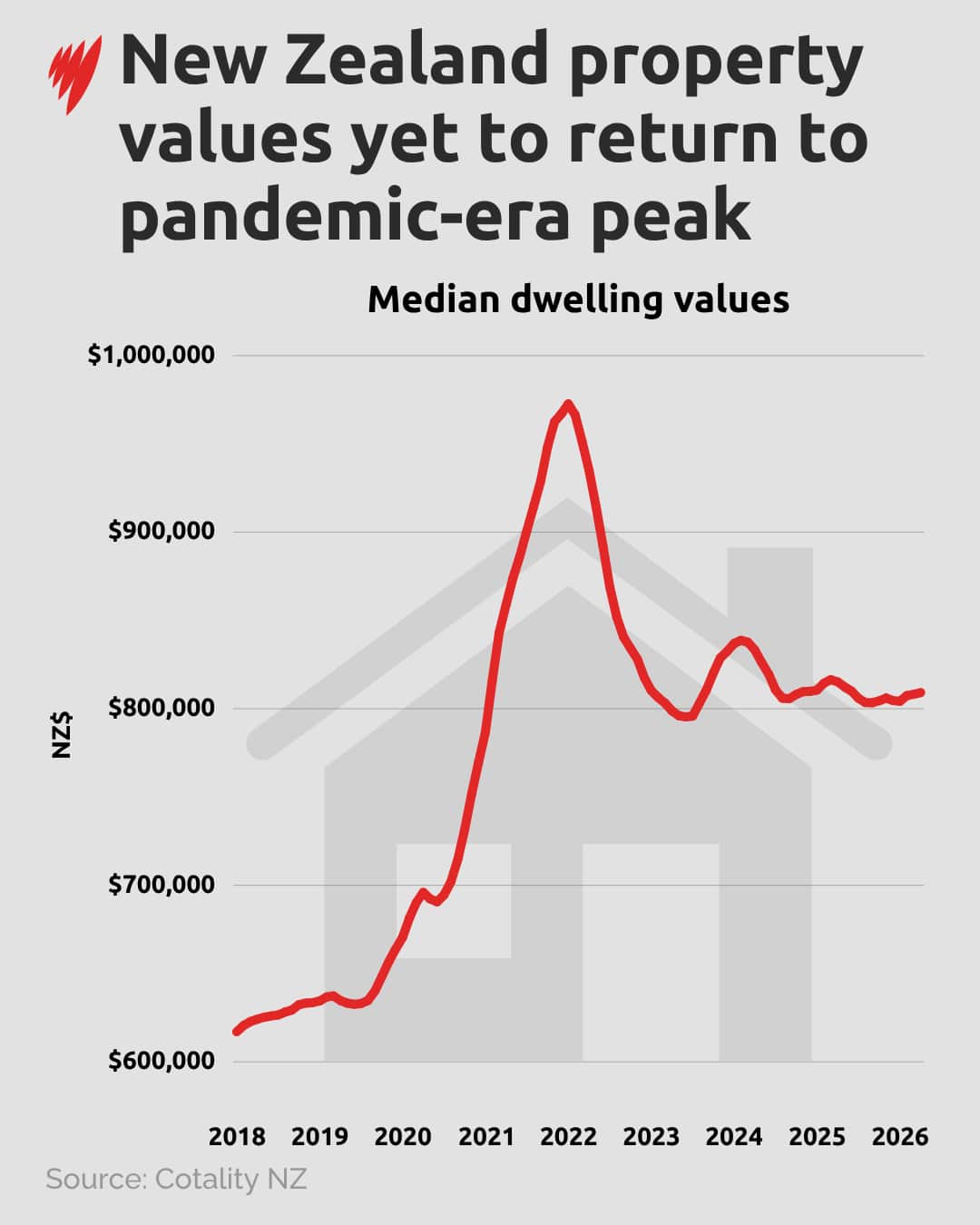
While New Zealand's housing market has started to recover from its downturn, prices are still down by more than 15 per cent from their late 2021 peak, according to Cotality NZ data.
Cameron Kusher, an independent property economist and director of Kusher Consulting, said he doesn't anticipate Labor's tax reforms — if implemented — will drive any significant investment across the ditch.
"There's a reason why people tend to invest in Australia rather than New Zealand," he told SBS News.
"Australia is a stronger economy. I think you find that a lot of New Zealanders move to Australia because there's more opportunity here in Australia."
He was doubtful that the New Zealand market presented the same opportunities as Australia's, citing its slower population growth and a less diversified economy.
"I'd probably question for someone in Australia if it's actually worthwhile for them to go and invest in New Zealand," he said.
ANZ chief economist Richard Yetsenga said the changes announced in the federal budget were the most substantial in decades, and would likely influence investment decisions for years to come.
But he questioned whether investing in New Zealand would provide Australians with a way around the reforms.
"If you're an Australian tax resident, you pay tax on your worldwide assets and income under Australian law, so it's not obvious to me — while I'm not a technical expert in the area — that investing in New Zealand property is a way around the changes in the budget," he told SBS News.
The big catch
Australian residents hoping to benefit from New Zealand's more generous tax treatment would likely still face Australian tax obligations on property sold in New Zealand because the Australian Taxation Office (ATO) taxes worldwide income and gains.
"Capital gains on NZ property may still fall within the Australian CGT regime even where NZ itself does not impose tax on the disposal," Reddy said.
Any tax paid in New Zealand would generally be credited against an investor's Australian tax liability, helping prevent the same income from being taxed twice.
However, Reddy said the double tax agreement between Australia and New Zealand does not mean Australian residents are taxed in Australia under New Zealand rules instead of Australian ones.
Reddy said misunderstandings about cross-border tax rules were common.
He said his firm had encountered Australians "at the bottom of the cliff" after they had already attempted to establish New Zealand structures they mistakenly believed would exempt them from Australian tax obligations.
"It is something that we are seeing a lot of, and unfortunately, spending our time trying to reduce tax penalties where people have either paid their taxes in the wrong country or not made the disclosures in both countries about their activities."
This article is general information. Please see a professional if you need financial advice.
For the latest from SBS News, download our app and subscribe to our newsletter.







