in brief
- Geopolitical tensions over Taiwan are hanging over the annual Pacific Islands Forum in Palau.
- However, island leaders insist local climate threats and rising drug crime take priority.
China and Taiwan's diplomatic tug-of-war is casting a shadow over the ongoing Pacific Islands Forum (PIF) as a handful of national leaders declined to attend — however, experts on the ground caution that a geopolitical focus risks ignoring the core priorities of Australia's neighbours.
The annual 18-member gathering in the Taiwanese-allied nation of Palau opened on Monday with climate change, economic security, and the rising influence of the transnational drug trade top of the agenda.
China has said it has "serious concerns" that Taiwan was invited to attend in its own right, while questions have been raised about whether China has influenced five of 18 national leaders from the forum (those of Kiribati, Fiji, Vanuatu, Samoa and Solomon Island) not to attend.
The cornerstone regional political forum began this year with a pointed message from Palau's President Surangel Whipps Jr, who urged nations to adhere to this year's theme of unity and reminded outside partners that they "do not choose our destination".
This year's PIF takes place as Kiribati moves to constitutionally restrict diplomatic recognition to UN member states only — thus excluding Taiwan — while China actively seeks to strip Taiwan of its 'development partner' status in the forum. This comes nearly two months after a Chinese ballistic missile test in the Pacific Ocean.
News that makes sense
Your trusted source for staying up-to-date with the world around you. Get free daily news updates and analysis, straight to your inbox.
Taiwan, a self-governing democracy, broke away from mainland China in 1949. China views it as Chinese territory that must be brought under its control by force if necessary.
Prime Minister Anthony Albanese has made strengthening regional ties a key focus of his administration's foreign policy, signing multiple bilateral agreements with countries like Fiji, Vanuatu, and Tuvalu.
But despite the noise around China, "leaders have made it clear they're here to work" Tess Newton Cain, principal consultant at Asia-Pacific strategic firm Sustineo, told SBS News from Koror.
"The issue of the China-Taiwan tussle is largely a distraction, and one that they try to minimise."
On Wednesday, $600 million in Australian funding was announced to tackle transnational drug smuggling from South America that is increasingly causing harm across the Pacific.
Cautions against Pacific chess games
China has made the PIF something of a battleground, maintaining that Taiwan ought to be sidelined during talks, as it is not technically a "dialogue partner" due to a difficult compromise that PIF members have reached over its status for the past three decades.
Palau, one of the few nations that maintains official diplomatic ties with Taiwan, has accused China of running a coercion campaign against it after travel warnings were issued to Chinese citizens looking to visit Palau.
Australia, which maintains a flexible approach to the 'One China' policy by recognising Beijing and maintaining informal economic and security ties with Taiwan, is better able to weather such geopolitical storms in part owing to its size.
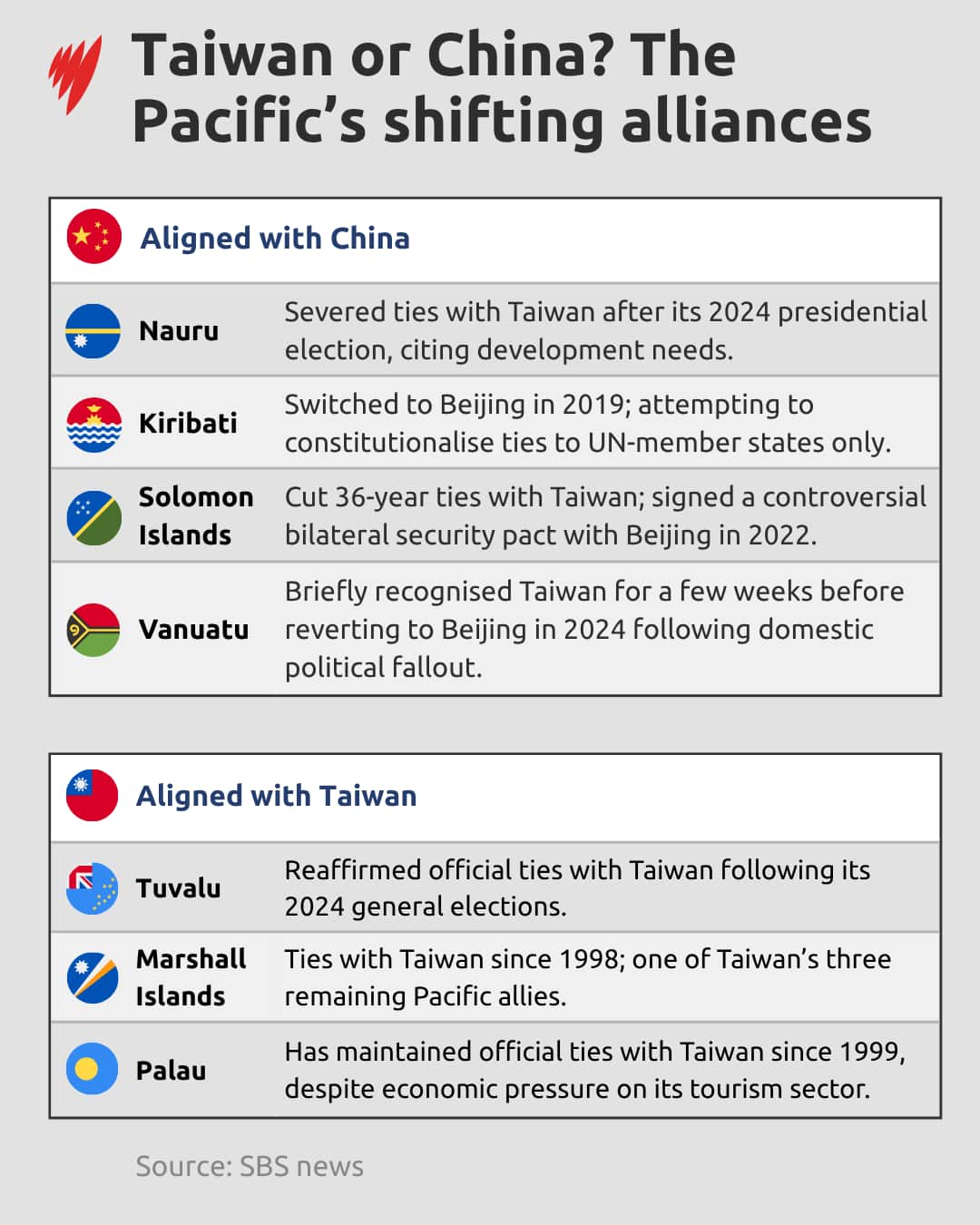
Yet, as Pacific island nations increasingly turn to China for economic support, experts caution that for Australia to treat the Pacific as a geostrategic game would be a mistake, as that is "certainly not" how Pacific leaders see their own relationships.
"It's not appropriate that Australian officials or politicians are shaking hands with members of the Pacific while looking past them to see what China may or may not be doing," Newton Cain said.
Professor Dave Peebles, director of the Pacific Security College at the Australian National University, agrees that the Taiwan question is not the focus of relations in the Pacific.
Issues of Taiwanese sovereignty are "not something" Australia is seeking to influence in its dealings with island nations, he told SBS News, as those decisions are for democratically elected governments of Pacific Island countries to make.
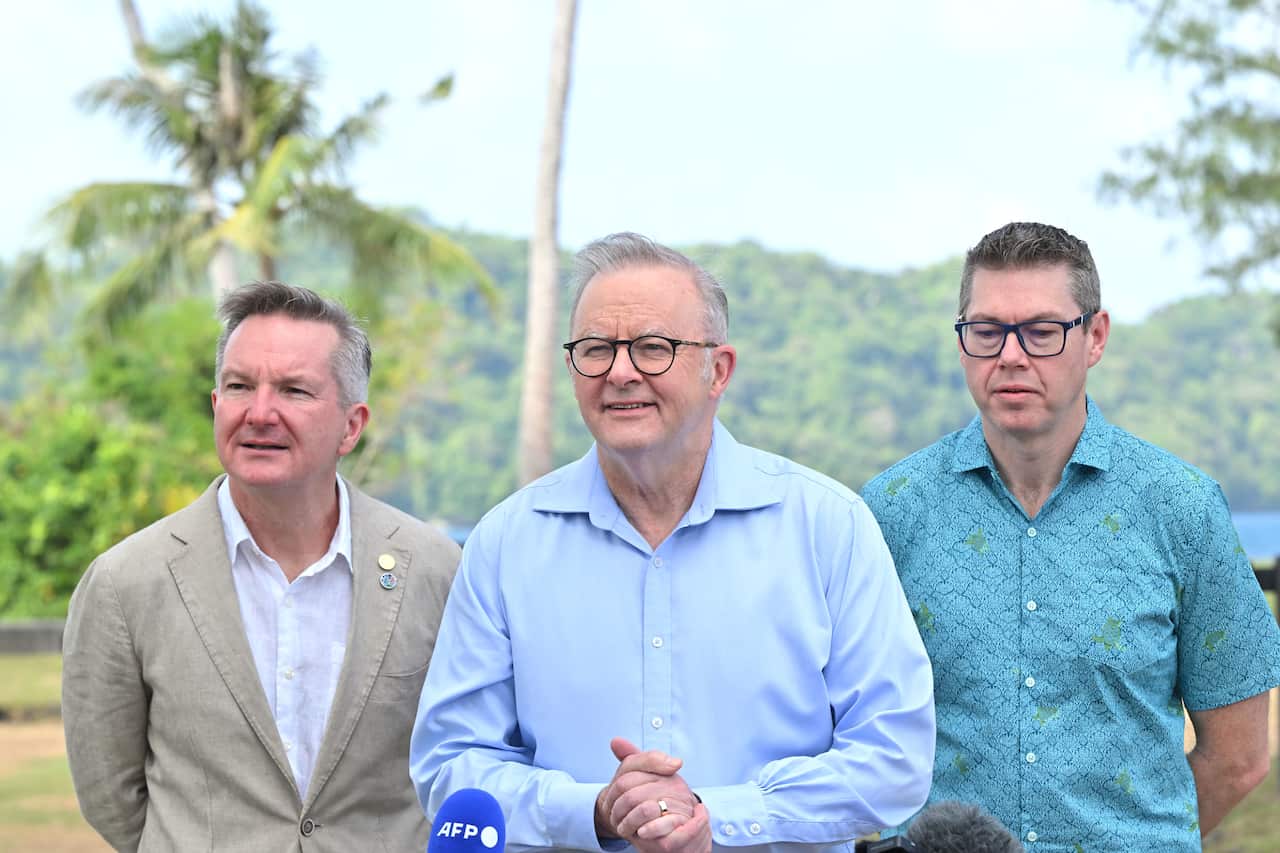
"Some Pacific Island countries do have similar relationships with Taiwan as Australia does," Newton Cain said. "Others are possibly just too small to be able to justify that and to have to wear the tussle and competition that comes with that."
However, she dismissed fears that Kiribati's current domestic push to change its constitution in a way favourable to China — making it far more difficult for successive governments to switch alliances back — is a blueprint for a wider Pacific pressure campaign.
Whether a country recognises Taiwan can have significant domestic impact on small island nations.
In 2024, after decades of support, the Pacific Island nation of Naoero (formerly Nauru) abruptly severed diplomatic ties with Taiwan and formally recognised the People's Republic of China as "the only legitimate government of China and Taiwan" — leaving the latter with just a handful of diplomatic partners, including just three in the Pacific.
Diplomats and technical staff were forced to rapidly leave the country as it moved to deepen economic ties with the economic superpower, which has developed a "very strong portfolio" of investment in regional countries that do make the switch.
"It's often quite evident to see at a fairly early stage the impacts of having a partner that comes with deeper pockets than Taiwan," Newton Cain said.
Bigger issues at hand
While the threat of a hostile takeover of the region that the Chinese Communist Party views as an "inalienable part of China" simmers in the minds of policymakers across the globe, the threat of regional intervention from the United States and its allies has thus far kept the cross-strait conflict tense but cool.
As such, analysts argue that, while military conflict in the region and its impact on the economy is a genuine concern for Pacific nations, there are more immediate problems to deal with.
"There's no getting around the fact that the global and regional order is changing and the Pacific isn't immune from that," Peebles said. "But I think too that the Pacific is confronting this poly-crisis and geopolitics, though very important, is but one of the issues."
The PIF is expected to produce a joint shared position from all members, including Australia, on climate, which will be taken to the pre-Conference of the Parties meeting in Fiji in October before COP31 in Türkiye in November.
For low-lying Pacific nations, rising sea levels are considered an existential threat, one that Australia recognised with the landmark 2023 Falepili Union treaty that would allow a third of the 11,000 people living in Tuvalu to immigrate and escape increasing flooding.
"This is a serious gathering of serious people to discuss serious issues," Peebles said, also speaking from the forum in Koror. "There is a lot going on at this meeting, happily, that has nothing to do with geopolitics and is setting the region up for success."
For the latest from SBS News, download our app and subscribe to our newsletter.







