(Transcript from World News Australia Radio)
The nations say membership of the international peace and security body should be increased to better represent the interests of all nations.
In a lively debate on the matter at the UN General Assembly, Australia has been one country advocating reform.
News that makes sense
Your trusted source for staying up-to-date with the world around you. Get free daily news updates and analysis, straight to your inbox.
Here's Andi Yu with the first of a two-part series. (Listen to part two here.)
(Click on audio tab above to hear full item)
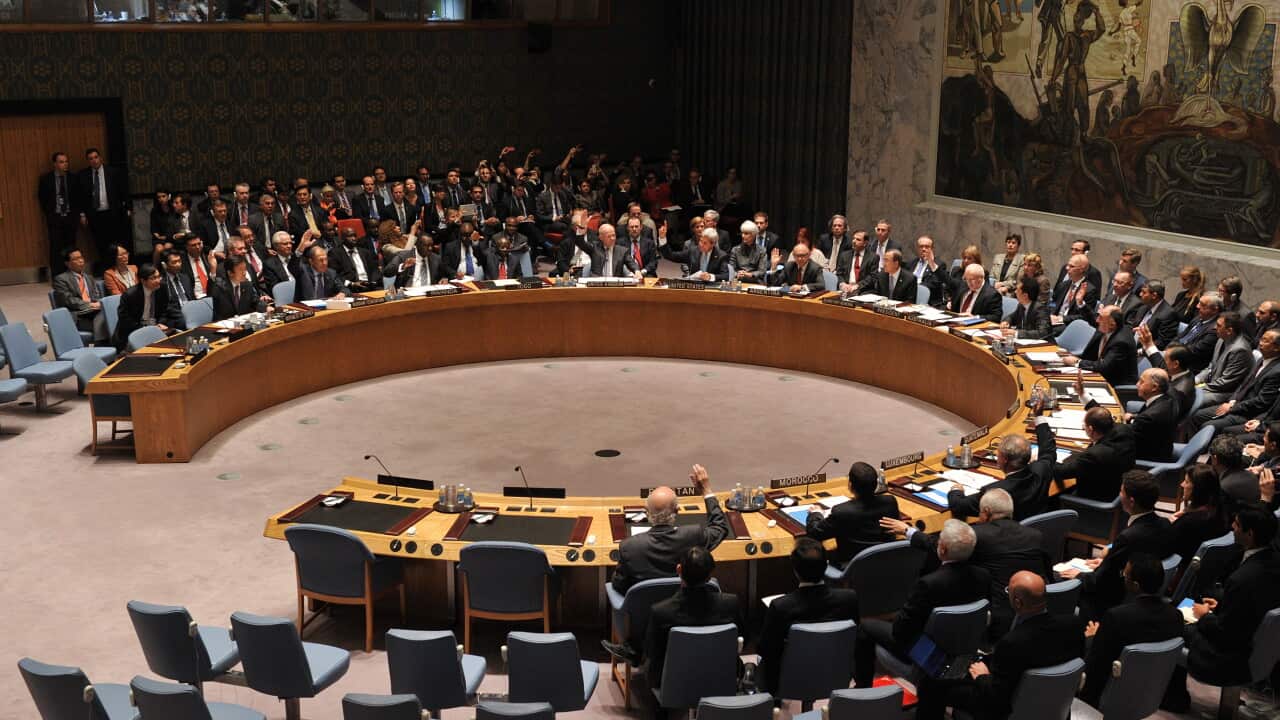
The Security Council was set up in 1946 after the Second World War, with responsibility for maintaining international peace and security around the world.
The Council comprises five permanent members - the United States, China, Russia, Britain and France - and ten temporary members, elected by the General Assembly for two-year terms.
All 15 members have a vote, but only the five permanent members have a crucial veto power, allowing any one of them to block decisions made by the rest of the Council regardless of the level of support.
The veto power is a sore point for many who say there is too much power in too few hands.
Australia's representative at the UN, Philippa King, acknowledges this as one of the key points for potential reform.
"A major criticism of the Council is that in recent times in the face of major humanitarian crises, it has failed to discharge its responsibility to maintain peace and security - a responsibility that it exercises on behalf of all member states. Much criticism is directed towards the impact of the use or the threat of use of the veto."
New Zealand representative Jim McLay says the permanent member nations should value equality over control.
"We urge the permanent members to take a hard look at the way they conduct their business. They could do much to assuage concerns about the legitimacy of Council decisions if they were more open and responsive to the views of the wider membership and if they treated the elected members of the Council, whose votes are needed for all formal Council decisions, treated them more as partners."
Security Council resolutions are supposed to be binding on UN members - and they can carry the threat of military action to force compliance.
In reality, they are often ignored.
One example often cited by critics to show the ineffectiveness of the Security Council, was when it failed to approve military intervention in time to prevent the genocide in Rwanda in 1994.
Rwanda's current UN representative, Eugene-Richard Gasana, agrees with the critics.
He says the five permanent members of the Security Council only serve their own political agendas.
"The responsibility to respect the citizens of this world shall not be held hostage of political interests of permanent members of the Security Council, which has caused us millions of lives, particularly, the 1994 genocide perpetrated against the Tutsi in Rwanda. We once again call up on permanent members to refrain from using the veto, especially in the case of genocide, war crimes and crimes against humanity."
To prevent this kind of inaction during future international crises, different ways to reform the veto powers are being put forward.
Australia's UN representative Philippa King says a proposal from one of the permanent members - France - should be considered.
"Given the recent Syria experience, we believe France's proposal for permanent members to voluntarily renounce their veto powers in cases of mass atrocity crimes, has merit and deserves further consideration."
New Zealand, Ireland, Mexico and others also support this proposal.
But some are calling for the veto power to be abolished altogether.
Among them is Botswana, represented in the General Assembly debate by Nkoloi Nkoloi.
"The African position views the question of veto as divisive, exclusive and subject to abuse by the veto-wielding powers. Africa therefore wishes to see a review of the veto power with a view to abolishing it."
Others agree the veto should be abolished, but are supporting the French proposal because it's unlikely the permanent five will allow the veto's removal.
South African UN representative Doctor Mashabane says the current system is undemocratic and hypocritical.
"It is an irony that those who consider themselves to be leaders of the free world and bastions of democracy, are themselves comfortable sitting in an undemocratic, archaic and unrepresentative structure. The more we continue with the rhetoric and not get down to business of negotiating the actual reform, the status quo continues to favour those who are privileged by the post World War Two settlement."







