
NSW Premier Chris Minns has defended his government's crackdown on protests, saying there was a "tinderbox" in the community and the new laws were aimed at protecting public safety.
Minns recalled parliament on Monday to fast-track a raft of changes to protest laws following the Bondi Beach terror attack that targeted a Hanukkah festival and killed 15 people.
Under the proposed changes, the authorisation of public assemblies could be restricted after a terrorist incident is formally declared.
Critics, including the Greens and Palestine Action Group, have labelled the reforms as "draconian" and "kneejerk anti-protest laws".
News that makes sense
Your trusted source for staying up-to-date with the world around you. Get free daily news updates and analysis, straight to your inbox.
Speaking at a media conference on Monday, Minns said the government was taking "decisive action" to keep the community safe.
"That is in recognition of the fact that while it may be a tinderbox out there in the community during the summer period, we can’t let unrestrained violence or disunity in our community run without a strong police presence," he said.
The reforms would also designate the chant "globalise the intifada" as hate speech.
Minns said he recognised the historic meaning of the intifada — two periods of Palestinian resistance against Israeli occupation marked by significant violence — but argued the phrase carried a different meaning in NSW.
"Its use in common parlance in demonstrations both here and around the world are a call to a global intifada. That is what it means," he said.
"Not in the Middle East, not in Israel or Gaza, but here in Sydney. In our streets … in those circumstances, I do believe that it leads to a culture and environment of heightened disunity and an invitation to violence."
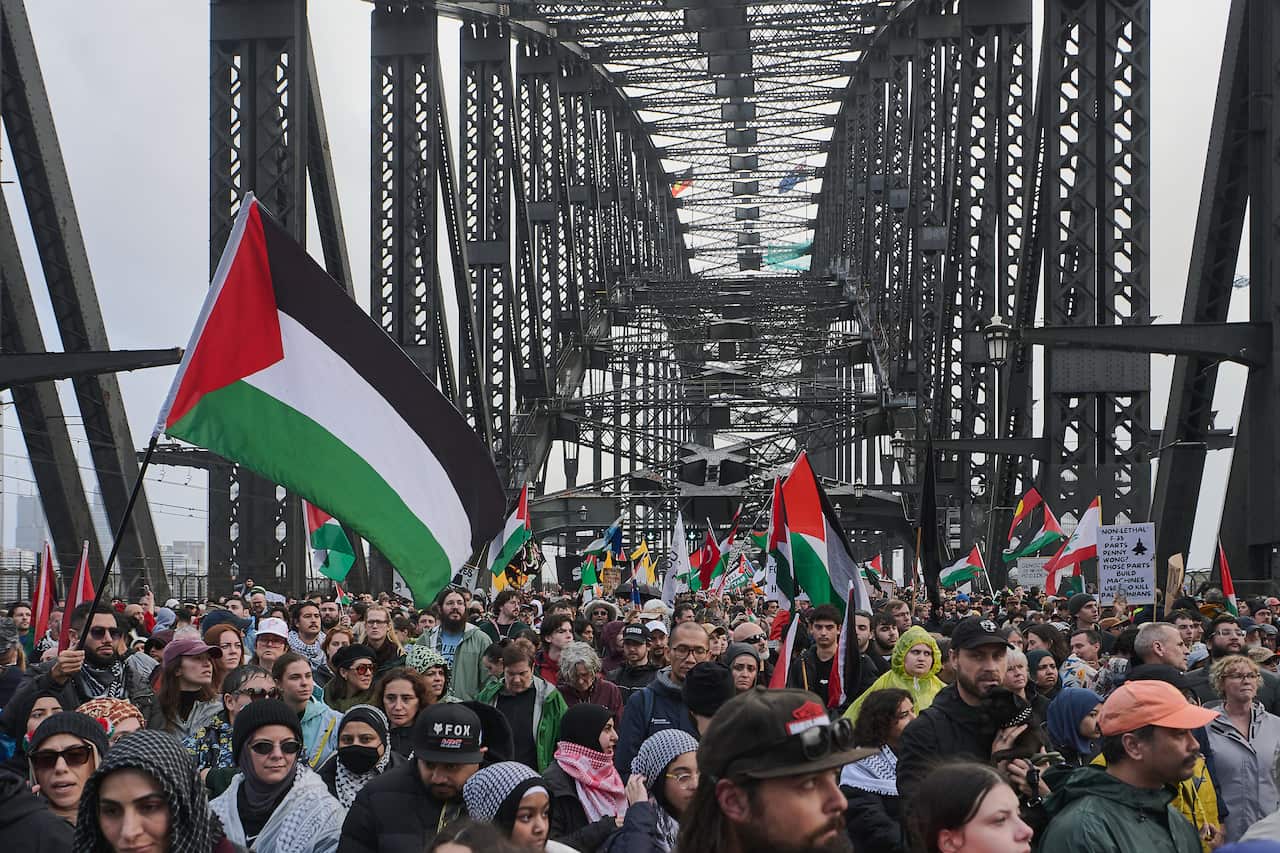
While pro-Palestinian rally organisers may hold "sincerely held views", Minns said they were "unleashing forces that they can't control".
"We have to do everything we can to ensure that words that are said at a rally are not used by somebody at a later point for violent retribution on city streets," he said.
"That means drawing a line in the sand and saying that this phrase used in this context can lead to violence."
Under the reforms, the police commissioner or deputy police commissioner could designate certain areas where public assemblies such as protests were restricted, with the police minister's agreement.
Once a declaration was made, no public assemblies would be able to be authorised for that area, including by a court, and police would be given access to existing powers to move people on when their behaviour "causes harassment or intimidation or obstructs traffic".
Those declarations would last for an initial period of 14 days, and could be extended for up to three months.
Critics label laws 'draconian'
Speaking on Monday, Dr Naama Blatman, an executive member of the Jewish Council of Australia, called Minns' proposed reforms "anti-protest laws" and said they would not make the community safer.
"These laws are borne of political pressure, not a genuine consideration for the safety of our community," Blatman said.
Blatman also referred to comments made by the government's antisemitism envoy Jillian Segal following the Bondi attack about the March for Humanity that took place on the Harbour Bridge in August, protesting against Israel's actions in Gaza.
"We need to stop with the hate, stop with the chants," Segal said.
"Stop with the waving of terrorist flags, because it progresses just as we saw the Opera House, the Harbour Bridge and now Bondi Beach, each a progression and hateful words leading to where we are today."
Blatman rejected the connection of the Bondi Beach terror attack to the Harbour Bridge protest.
"What happened in Bondi was an evil antisemitic attack but let it be very clear, there is nothing connecting these attacks to the movement for justice in Palestine, to the protests we held, to the marches we shared," she said.
"Criticism of Israel as harsh as it may be, is not equivalent to antisemitism."
Josh Lees, an organiser from the Palestine Action Group, which has led demonstrations against Israel's actions in Gaza, including the March for Humanity, spoke alongside Blatman on Monday.
Lees said the proposed reforms were part of a "concerted campaign being waged by some to try to link the horrific Bondi attack to the Palestine protest movement".
Lees said the group reiterates its "complete opposition to all forms of racism, including antisemitism" but called the reforms "kneejerk anti-protest laws".
NSW Greens MP Sue Higginson added on Monday that the proposed reforms are some of the most "draconian, authoritarian anti-protest laws this country has ever seen".
"I have no doubt this power that the premier is asking the NSW Parliament to pass today and tomorrow is unconstitutional," she said.
While symbols of terrorist groups are already prohibited under federal laws, NSW Attorney General Michael Daley said the proposed state laws would be simpler.
Minns defended the proposals, saying he believes antisemitism "begins with slogans" and escalates to violence.
"I believe, in many cases, when you see violent imagery and hateful slogans ... it is unleashing forces that the organisers of the protests can't control," Minns said.
"Whatever the reasons for those protests and genuine grievances or concerns about what is happening overseas, my responsibility is in Sydney."
Victoria to follow NSW
Victoria has unveiled a five-point plan to combat antisemitism in the state — home to Australia's largest Jewish population — similar to laws proposed in NSW.
The plan would strengthen hate speech and anti-vilification laws and give police new powers to manage protests after terrorist events.
It includes reviewing gun laws, appointing a commissioner to counter violent extremism, and promoting a "return to normality" for the Jewish community.
Victorian Premier Jacinta Allan said on Monday: "There is no one law that can change it all. It's as complex a challenge as we have ever faced."
She added, "This is not a Jewish problem to fix. This is everyone's problem."
Online platforms could be held liable for hateful material, and police could compel them to identify users.
Opposition leader Jess Wilson called for a protest permit system and said: "The Jewish community has been warning that this is the consequence of allowing antisemitism to fester in our streets."
The International Holocaust Remembrance Alliance definition of antisemitism would be adopted across the public sector, and a bipartisan committee would examine legislative gaps.
Allan urged urgent action and bipartisan support, promising the plan would make Victoria's anti-vilification laws "even stronger".
For the latest from SBS News, download our app and subscribe to our newsletter.







