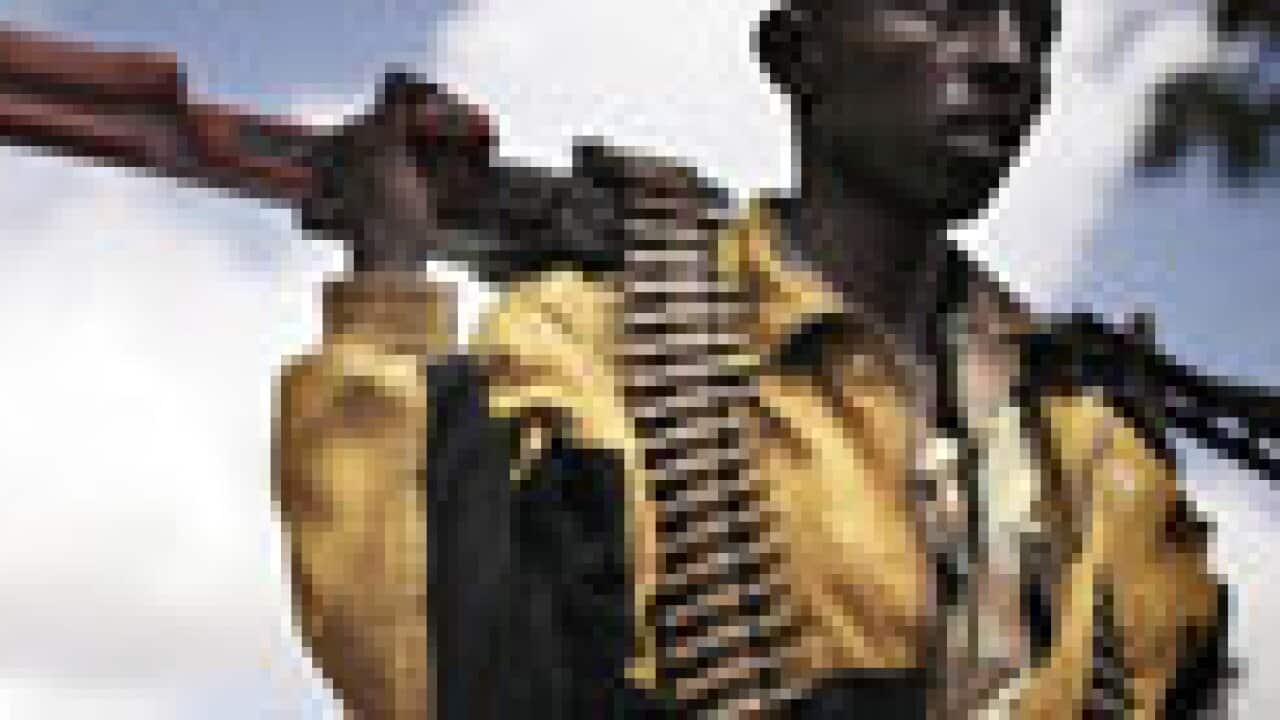
Somalia's disparate leaders signed Tuesday a "roadmap" for the formation of a government to replace the fragile transitional body that has failed to bring peace to the fragmented country.
"We are clearly committed to implement this roadmap, the Somali people have suffered a lot," said Somali President Sharif Sheikh Ahmed after three days of talks at a heavily-guarded conference venue in Mogadishu.
"We want the Somali people to be secure, to lead them to prosperity," Ahmed added.
News that makes sense
Your trusted source for staying up-to-date with the world around you. Get free daily news updates and analysis, straight to your inbox.
The new political deal focuses on improving security in Mogadishu and other areas in southern Somalia, national reconciliation, a draft charter, governance and institutional reforms.
Somalia's prime minister, as well as representatives of the breakaway Puntland region, the central Galmudug region and the pro-government militia Ahlu Sunna Wal Jamaa signed the deal under UN auspices.
The agreement is the latest among more than a dozen attempts to resolve Somalia's more than two decade-old civil war, with the country split between rival factions and host to pirate gangs who hijack ships far across the Indian Ocean.
Constant political wrangles and a bloody Islamist insurgency have undermined Somalia's Transitional Federal Government (TFG), which has been unable to carry out its key mandate of reconciling the country, writing a new constitution and organising elections.
Hundreds of people are believed to be dying each day from famine exacerbated by conflict, with three-quarters of a million Somalis facing death by starvation, many of them children, the UN said on Monday.
INTERNATIONAL PARTICIPATION
Representatives of the United Nations, African Union, Arab League and East African peace bloc, the Inter-Governmental Authority on Development (IGAD), also inked the agreement.
The UN-sponsored talks in the heavily-guarded parliament building and airport here started Sunday as political leaders worked to build on last month's withdrawal of Al-Qaeda linked Shebab insurgents from the capital.
The US representative to Somalia James Swann said he was "particularly pleased by the broad participation" at the conference, but also warned of challenges ahead to implement the deal.
"The roadmap gives us a set of benchmarks, some of them with tight deadlines," he said, speaking at the conclusion of the meeting.
"We have to look at them closely to make sure they do indeed stay on track."
The roadmap is to be implemented over the coming year, after Sharif and the parliament speaker agreed in June to extend their terms for another year.
A critical element will be agreeing on a system of government, as Somalia is fragmented into regional - and often rival - administrations.
The northern Puntland and Somaliland regions declared autonomy in the 1990s.
MISSING ELEMENTS
The central regions are also governed by local administrations and militia, the TFG has for years had limited control of Mogadishu, and much of southern Somalia is ruled by hardline Shebab fighters.
The Shebab were not represented in the talks, while Somaliland declined to attend because it is seeking international recognition as an independent state.
But analysts said the deal should be welcomed with cautious optimism - noting multiple failed agreements in the past and warning that forging peace in Somalia will take far more than inking paper alone.
"The departure of the Shebab from Mogadishu has opened some kind of political space, and it would be wrong to be too dismissive of the meeting," said Sally Healy, from Britain's Chatham House think-tank.
"At least this time it is being held on Somali soil in Mogadishu, and not like other conferences held outside. It's one and a half cheers, not three cheers."
But J. Peter Pham, senior analyst with the Washington-based Atlantic Council, warned that "discussions must be grounded in reality, not posturing, much less flights of fancy."
"Unfortunately the latter seems to be the case with the current meeting: people and agencies which have been largely absent or irrelevant in recent months are now rushing to make themselves appear important," he told AFP.
He was also deeply sceptical that given the government's "lacklustre performance" it could hold national elections within a year.
"I would be very surprised, quite frankly, if the TFG was even able to conduct municipal elections in all sixteen districts of Mogadishu a year from now, to say nothing of across all of south central Somalia," Pham said.
"Its leaders are more likely to steal any funds for such a poll - assuming anyone is still naive enough to give them cash."







