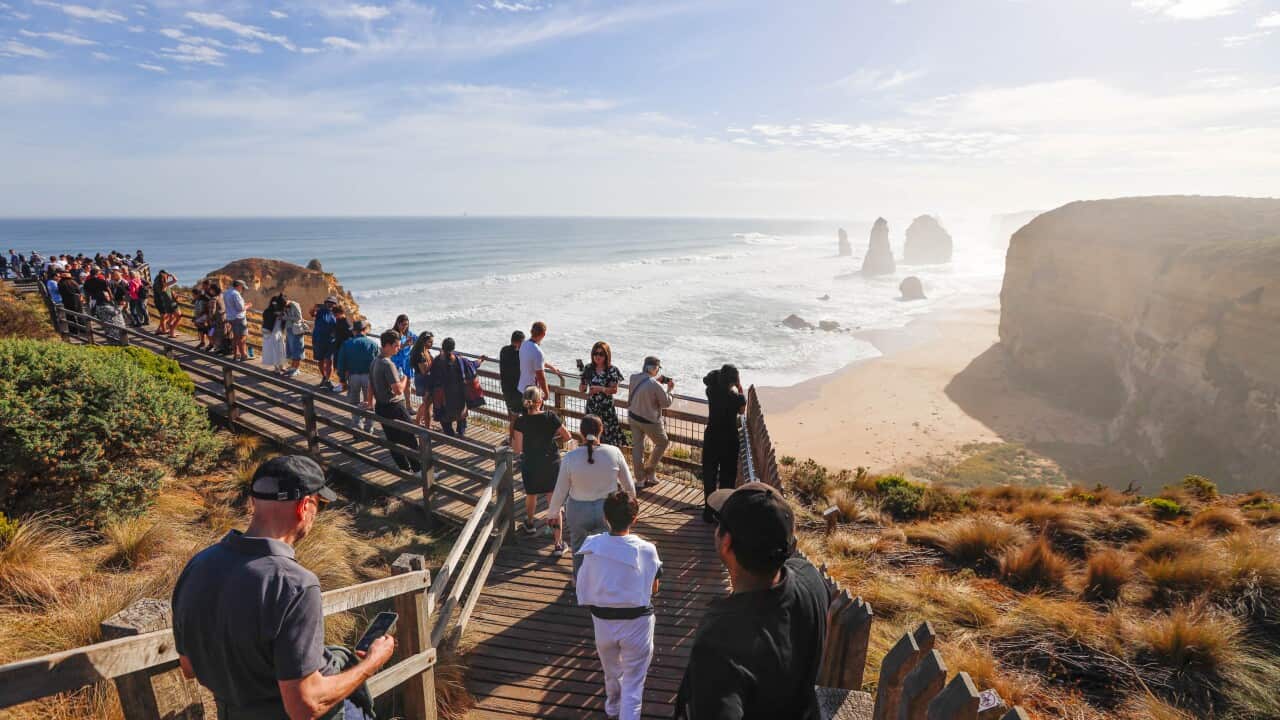
IN BRIEF
- New research published on the Twelve Apostles estimates the geological formation is younger than previously known.
- The study is the first to be published on the sea stones since 1944.
Scientists at the University of Melbourne have uncovered how the Twelve Apostles, Victoria's iconic limestone rock stacks, were formed, revealing their "real age".
Until now, researchers have said that the evolution of the geological phenomenon had long remained a mystery.
The study found that shifting tectonic plate movements over millions of years had pushed the structures out of the sea. This led the group of scientists to learn that the change had occurred within the last few thousand years, after the last Ice Age — meaning that they are younger than previously understood.
The research, published on Thursday in the Australian Journal of Earth Sciences, found the Twelve Apostles' layers are dated between 8.6 and 14 million years old.
An 'environmental time-capsule'
News that makes sense
Your trusted source for staying up-to-date with the world around you. Get free daily news updates and analysis, straight to your inbox.
According to the new information, the limestone layers were formed before coastal erosion exposed and shaped the towering structures that we see today.
Lead researcher and associate professor Stephen Gallagher said "these layers are one of the best preserved and most accessible records of climate and sea level from the Miocene period".
The Miocene was a time of varied climate change, characterised by early cooling and the expansion of ice until the middle of the period, when global warming occurred, before it returned to long-term cooling. In Australia, the climate experienced an increase in aridity, impacting terrestrial and marine ecosystems.
To conduct their research, scientists took to the Gibson Steps next to the Twelve Apostles. The steps allow public access to the beach and to view layers in the cliffs.
The layers are tilted a few degrees, and by using a Jacob's staff measuring tool, researchers were able to measure the layers in between the Twelve Apostles.
Scientists measured each layer in metre segments, as well as sampling every 25cm. They also measured the natural gamma radiation of the layers using a spectrometer.
"To say we know the layers is not an exaggeration. We know every centimetre of these layers," Gallagher said.
However, they are yet to uncover the "climate story".
The Twelve Apostles as a signal for the global climate
Looking at the Twelve Apostles as a "window back in time", Gallagher explained that they can use it to understand where temperatures and sea levels could be heading on the current path of climate change. As only eight of the twelve Apostles remain, research has to be conducted while still possible.
The stacking of the layers provides a geological history, which the scientist considers the "pièce de résistance".
Since the Miocene period, research shows that the temperature cooled by an estimated 4C, along with a decrease in carbon dioxide.
However, Gallagher said the critical number is from 25 million years ago, when the carbon dioxide level was estimated to be 480 parts per million, which is what the CO2 would have been at the base formation of the Twelve Apostles.
This showed the scientists that the main layers of the structure record the cooling of the climate transition, potential CO2 collapse, and the sea level fall.
Carbon dioxide levels naturally range from 480 to 270 parts per million, and currently, we are estimated to be at 430 parts per million carbon dioxide in the atmosphere. Compared to the recent natural carbon dioxide levels, this is quite high, according to Gallagher.
It's possible the carbon dioxide levels could climb to 480 parts per million again, as well as a 4C increase, taking us back to levels estimated during the Miocene.
This, for researchers, is why the Twelve Apostles have the potential to measure climate change.
"We look into the future by looking into the past, so we can go back in geological time and see this change and look at the effects of sea level, climate and any extinctions in the environment at the time ... It's a fast analogue for our future," Gallagher said.
The next step for researchers is to examine individual rock layers and to understand how ancient processes continue to influence modern coastal erosion through changes in climate, ocean conditions and sea levels.
For the latest from SBS News, download our app and subscribe to our newsletter.







