
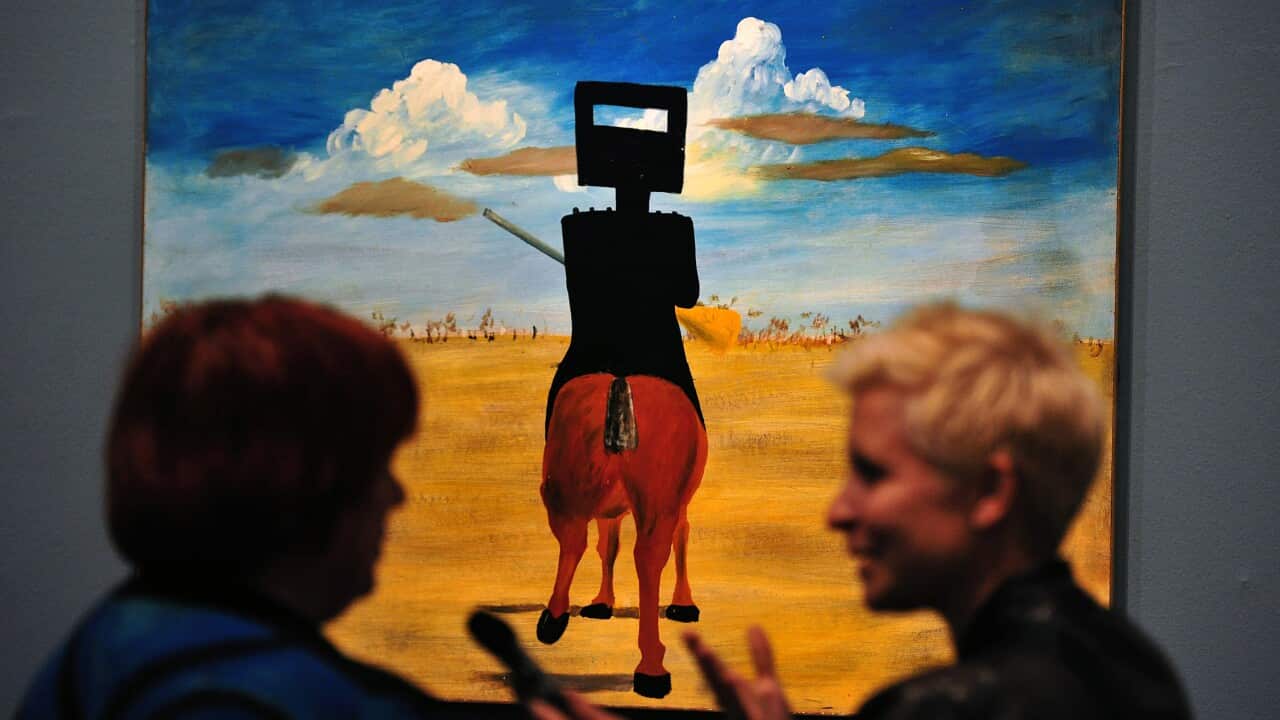
Twelve rooms at the Royal Academy have been taken over for the show, which includes bark paintings, early colonial watercolours, heroic pioneer scenes and modern works.
The landscape forms a thread that links them all together, from the inhospitable bush portrayed by the early settlers to the abstract Indigenous paintings of ceremonial places.
But The Sunday Times' Waldemar Januszczak wrote much of the so-called cream of Australian art is "lightweight, provincial and dull, and some of it is reminiscent of liquid crap".
Mr Januszczak described Indigenous art as “tourist tat”, Frederick McCubbin's famous The Pioneer as “poverty porn”, and Fred Williams' desert landscape as “thick cowpats of minimalism”.
In his most vivid metaphor, Januszczak took aim at John Olsen's 'Sydney Sun', saying it “successfully evokes the sensation of standing under a cascade of diarrhoea.”
The National Gallery called it a magnificent work by one of Australia's most distinguished artists when it was purchased for half a million dollars in 2000.
Olsen dismissed the review as ‘‘extremely foolish’’ and ‘‘an attempt to put Colonials in their place’’.
He told Fairfax his artwork was inspired by NASA photos of the sun that showed immense globules of energy emanating from the source.
‘‘It's not just a simplistic idea. You can call it diarrhoea or energy. It just depends on what you ate last night".
But not all reviews were negative. The Independent praised the exhibition, joining the Royal Academy in proclaiming its latest show of Australian art as “the most comprehensive survey of Australian art to have been shown outside Australia.”
"Which indeed it is, a shoulders-back display of 200 works covering 200 years of a country which has long found expression in its visual art," wrote Adrian Hamilton on Sunday.
"Two hundred years is a lot of ground to cover," said Kathleen Soriano, the Royal Academy's director of exhibitions.
THE EXHIBITION
The earliest colonial art shows a wariness of Australia's terrain, which the first British settlers in 1788 found hard to cultivate, portraying settlements as bright spots in a dark and dangerous landscape.
But the paintings chart how those who survived built railways and raised cattle, and finally began to enjoy the views - and the beach.
Many early works are watercolours in the English tradition, but after the gold rush other Europeans and Chinese began arriving, bringing different styles with them.
Some artists acknowledged the price the Indigenous people paid for the colonial expansion, including Eugene von Guerard in his "Stony Rises" (1857), which shows a group of Aborigines cast in darkness as the sun sets.
"It's the sun setting on the Aboriginal people," said Ron Radford, director of the National Gallery of Australia who co-curated the show.
ABORIGINAL ART
The exhibition showcases some spectacular Aboriginal art, including eucalyptus bark paintings from Arnhem Land, northern Australia, and works by Albert Namatjira, who learned watercolours while acting as a guide and painted some of the earliest and most striking pictures of the Australian desert.
There are works from the 1970s, when Aboriginal men in the Western Desert began to paint their mythology or "dreaming" on discarded building materials. There are also more modern paintings, such as Anatjari Tjampitjinpa's concentric circles from 1981, depicting ceremonial grounds in central Australia.
LANDSCAPE AS PART OF IDENTITY
The exhibition also looks at the establishment of the landscape as part of Australian identity, with pictures celebrating the heroism and strength of those forging a new life in rugged terrain.
Frederick McCubbin's 1904 triptych "The Pioneer" shows a young couple starting out with only a wagon, then with a homestead and a child, and finally the son at his father's grave, a new town in the distance.
Four decades later, Sidney Nolan presented his vision of Ned Kelly, an outlaw character similar to England's Robin Hood, outwitting the comically stupid police.
By the 1960s, the landscape had been distorted, as shown by Fred Williams' "Yellow Landscape", which discarded the horizon and depicted trees as mere dots and dashes of paint against a rusty background.
The exhibition closes with modern works, from Peter Dombrovskis's famous photograph of the Franklin River, which became a symbol for the green movement in the 1980s, to Fiona Hall's sardine tins, each with a lid moulded into a plant and a sex act depicted inside the aluminium container.
"If the show ends on an incomplete note, it is because its art, like the country at large, seems still uncertain of where it is going," writes The Independent's Adrian Hamilton.
"For all its size, Australia is still a nation of only some 22 million people – barely more than a third of the United Kingdom’s. No wonder it puts so much emphasis on its native Aboriginal artists. They at least seem confident in their dreaming".
"Australia" runs from September 21 to December 8.





