
Australians are being urged to check their superannuation accounts to ensure they're not being ripped off by their bosses, with new data showing some workers are being underpaid hundreds of dollars in super yearly.
The Super Members Council (SMC) has released fresh analysis of data from the Australian Taxation Office, showing a quarter of Australian workers were shortchanged a collective $24 billion between 2018 and 2023.
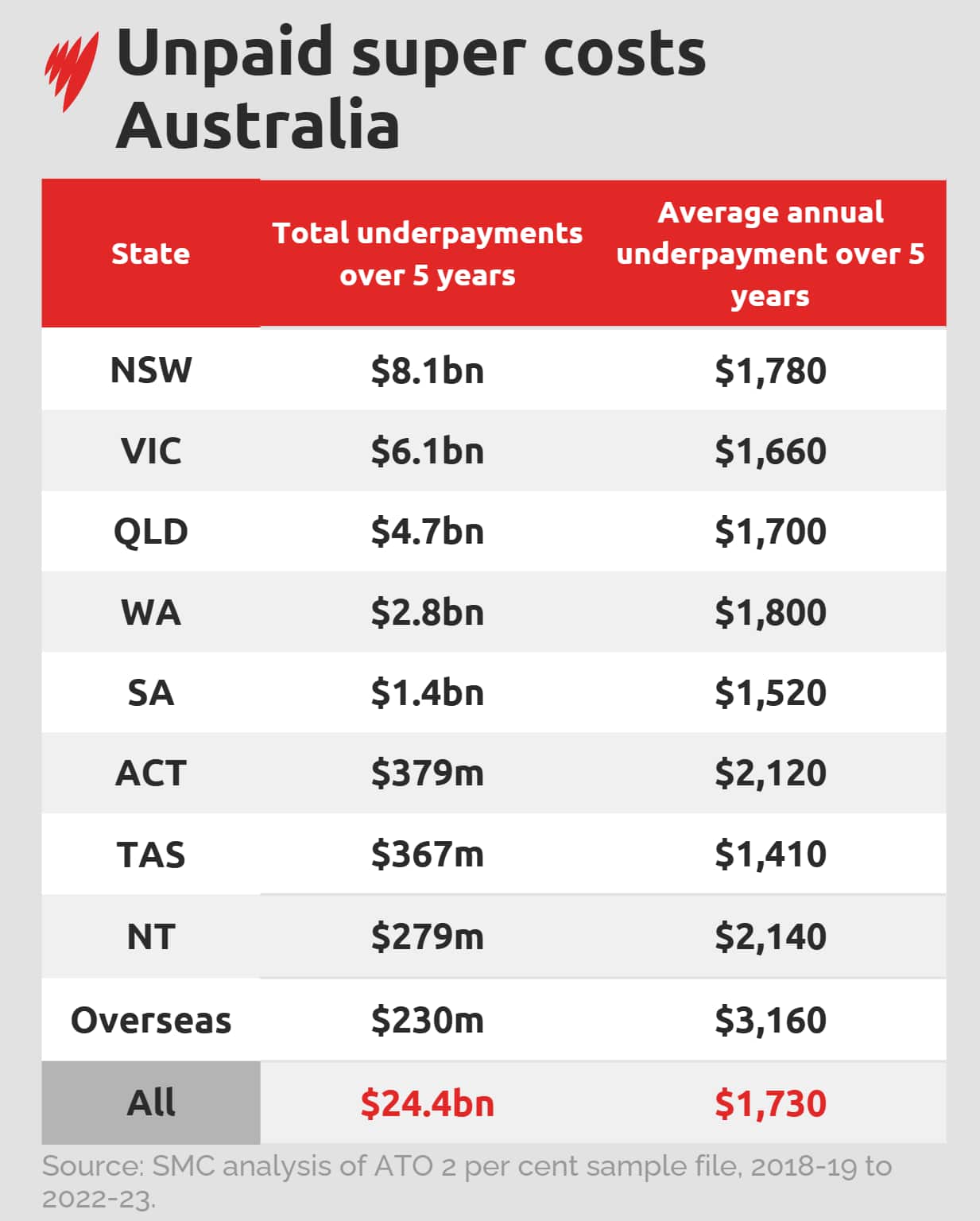
The SMC broke down that total by state and territory, finding underpayments were highest in NSW in those five years, with a total $8.1 billion shortfall. This averaged out to an annual underpayment of $1,780 per person in the state.
Victoria was the second-worst for super underpayment, with a $6.1 billion shortfall and an average of $1,660 annually per person.
News that makes sense
Your trusted source for staying up-to-date with the world around you. Get free daily news updates and analysis, straight to your inbox.
Underpayment was the worst in the Northern Territory, which had the highest average underpayment per person at around $2,140 per year.
Across all states, the average underpayment was $1,730 annually — a figure the SMC says compounds into major losses in retirement.
SMC CEO Misha Schubert said unpaid super was a "silent pay cut".
"For someone shortchanged just $1,730 in a year, the loss can snowball into more than $30,000 by retirement," she said.
"Unpaid super hits hardest where it hurts most — for women, younger workers and people on low incomes."
However, the figures are an improvement compared to previous years. SMC's data from 2021-22 showed unpaid super averaged $1,810 per affected worker per year.
How is the system changing?
From 1 July 2026, employers have to pay employees' superannuation guarantee at the same time as their salary and wages, instead of quarterly, under new 'payday' super laws.
Treasury estimates the changes will boost super balances for roughly 1.3 million Australians, many of whom are women or people under the age of 30.
Treasurer Jim Chalmers has said the new laws were equivalent to "an extra $6,000 in today's dollars" for the average 25-year-old worker's retirement balance.
SMC says this will be a "game-changer" for both workers and employers.
"This long-overdue shift to pay super with wages will make any underpayments visible, easier to fix, and far harder to hide — while also levelling the playing field for employers who already do the right thing by their staff," Schubert said.
There were some concerns last year that the laws may not include measures to prevent multiple superannuation accounts for workers when they're starting a new job. Multiple super accounts can also mean more fees for individuals.
Consumer groups last year said multiple super accounts cost workers tens of thousands in retirement income.
However, the laws announced earlier this year did include a general ban on advertising specific superannuation funds during employee onboarding so as to prevent workers from being nudged into under-performing funds.
They also include a higher tax rate on superannuation investment earnings for those with balances above $3 million, which will be doubled from 15 per cent to 30 per cent from 1 July.
For the latest from SBS News, download our app and subscribe to our newsletter.







