
In brief
- The first rebate-free energy bills in over a year are starting to be circulated.
- A finance expert shares five ways you can address the increase in electricity costs.
Taking "critical" steps could save you hundreds on electricity costs as the federal government energy rebates come to an end, and the first bills quarterly energy bills of the year arrive.
The $75 quarterly rebates provided a total of $450 in energy bill relief. While they've been a "vital shock absorber", according to Canstar data insights director Sally Tindall, the financial comparison website found there are ways for some Australians to save almost $400 a year.
Treasurer Jim Chalmers announced the end of the rebates in December, saying changes to the tax system, as well as to Medicare and the Pharmaceutical Benefits Scheme, would deliver more permanent relief.
"People can use that to help pay their electricity bills or to meet their other cost of living pressures," he said of the tax cuts.
"This wasn't an easy decision, but it's the right decision."
News that makes sense
Your trusted source for staying up-to-date with the world around you. Get free daily news updates and analysis, straight to your inbox.
But of 3,000 Australians surveyed Canstar, 18 per cent said they were struggling to pay their first electricity bill of 2026.
Almost half of the respondents could afford this increase, but were worried about future payments.
There has been an underlying price increase in household electricity bills over the last 12 months of approximately 4.5 per cent, according to the Australian Bureau of Statistics.
Tindall told SBS News many houses will have "chewed through" the last rebate and will now be faced with "intimidating" bills.
"If you are struggling to pay your next electricity bill, it's so important to do something about it right now.
"I think the natural inclination for people is to shuffle it to the bottom of the to-do pile and put their head in the sand.
"But when it comes to paying bills on time, that is the worst thing to do because if you then end up in arrears, it can really impact things like your credit score and can result in late fees."
How much could you save by switching?
The first step to take, according to Tindall, is to shop around for cheaper plans with your current provider and its competitors.
Households are spending hundreds of dollars above the lowest available electricity plan, and that gap varies based on where you live, Canstar found.
The states with the most expensive average electricity plans have the highest potential savings.
Canberrans paying an average of $2,414 in the next year could save $382 by switching to the lowest plan over that period.
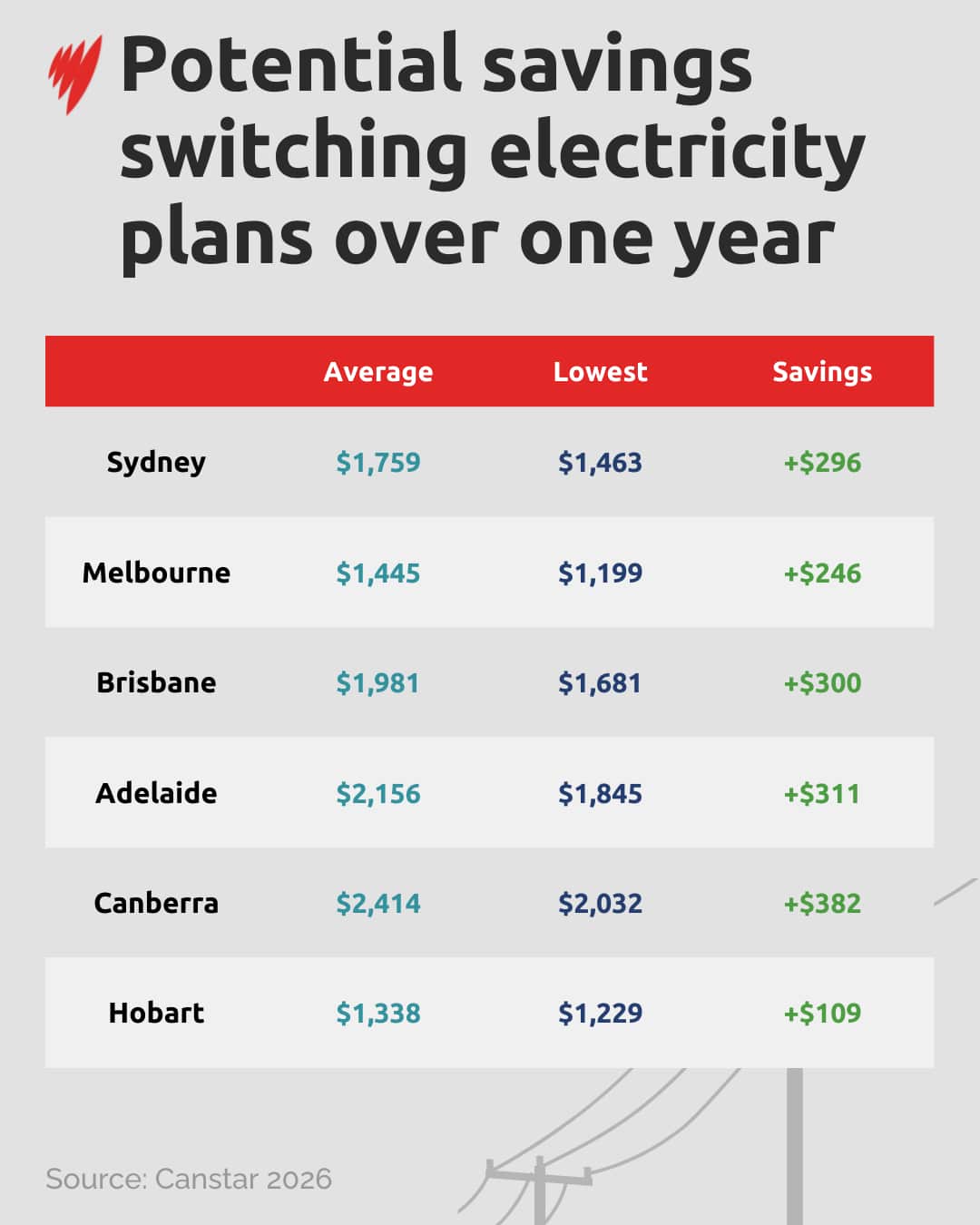
People in Adelaide and Brisbane could save $311 and $300, respectively, in the next 12 months.
This is followed by Sydney, with potential savings of $296, then Melbourne at $246.
Hobart had the cheapest power plans, where residents will spend an average of $1,338 in 2026. Switching could save Tasmanians $109.
This data doesn't capture Perth and Darwin.
Your provider is obligated to tell you if they have cheaper plans available, Tindall added, and can provide options such as bill extensions, payment plans, or hardship support.
Besides switching providers, there are also other steps you can take to tackle your energy bills.
Hardship support
One way to help with the increasing cost of electricity is to ask your provider for hardship support.
"Telling them that you are struggling to pay a bill before it is due is critical. They are obliged to help people in hardship," she said.
"That will trigger a response at their end so that they put you through to their hardship team, and they can work through options of giving you more time to pay that bill."
Providers could then give you additional time to pay a bill or look at alternative payment options.
Independent financial assistance
When considering your options with providers, it is "really important" to get independent financial advice, Tindall said.
She said the National Debt Helpline (1800 007 007) is a "great resource" that is also free, so its a good idea to give them a call for financial advice and negotiation tips.
"They can sometimes give you the words to help you renegotiate it directly with your provider and sometimes step in on your behalf as well," she said.
Rebates and assistance
Lastly, there are two places you can look for pre-existing financial support.
People can check if they are eligible for rebates or savings in every state through savings and rebate finders.
There are also specific programs for energy relief, such as the NSW Energy Accounts Payments Assistance, VIC Energy Assistance Program and QLD Home Energy Emergency Assistance Scheme.
"All of the states have tools online to help you work through what you might or might not be eligible for," Tindall said.
"You could be surprised at what potential savings you can unlock."
For the latest from SBS News, download our app and subscribe to our newsletter.







