In brief
- The World Health Organization says more hantavirus cases could emerge.
- This is due to the Andes virus' long incubation time of up to six weeks.
The World Health Organization (WHO) said on Friday that more hantavirus cases could emerge after the disease killed three passengers from a cruise ship but it expected the outbreak to be limited if precautions were taken.
Another sick passenger from the MV Hondius landed in Europe earlier in the day, as the vessel headed to the Spanish Canary Islands and health officials scrambled to map the outbreak of the potentially deadly human-to-human strain.
The fate of the Hondius sparked international alarm after three people travelling on it died, though health officials have played down fears of a wider global outbreak from the rat-borne virus, which is less contagious than COVID-19.
WHO chief Tedros Adhanom Ghebreyesus told journalists in Geneva that five confirmed and three suspected cases had been reported overall, including the three deaths.
News that makes sense
Your trusted source for staying up-to-date with the world around you. Get free daily news updates and analysis, straight to your inbox.
"Given the incubation period of the Andes virus, which can be up to six weeks, it's possible that more cases may be reported," he said, referring to the rare strain detected aboard the Hondius, which can be transmitted between humans.
The Leiden University Medical Centre in the Netherlands later announced another patient had tested positive.
But the WHO's emergency alert and response director Abdi Rahman Mahamud insisted: "We believe this will be a limited outbreak if the public health measures are implemented and solidarity shown across all countries."
People thought to have contracted the virus are being treated or isolating in Britain, Germany, the Netherlands, Switzerland and South Africa.
Rare disease
Hantavirus is a rare respiratory disease that is usually spread from infected rodents and can cause respiratory and cardiac distress as well as haemorrhagic fevers. There are no vaccines and no known cure for it.
A passenger is thought to have contracted the virus before boarding the ship in Argentina and eventually infected others on board as it sailed across the Atlantic.
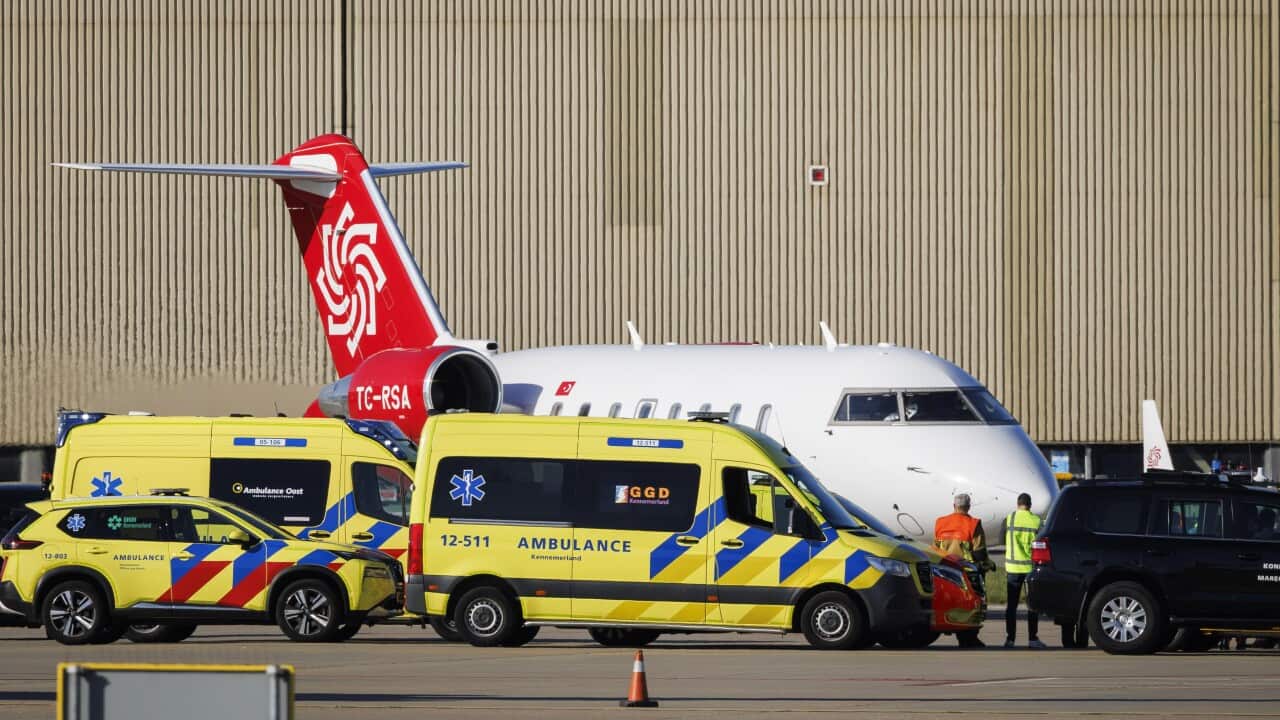
Three evacuees were whisked away from the ship on Thursday when it anchored off Cape Verde and a fourth landed on Thursday in Amsterdam, said the vessel's operator, Netherlands-based Oceanwide Expeditions.
"No symptomatic individuals are present on board" the ship at the moment, as it sails toward the Spanish island of Tenerife, it said in a statement.
The ship is scheduled to arrive there on Sunday and those on board evacuated.
The ship's Dutch operator Oceanwide Expeditions said there were 149 people on the ship, including 88 passengers.
Two people who returned to the UK from the ship have been advised to self-isolate, the UK Health Security Agency said, adding they were asymptomatic and insisting the risk to the public was "very low".
Officials in Argentina said they planned to test rodents in the coastal city of Ushuaia, from where the ship had set sail on 1 April.
First case
A Dutch man who had boarded in Ushuaia along with his wife died aboard the ship on 11 April.
The man's body was taken off the ship on 24 April in Saint Helena, an island in the south Atlantic where 29 other passengers disembarked, the ship's operator said.
It said it was working to trace all passengers and crew who got on or off the ship since 20 March.
Ghebreyesus said the WHO had informed 12 countries that its nationals disembarked from the cruise ship on Saint Helena.
The deceased man's wife — who left the ship to accompany his body to South Africa — died there 15 days later after also falling ill, with hantavirus confirmed as the cause on 4 May.
The couple had visited Chile, Uruguay and Argentina before the cruise, Argentine officials said.
Chile's health ministry said the two passengers who died were not infected in that country as they travelled there at "a period that does not correspond to the incubation time".
The WHO says the incubation period for hantavirus can be up to six weeks.
The Dutch woman had flown on a commercial plane from the island of Saint Helena to Johannesburg while she was showing symptoms.
Officials were trying to trace people on that flight, which South African-based carrier Airlink said was carrying 82 passengers and six crew.
A German passenger died on 2 May. Her body remains on the ship.
For the latest from SBS News, download our app and subscribe to our newsletter.







