In brief
- Pauline Hanson, Fatima Payman and Dai Le have united to argue parliamentary staffing allocations are unfair.
- The prime minister has significant discretion over personal staff, but the trio wants an independent system instead.
Pauline Hanson and Fatima Payman have clashed over race, religion and politics.
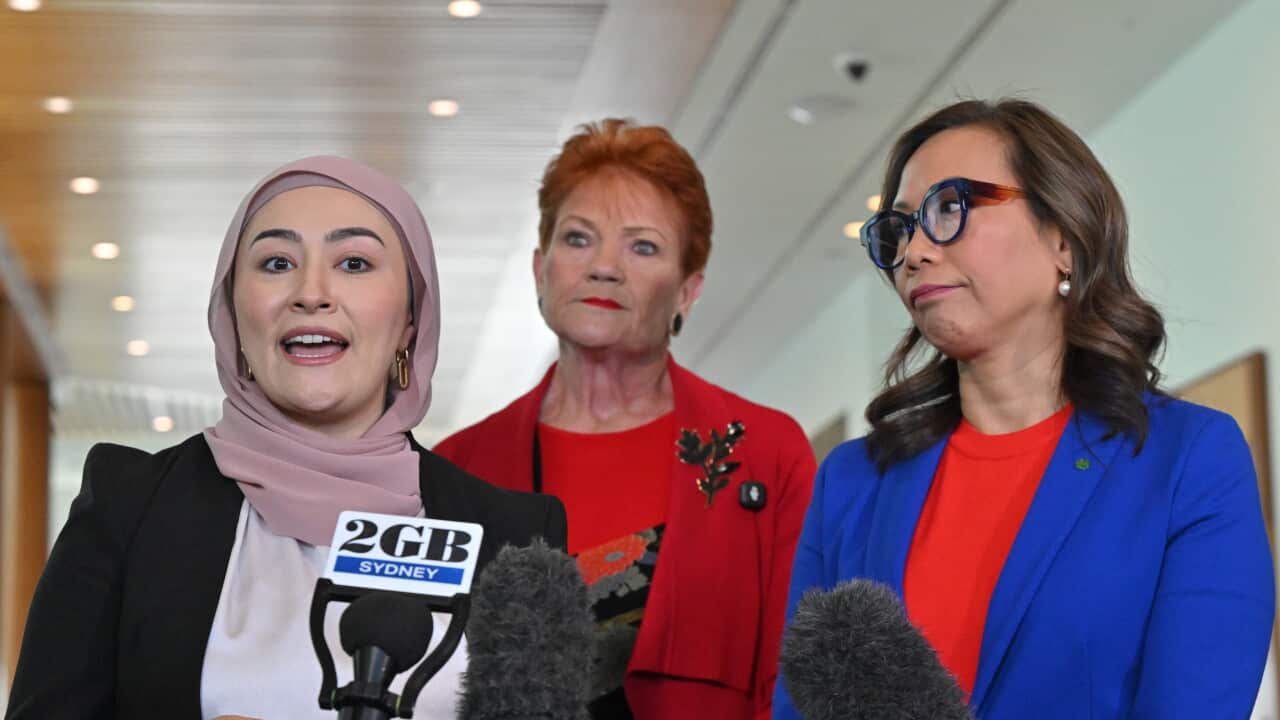
But this week, the One Nation leader and Muslim independent senator stood together, alongside Vietnamese-born independent MP Dai Le.
At the centre of their unlikely alliance is a fight over parliamentary staffing, with the three accusing Prime Minister Anthony Albanese of unfairly determining who gets additional staff and calling for the system to be taken out of the prime minister's hands.
The unlikely trio appeared together at Parliament House on Thursday, arguing the way personal staff are allocated to politicians is unfair and lacks transparency.
Their grievance centres on an unusual feature of Australia's parliamentary system: while MPs and senators employ their own staff, the prime minister has significant discretion over the allocation of additional personal staff.
News that makes sense
Your trusted source for staying up-to-date with the world around you. Get free daily news updates and analysis, straight to your inbox.
That discretion has previously faced scrutiny in parliament.
Why did Hanson, Payman and Le join forces?
Despite their political differences, all three say they are being denied the staffing resources they need to do adequately their jobs.
Payman, who left Labor in 2024 after crossing the Senate floor over Palestinian statehood, currently has no additional personal staff allocated to her.
Le, who defeated Labor to win the western Sydney seat of Fowler as an independent in 2022, has one.
One Nation, meanwhile, increased its representation at the 2025 election but says its staffing allocation did not increase accordingly.
According to AAP, modelling puts One Nation's allocation at 0.83 personal staff per parliamentarian, compared with 4.09 for Labor and 1.47 for the Coalition.
Those figures include different categories of parliamentarians and office-holders, so they are not a direct like-for-like comparison of backbench MPs.
Hanson, Payman and Le argue the differences demonstrate the need for a more transparent and independent system.
According to The Conversation, Le told reporters on Thursday there were "no published criteria, no explanation, no appeal" for staffing decisions.
The three have threatened to pursue legislation changes when parliament returns in October to remove the prime minister's power over non-government personal staff allocations and give the responsibility to an independent authority.
Who actually decides how many staff politicians get?
Parliamentary staffing is divided into different categories, with different rules governing how positions are allocated.
Politicians generally have two broad categories of staff: electorate employees and personal employees.
Electorate staff perform work such as assisting constituents and supporting MPs and senators in their parliamentary duties.
Personal staff can perform different roles, including providing policy advice, research, communications and support for a parliamentarian's work in Canberra.
They are employed under the Members of Parliament (Staff) Act, commonly known as the MOP(S) Act, and cannot legally be employed for party-political purposes.
But additional personal staff are not distributed to every politician according to a single automatic formula.
The Department of Finance says the prime minister determines the number of personal employee positions allocated to ministers and assistant ministers, as well as the allocation given to the opposition.
The prime minister also determines the allocation given to the leader of a minority party, who can then distribute those positions among their party's MPs, and may allocate personal employees to independent parliamentarians.
That means gaining another MP or senator does not necessarily translate into an increase in personal staff members.
Albanese's power over staff members is not unique. The system has given successive prime ministers significant control over personal staffing allocations
Why do extra staff matter?
Additional personal staff provide support across a range of parliamentary duties, and can affect their capacity to carry out parliamentary and electorate work.
They can research legislation, prepare MPs and senators for parliamentary debates and committee hearings, develop policy advice, deal with media and stakeholders and help offices manage correspondence and constituent issues.
Crossbenchers and smaller parties also have fewer parliamentary colleagues and party resources to draw on than the major parties.
The Parliamentary Library has previously noted that staffing levels for crossbenchers have varied significantly over time, and have sometimes changed depending on the political circumstances of the parliament.
When independents held the balance of power following the 2010 election, for example, additional staff were allocated to crossbench MPs. Those arrangements changed after the 2013 election.
Additional personal staff can assist parliamentarians with work including scrutinising legislation, preparing for parliamentary debates and participating in committee work.
Has this fight happened before?
The allocation of personal staff to crossbench parliamentarians has previously been contested, including since the Albanese government took office in 2022.
After Labor took office four years ago, Albanese reduced the number of additional personal staff allocated to crossbench parliamentarians, prompting significant criticism from independents.
A Parliamentary Library research paper subsequently noted that while the overall number of personal staff had increased substantially over the longer term, allocations to crossbenchers and former leaders had not increased in the same way.
The issue returned to parliament in 2025, when senators sought to change how personal staff were allocated to non-government parliamentarians and reduce the prime minister's discretion over the process.
A bill co-sponsored by Coalition and crossbench senators, including Hanson and Payman, proposed guaranteeing minimum personal staffing levels for non-government parliamentarians.
It also sought to limit the prime minister's discretion over those minimum allocations.
The bill passed its second reading in the Senate but was ultimately defeated at the third-reading stage in September 2025.
The Senate nevertheless backed an amendment calling for the government to work with elected groups and independents to develop a "fair and independent staffing model" that accounted for representation, staff wellbeing and workloads.
Reviews of parliamentary workplaces have also previously recommended greater transparency around staffing allocations and an evidence-based examination of workloads.
Why is their alliance so unusual?
Hanson and Payman, in particular, have a long history of clashing politically.
In 2024, Hanson sought to have Payman's eligibility to sit in parliament investigated over questions surrounding her Afghan citizenship.
Payman responded with a fierce attack on Hanson in the Senate, comments she was subsequently required to withdraw.
The political tensions between them remained.
Payman told reporters on Thursday however that politicians should be capable of putting those disagreements aside when they find a common cause, according to a by The Guardian.
For the latest from SBS News, download our app and subscribe to our newsletter.







