
I fell in love with Nepal in 2007.
I travelled there for work on a Fred Hollows Foundation trip. For me, there was something special about Nepal, especially Kathmandu.
I fell for the back-in-time feel of the city, the people and their kind nature, the rooftop cafes with amazing cake, the food (especially the momos), the game Bagh Cha, their famous Thangka artwork and the country’s fascinating political history.
Fast forward eight years – and I’m back again. This time, there’s nothing fun about it. I’ve come to cover the 7.8 magnitude earthquake that rocked this impoverished nation, claiming more than 7,300 lives, for Dateline's story Nepal's Nightmare.
News that makes sense
Your trusted source for staying up-to-date with the world around you. Get free daily news updates and analysis, straight to your inbox.
I touch down to chaos in Kathmandu. The country’s one international airport isn’t coping with the number or the physical weight of all the aid and military planes – the tarmac is starting to crack.
None of my luggage arrives for days – a first world problem – but indicative of the situation facing NGOs and foreign governments trying to move vital aid into and around the country. The lack of infrastructure and clear planning is evident immediately.
On my flight over, I met a group of Nepali Australian medical workers. They’re well meaning and have brought medical and aid supplies. None of their stuff arrives either – delaying their plan to head straight into remote communities to help.
Almost as soon as we leave the airport, we see makeshift tent cities. And rubble. Rubble everywhere. Seeing the magnitude of the destruction shatters my fond memories of travelling here.
Nepal is a politically fractured country. The country’s politicians can’t manage to agree on a constitution due to arguments over the level of federalism. There are no local or state governments. So as you can imagine, the level of emergency planning and resources is minimal.
We see the aid trickle in slowly – to Kathmandu first. But many of the worst hit areas are more remote and tougher to reach. People are trying to help – aid workers, volunteers, locals – but it’s tricky.
Landslides washed away access to a lot of these remote places so driving isn’t an option. The country only has a few helicopters large enough to reach many of the communities.
Dateline travels to Sindhupalchowk where locals complain the government’s not doing enough, not acting swiftly. It’s a complaint I hear often during my week on the ground.
While they are disappointed, the locals don’t seem as surprised by the government’s disorganisation. They’re seemingly used to it. Rather than relying on their government for a plan – they make their own.
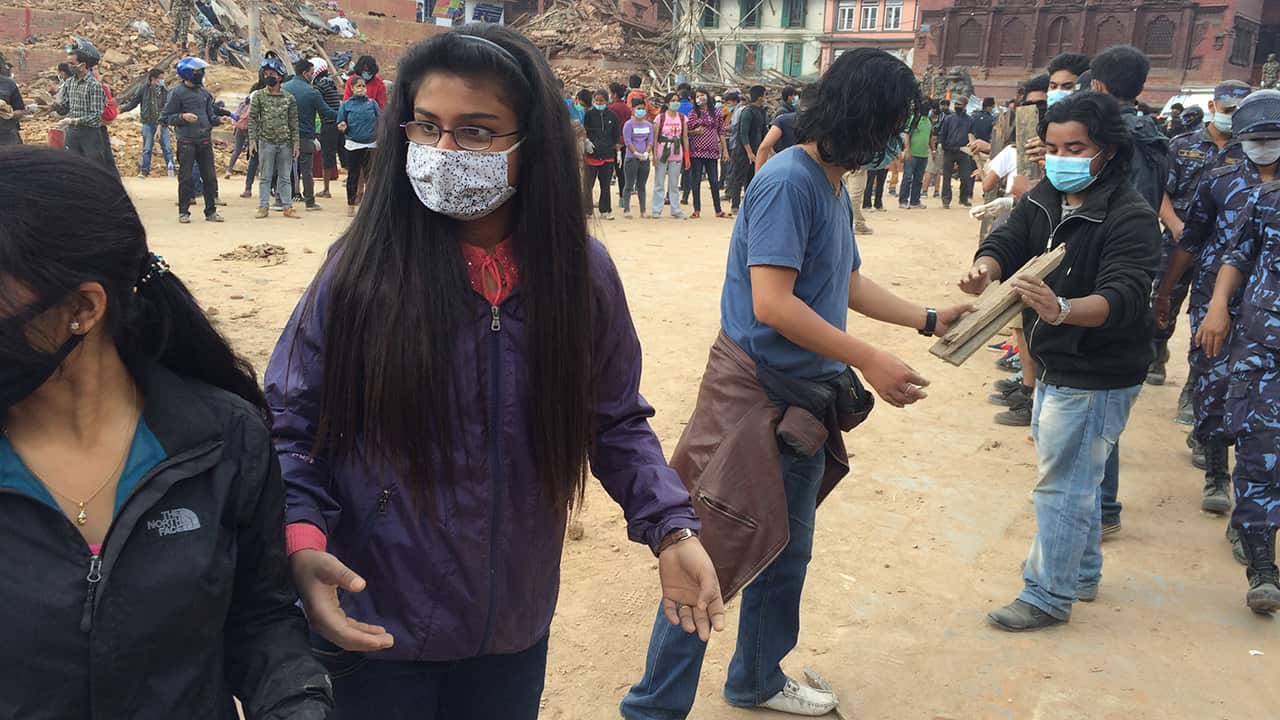
We witness an amazing sight in the Old Town of Kathmandu - a giant human chain of volunteers snaking through the remains of temples. They’re cleaning up the rubble brick by brick, passing them along the line of people. It was impressive and you can see where they’ve been. Slowly, they’re cleaning up the city.
Our local producer comes with us as we film the volunteer effort. Afterwards, he explains he can’t continue working with us because he feels compelled to volunteer and help his people.
His replacement describes the tragedy to us as a disaster so bad it makes him question whether God exists. Most people I meet know someone who died – a brother, a friend, their boss. This disaster has had a profound impact, though the stoicism of the Nepali people masks it – on the surface at least.
Nepal is bigger than Tasmania, but smaller than Victoria. Its population is slightly more than Australia’s, just shy of 28 million. So while small in size – geopolitically it punches above its weight.
It’s sandwiched between super powers China and India. Both giants have a heavy medical and aid presence on the ground... my money’s on strategic motives behind their generosity.
After I file our Dateline story, I’ll be braving Kathmandu airport and its cracked runway, conscious of the luxury of leaving. Most of the people I met here can’t, won’t, leave. They’ll stay and rebuild.
This earthquake’s not the first challenge this country’s overcome and it won’t be the last. In the last few decades, the country’s come through a civil war, a royal coup and the shooting slaughter of the entire royal family.
The qualities that made me fall in love with Nepal still exist. They’re just a bit broken. But this community will put it back together with – or without – the government’s help. Hopefully stronger than ever.
See the story above and click here to find out how to donate to help the people of Nepal.
Follow @MeggiePalmer and see more of her photos in our photo gallery from Nepal.

Dateline is an award-winning Australian, international documentary series airing for over 40 years. Each week Dateline scours the globe to bring you a world of daring stories. Read more about Dateline

Have a story or comment? Contact Us







