ABOVE: Killer whale Lolita has been wowing seaquarium crowds for over 40 years. Revisit the Dateline special on the campaign to free her.
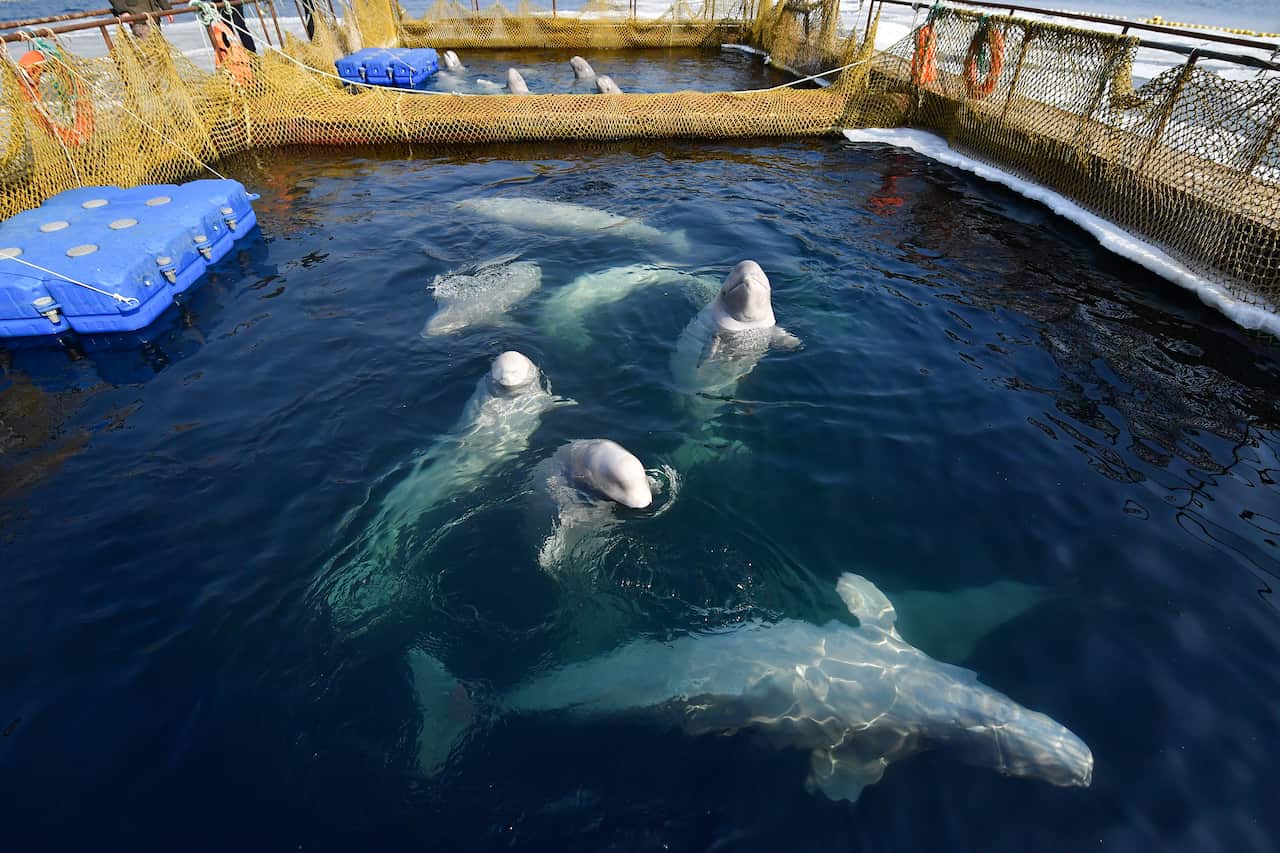
Russia on Thursday started the process of releasing almost 100 valuable orcas and belugas that have been held for months in what became known as the “whale jail” in the country’s Far East, after an international outcry and intervention by President Vladimir Putin.
The movement of the first batch of two orcas and six belugas was first broadcast during Putin’s annual call-in show Thursday, highlighting his role as a modern, televised czar, ready to solve any issue, big or small.
The first eight animals were moved from the watery pens where they were forced to spend almost eight months to water reservoirs installed in trucks. They will spend six days traversing more than 1,100 miles to reach the Shantar Islands in the Sea of Okhotsk, the area where they were caught last year.
This route was not the only option considered by Russian authorities. The initial decision was to release them where they were held in captivity, farther south along Russia’s Pacific coast.
News that makes sense
Your trusted source for staying up-to-date with the world around you. Get free daily news updates and analysis, straight to your inbox.
An international group of scientists and marine mammal specialists, which included Jean-Michel Cousteau of the Ocean Futures Society and Charles Vinick, executive director of the Whale Sanctuary Project, pleaded with the government to choose the more costly option of releasing them in their natural habitat, where they were caught.
The whales were initially captured by four private companies linked to one man. The companies used loopholes in Russian law to obtain permits to catch animals and then sell them to China, where they would spend their lives performing in theme parks.
The companies moved their catch to Srednyaya Bay near the Russian city of Vladivostok, where they were spotted by local environmental activists and journalists, who sounded the alarm.
Putin directed government officials to determine the fate of the mammals; they took custody of the whales and sought the advice of Cousteau and Vinick.
The prices the captive animals would have brought could have surpassed $100 million, Putin said during his call-in program. The companies that held the whales were reluctant to release them, even after he got involved.
“That’s why there are many interested parties and the problem could not get solved easily,” he said. “Wherever big money is involved, it gets difficult to solve things. Thank God a solution was found.”
The whales are going to be released in groups from June until October, the Russian government’s Fisheries and Oceanography Institute said in a statement. They will be monitored by 70 specialists, including veterinary doctors and scientists. Each whale will be accompanied by two people and will be equipped with a GPS tracker before release.
The institute also said that it would be the first time so many captive whales had been returned to the wild, anywhere in the world.
The companies that took the animals will have to pay hefty fines and might face criminal charges. A Russian court ruled that their permits to catch the whales were illegal, and activists say that aside from the validity of the permits, the companies violated legal restrictions on capturing the creatures.
During Putin’s call-in show, officials also reported to him that the government decided to ban catching whales for cultural reasons — the legal pretext that businesses had used for years to capture and then sell the animals.

Dateline is an award-winning Australian, international documentary series airing for over 40 years. Each week Dateline scours the globe to bring you a world of daring stories. Read more about Dateline

Have a story or comment? Contact Us







