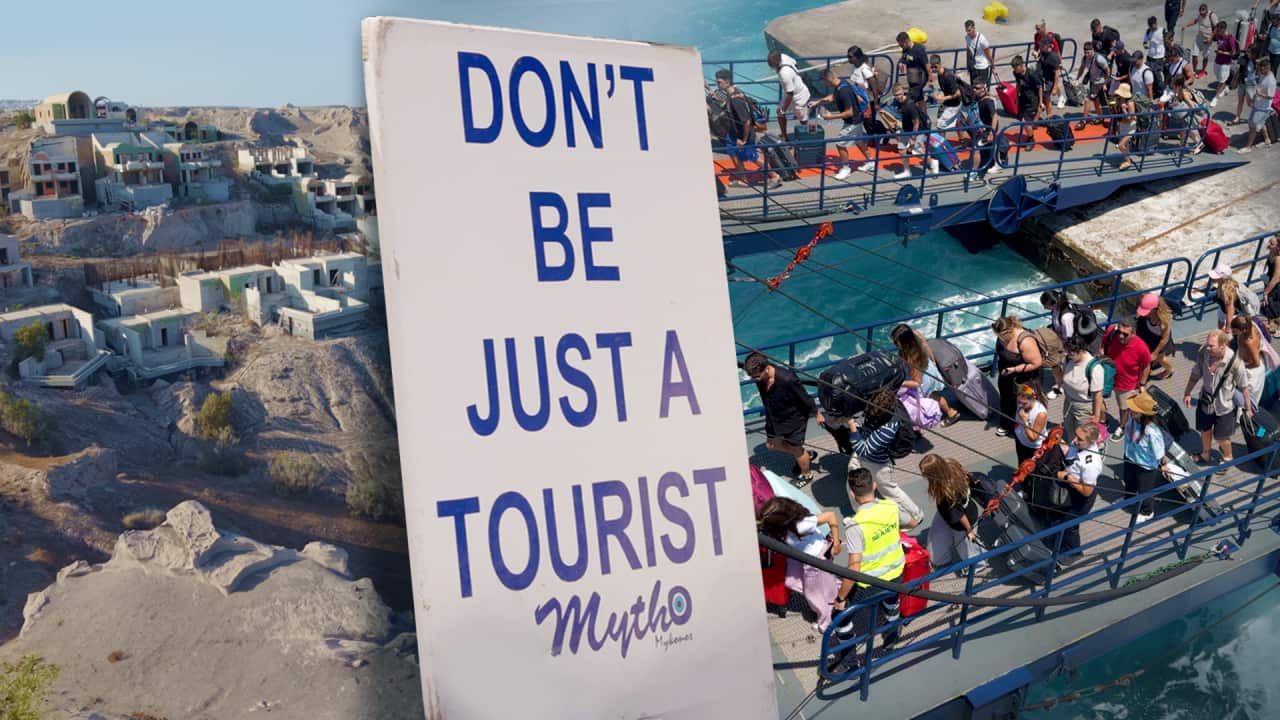
Dateline investigates Greece's overtourism crisis in its latest episode Greek Islands: Built Up And Booked Out. Watch now on SBS On Demand.
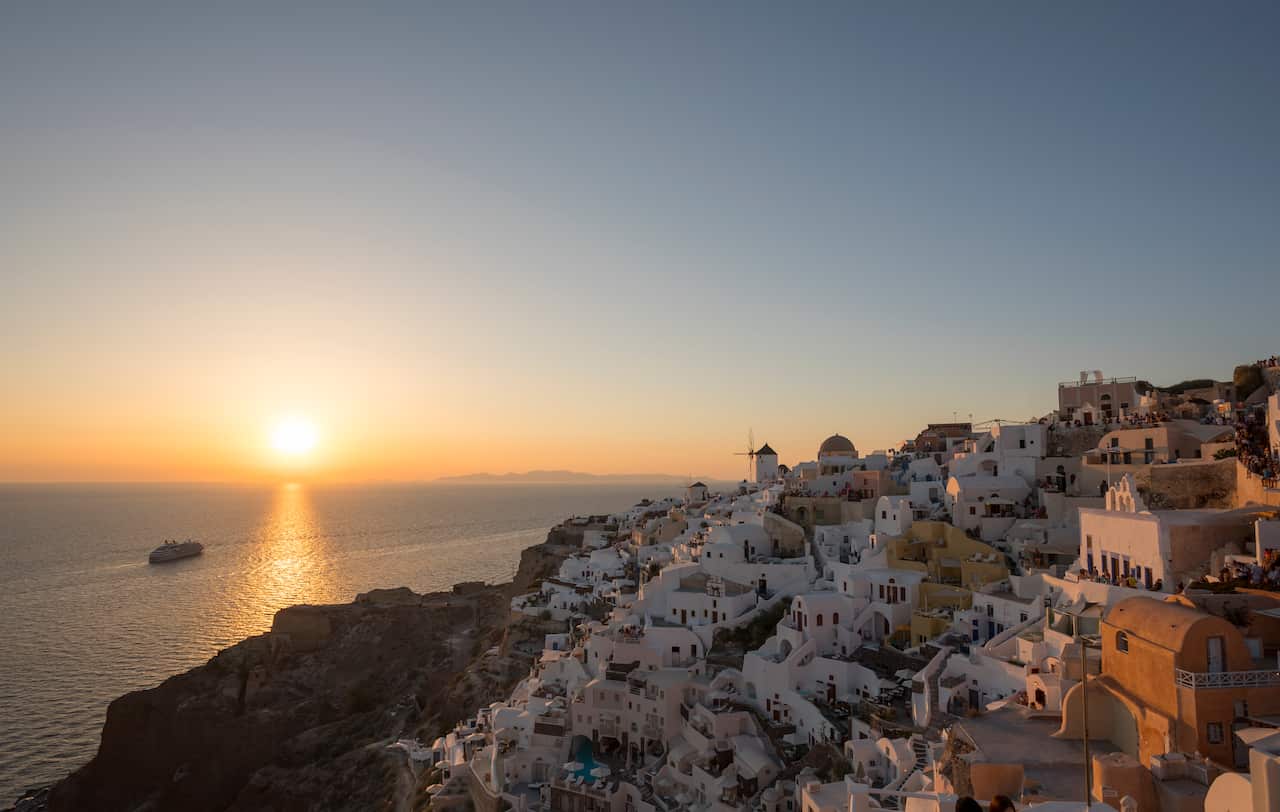
Each day at the height of summer, thousands of tourists pack Santorini's narrow streets, weaving between the postcard-perfect blue domes and whitewashed cliffside homes.
The spectacular views from the cliffside village of Oia has made the Greek island world-famous. Santorini ranks among the most popular Greek islands for Australian travellers.
Tourists stake out the best vantage points to catch a glimpse of Santorini's prized sunset hours before the sun starts to dip into the Aegean Sea. But it's becoming more difficult every summer due to increases in tourist numbers.
News that makes sense
Your trusted source for staying up-to-date with the world around you. Get free daily news updates and analysis, straight to your inbox.
A combination of factors has fuelled the island's tourism surge. Santorini is receiving enormous social media exposure, with the island widely described as one of the world's most 'Instagrammable' islands.
Worldwide campaigns have heavily promoted travel to the Greek Islands, and cruise operators have expanded their Mediterranean itineraries in response to surging demand after the COVID-19 pandemic.
By nightfall, after capturing their sunset snap, many of these travellers will return to one of the three cruise ships anchored offshore. By the next day, a fresh fleet will arrive and unload yet another wave of visitors.
They're among the 37 million international tourists who visited Greece last year, with many travelling to the country's islands.
Greece is also a popular holiday destination for Australians, with more than 300,000 travelling to the country in 2023/2024.
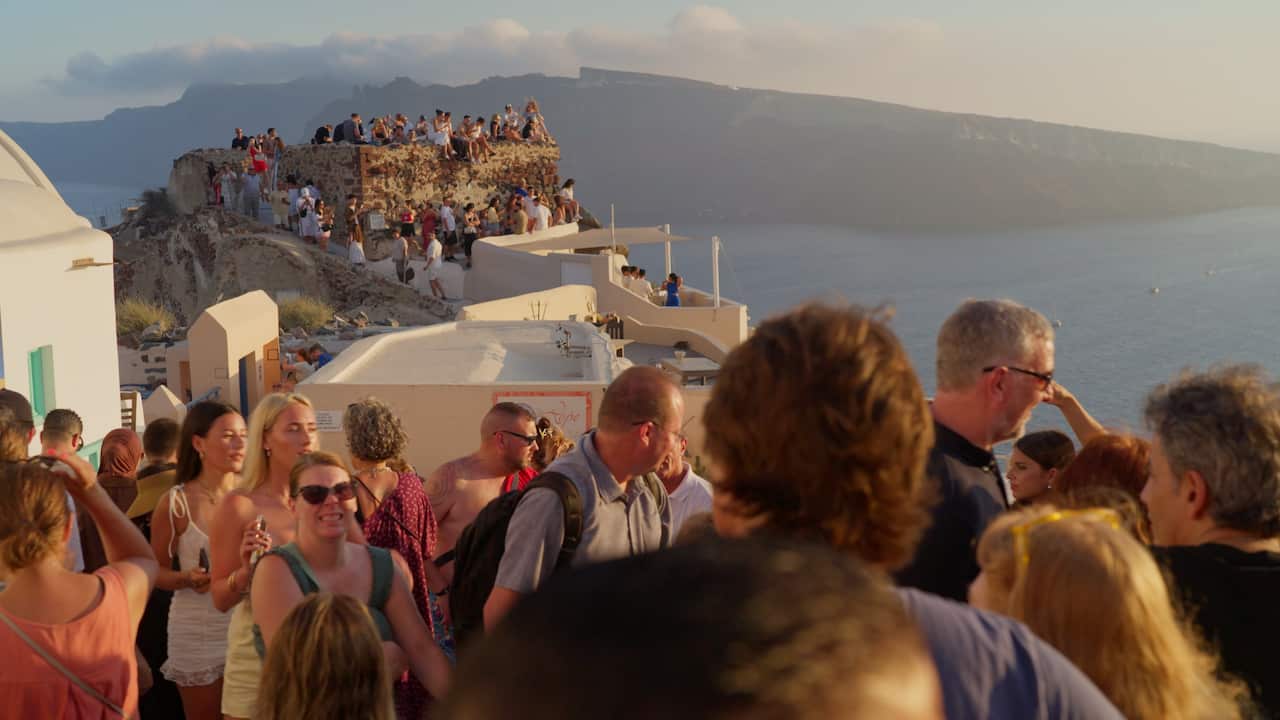
But for Santorini's 16,000 residents, the relentless flow of foreigners — up to 8,000 a day — is changing daily life and pushing the island beyond its limits.
"There are no more open spaces. They were destroyed by the thieves," one local man says.
The 'thieves' he's referring to are developers, who have snapped up land and built sprawling hotels to cash in on the tourism boom.
While tourism has been an economic lifeline for the island's traditional fishing and farming communities, it has also come at heavy price.
A fragile landscape being pushed to its limit
Santorini is one of the driest islands in Greece, with no natural source of drinking water.
Over the centuries, residents survived by carving cisterns into volcanic rock beneath their homes, which collected and stored rainwater underground. But many of those cisterns no longer exist; they have fallen into disrepair or have been converted to luxury cave suites with plunge pools.
Santorini now boasts more than 1,000 pools, and water must often be shipped in to meet demands.
Locals say the strain on the island's water supply is unsustainable, especially in the peak tourist season when demand surges. Yet new construction is still widespread.
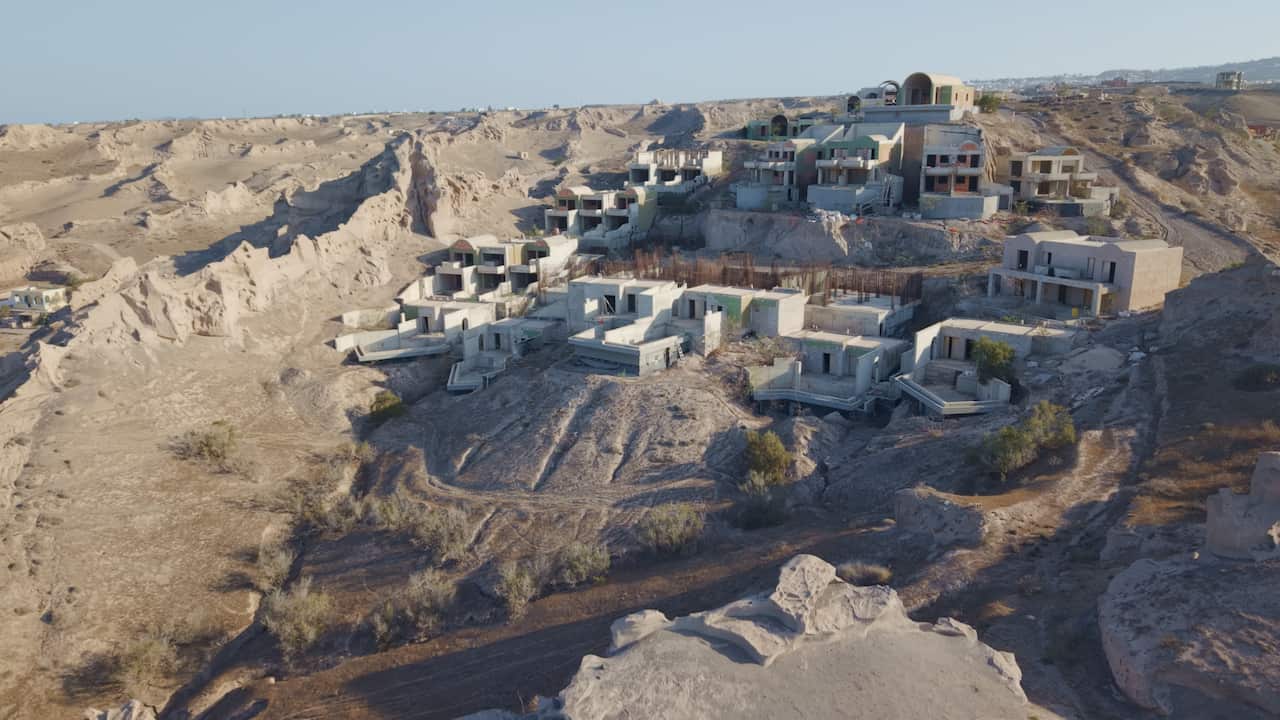
Developers build hotels on steep volcanic slopes where the soil is unstable, despite Greece being one of the world's most earthquake-prone countries.
Early last year, a wave of intense earthquakes rocked Santorini, triggering evacuations and renewing fears about overdevelopment. Scientists recorded 28,000 tremors in just a few weeks. Even minor tremors can trigger dangerous rockfalls.
Environmentalist Karolina Rakaki says the pressure on the island is 'unbearable'. She's lobbying to halt new construction projects. But she's up against powerful players.
"Many court cases in Greece are not decided according to who has the better arguments, but according to how powerful the opponent is," Rakaki says.
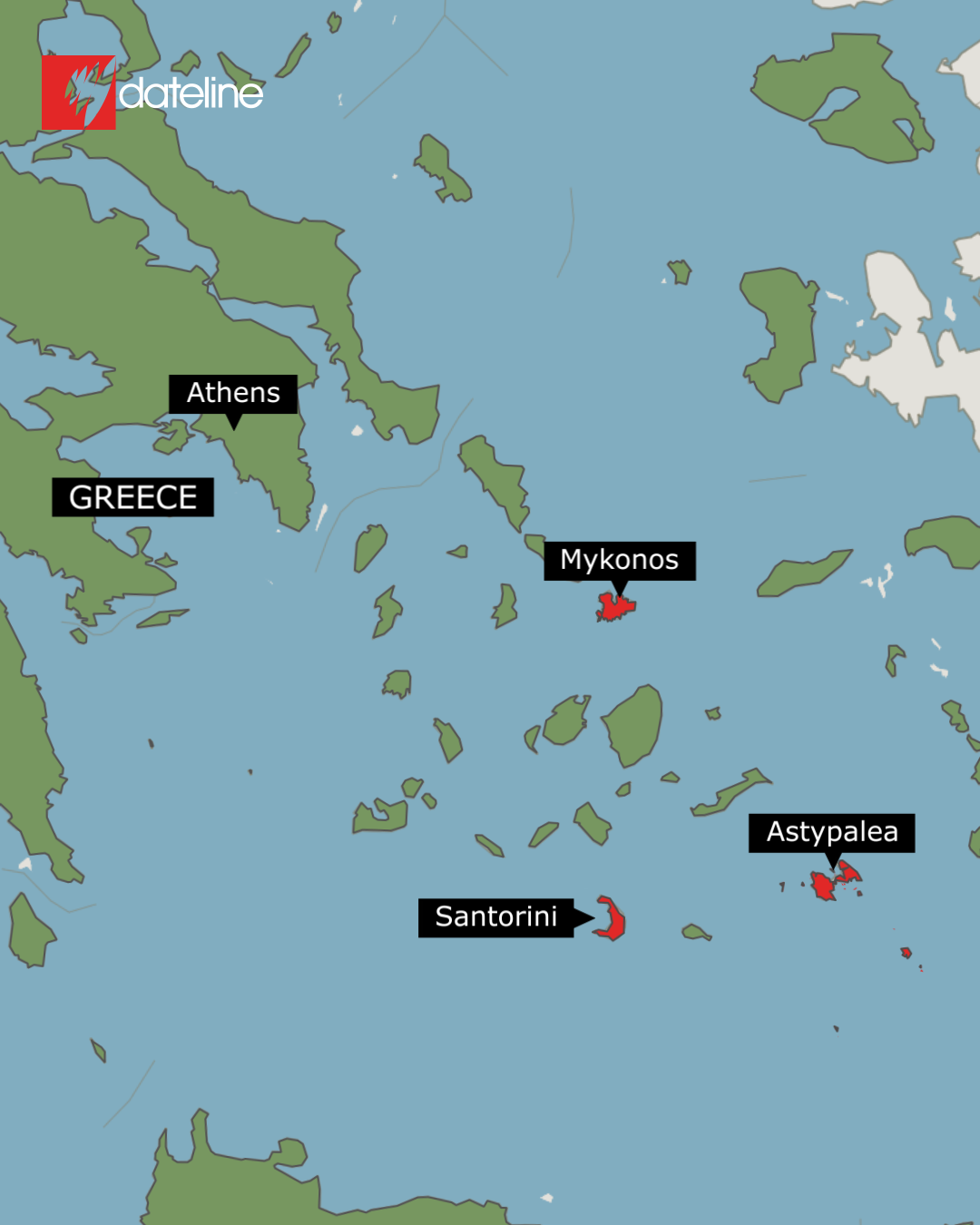
It's not just Santorini feeling the pressure. Similar tensions are unfolding between locals and developers in nearby Mykonos.
Allegations of corruption and illegal development
Mykonos has earned a reputation as a playground for the rich and famous.
Photographer Petros Nazos snaps celebrities partying at the island's exclusive clubs, where tables can cost up to €10,000 ($16,000) a night.
Tourism is big business. But a web of illegal construction and property sales linked to organised crime has flourished alongside it.
"We're here on an island where very rich people come. They have their own interests," Nazos says.
"There are practically no laws anymore. Everyone does what they want here, and that's our downfall."
Several police officers have also been arrested for corruption, as authorities try to crack down on illegal building and crime.
Mykonos mayor Christos Veronis insists anti-corruption efforts, including extra police, have improved the situation.
"Mykonos has changed. Now there are no more black limousines with thugs driving around the island," he says.
People accused of building without permits can face demolition orders and hefty fines. Yet many illegal structures are still standing, as local authorities look to others for enforcement.
Veronis says the central government is responsible for demolishing unauthorised buildings, while officials in Athens say it's the job of island authorities.
"They can't simply pass on such serious decisions to the local authorities," Veronis says.
"To tear something down, I have to be a faceless, anonymous state. I can't do that as a small mayor. It's complicated. The government could do it, but it doesn't."
The island doing things differently
Not every Greek island is following the same path.
On the remote island of Astypalea, tourism is low-key. That's exactly how business owner Konstantina Giannarou wants it to stay.
Astypalea has no international airport and cruise ships can't dock there. There's also no direct ferry.
Last year, 70,000 tourists made the long boat journey to Astypalea. It's only a fraction of the numbers flooding into hotspots like Mykonos.
Giannarou runs a small hotel with her mother. She says the travellers who visit Astypalea are searching for an authentic, homely experience.
"I don't want us to have tourists who come here and party, drinking until the morning and all that like on other islands," she says.
"A souvlaki in Mykonos costs €17 and here it costs €3.50… I would like us to stay the way we are."
But the threat of development looms over the peaceful island.
Astypalea mayor, Nikolaos Komineas, says local authorities are trying to protect the island from overtourism, and have managed to halt a 200-house development.
Walking through rocky hillsides dotted with wild thyme plants, he proudly points to the bees buzzing around them in abundance. They produce the island's renowned honey.
"We try to preserve agriculture and animal husbandry, our old traditions," Komineas explains.
"This is our true island life. It has to stay the way it is, forever."
His approach is in stark contrast to popular islands like Mykonos and Santorini. Though it's been decades since tourism took off, authorities are only now trying to rein in visitor numbers. Daily cruise ship passengers, which would surge to as many as 17,000 on peak days, are now capped at 8,000 in Mykonos and Santorini. Tourists also have to pay a €20 ($32) tax to step foot on the islands.
But still, the pressures brought on by tourism show no signs of easing. Greece has just posted its third consecutive year of record-breaking tourist arrivals, with international arrivals increasing 5 per cent between 2024 and 2025
Greece's popularity leaves Astypalea's residents grappling with the dilemma of how to welcome tourists without sacrificing the island's culture and environment.
"We want tourism," Komineas says. But not if it "upsets the balance of the island and ruins everything".
Watch your favourite Dateline episodes around the clock on SBS On Demand's dedicated Dateline channel. For the latest from SBS News, download our app and subscribe to our newsletter.

Dateline is an award-winning Australian, international documentary series airing for over 40 years. Each week Dateline scours the globe to bring you a world of daring stories. Read more about Dateline

Have a story or comment? Contact Us







