This audio is voiced by AI and may occasionally mispronounce words.
Share your feedback and help us improve this feature. Read more about how we use AI at SBS here.
It was once a dream of many: work hard and retire in your 60s. Now, more Australians are employed into their 70s, 80s and even 90s. Insight meets those still working by choice, those who can't afford to stop, and asks what happens when you keep working later in life? Watch Insight episode Working Later in Life Tuesday 8.30pm on SBS or SBS On Demand.
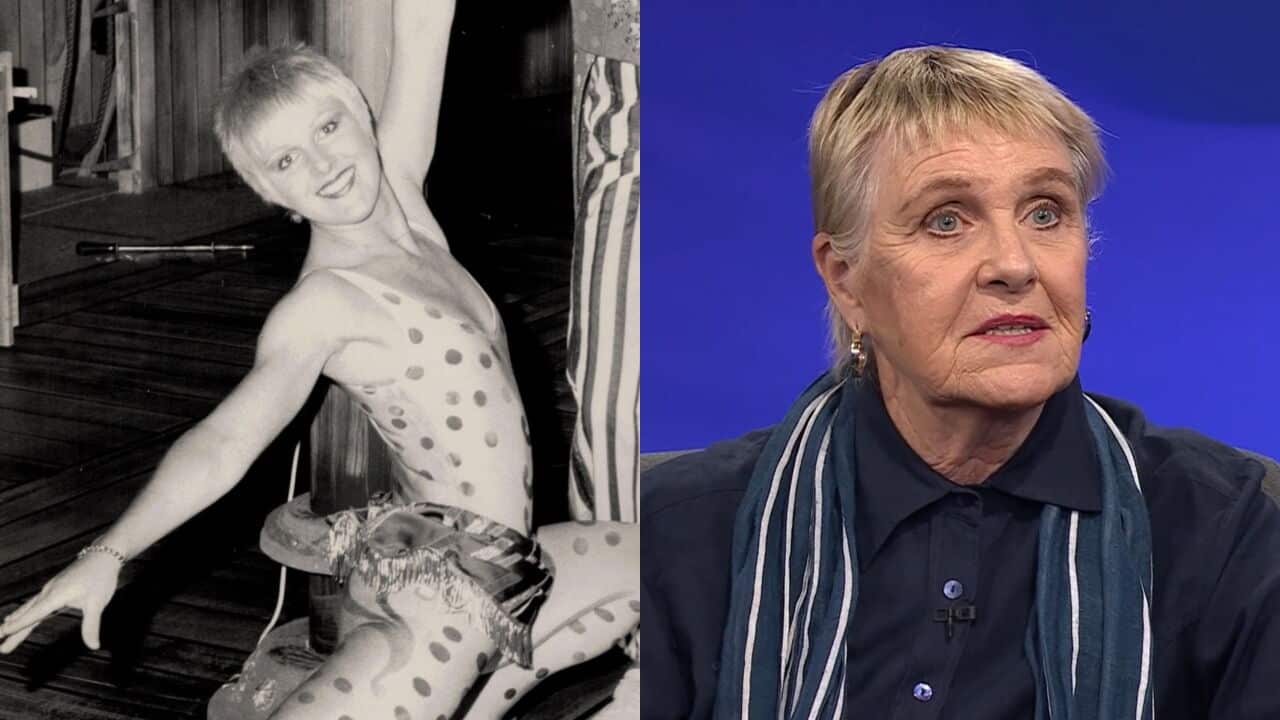
Keiri Easdown retired as a professional dancer at the age of 45 when the work became too physically demanding. She never imagined that nearly three decades on, she would have tried four more careers and still be working.
"It was a rude shock really — having to do something like give up dancing," she tells Insight. "That was who I was; it was my life."
News that makes sense
Your trusted source for staying up-to-date with the world around you. Get free daily news updates and analysis, straight to your inbox.
Leaving a physically demanding career — and one that also didn't allow her to save much money — the single mum had to retrain to earn a living and support her two children.
"Whatever I earned pretty much went out of the house; it paid the rent, it paid the bills for my children."
Since leaving behind her dance career, the 73-year-old has pivoted careers upwards of four times.
She's been an entertainment director at Gold Coast theme park Dreamworld, did some time in retail and corporate for a whitegoods company, and worked as a cleaner, before that became too physically taxing in her mid-60s.
On average, Australians plan to retire between their 65th and 66th birthdays, according to data released in 2024 by the Australian Bureau of Statistics (ABS).
But Keiri, who has been working as a teacher aide at the school her daughter and son-in-law teach at since her late 60s, says she needs to keep working.
"The money is absolutely critical," she says.
"I have very little in superannuation. As a dancer, we didn't earn much. We lived hand to mouth."
Women are working later
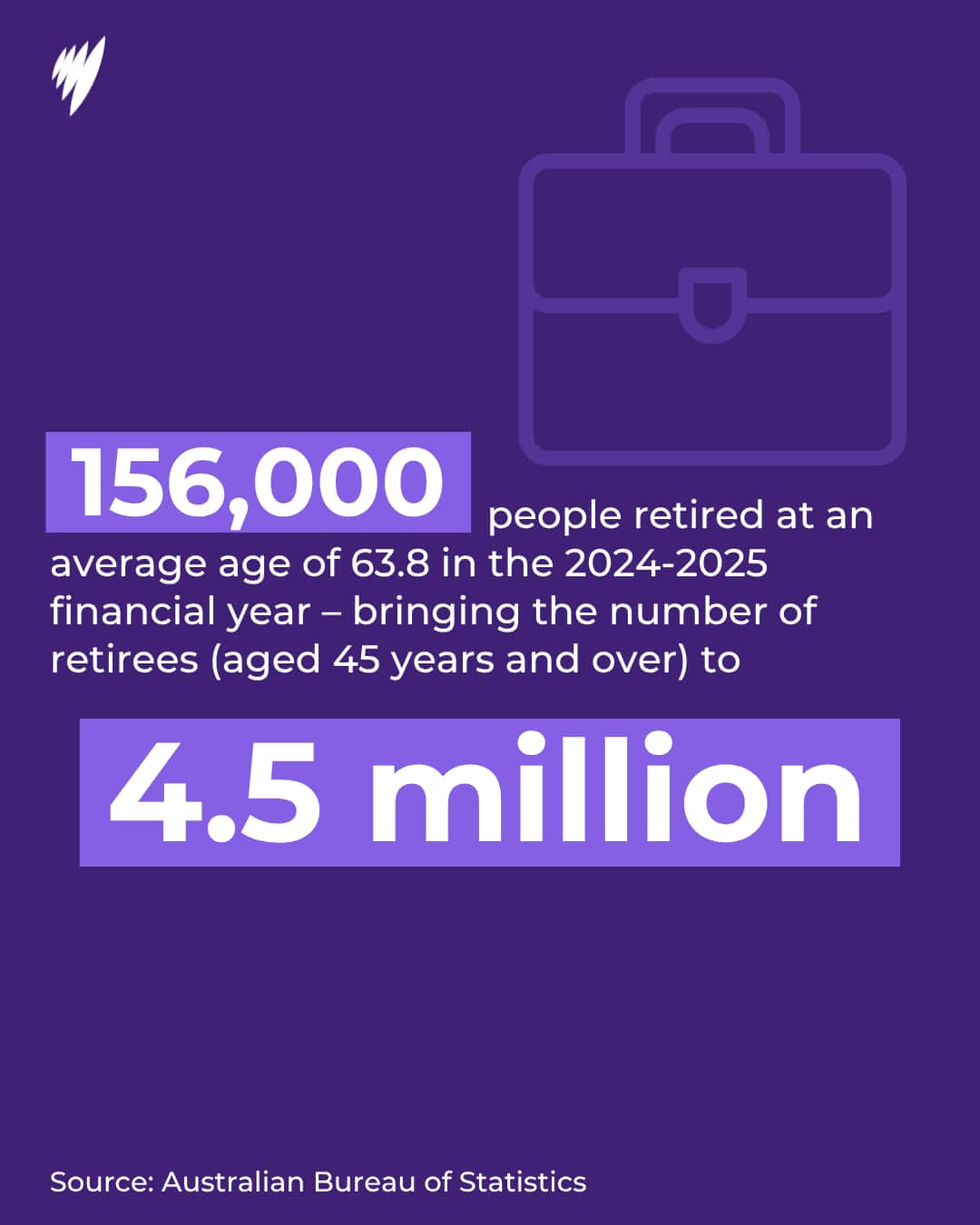
The average age of the 156,000 people who retired in the 2024-2025 financial year was 63.8, according to the ABS. Their exit from the workforce brought the nation's total number of retirees (aged 45 years and over) to 4.5 million.
The 2025 Household, Income and Labour Dynamics in Australia (HILDA) survey conducted by the University of Melbourne's Melbourne Institute found that, even though women are still retiring slightly earlier than men (a year on average), they are staying in the workforce longer than they once did.
In 2003, 69.5 per cent of women and 48.5 per cent of men in the 60-64 age group were retired. Twenty years later, these figures had dropped to 40.8 per cent and 27.4 per cent, respectively.
The research also found that, with comparatively lower superannuation than men, women were more likely to need to remain in the workforce longer to achieve financial security for retirement.
A sliding scale for the age pension?
Gary Thomas, a 57-year-old electrician, would love to retire soon but says he needs to keep working for financial security — despite his body being "worn".
He has considered a less physical role but says he can't afford to make the switch; he and his wife have a mortgage and want to help their three sons get into the housing market.
"People often recommend: 'Oh, you can work at a hardware store.' But I'd make a third of what I make now, and they'd give me maybe 25 hours a week," he says.
Gary doesn't see himself retiring soon but wishes he could be retrained.
"It would be good if we had [government] training programs — options where people could retrain to do something else," he says.
The electrician, who is based in Kangaroo Valley in regional NSW, thinks the government should introduce ways to assist those wanting to retire before 67, which is when someone can become eligible for the age pension.
"Maybe there could be a sort of a sliding scale.
"[For example], I can't work six days a week anymore so I've slowed down to five, but maybe I could slow down to three. I could work longer, but I could get a partial pension or partially tap into my superannuation now — as opposed to having to wait."
Workplace longevity
The age pension is the most common main source of income for Australian retirees, according to a 2025 ABS report.
Jo Earl, honorary professor of psychology at UNSW, has spent the last 20 years studying what helps improve people's retirement planning and predict the adjustments they may have to make to these plans.
She suggests the pension eligibility age, which rose from 65 to 67 in 2023, is a reason that some people continue working later. She also supports lowering the pension age for blue-collar workers.
"I think we've heard good arguments for making the pension relatable back to workplace longevity."
"While we're waiting for that to happen, people are trying to do workarounds. They're working part-time, or they're reducing their hours, or the work's being adjusted, or there's job redesign and that helps to a certain extent."
She says retraining later in life is a good option for many — especially if they can do it before their planned retirement date.
"We often start looking at those retraining options in the face of poor health; so, I'd be in favour of doing that retraining much earlier in anticipation," Earl says.
"Maybe starting 10 years back from that potential retirement date, because we must know from the data that we've got, about when people are leaving those workplaces for physical and psychological reasons."
'Why should I retire?'
Dougall Blanch, 70, is still working and has a fear of retiring, which he believes comes from his parents dying around what was typically considered 'retirement age'.
"My father had to retire at 60 and died at 59 and 11 months. And then my mother had to retire at 65, and she died one month before mandatory retirement.
"I'm scarred by it all — I just was scared of retirement."

Dougall and his wife Di, who live in regional NSW, opened their first confectionery shop specialising in fudge four decades ago.
"It was seven days a week, nine till five. And then on weekends you would do nine till 9.30pm, 10 o'clock; and then school holidays, would do nine till 10 o'clock at night," he says.
Finding the long hours too taxing while raising their three children, they sold their shop and created a fudge franchise around Australia and New Zealand. The couple then opened another shop in 2012, which grew to have fourteen staff and the same long hours.
Dougall says it all became too much, and he figured out he needed to retire to something, not from something. He soon stumbled across the answer.
"A food trailer — I'm selling fudge from a van now about three days a week," he says.
I’m fit and healthy and I actually love what I do, so why should I retire?Dougall
Dougall feels he's left the fast lane he was in for 50 years and is now in the middle lane: the semi-retirement lane.
"I'm happy as happy now. I've found my place ...
"I'm fit and healthy and I actually love what I do, so why should I retire?"
Staying 'relevant'
Like Dougall, Susan Goodsell planned to take a bit of a step back from work, but is finding it hard.
"Every Christmas I make the same pledge: I will not be practising after this," the 77-year-old lawyer says.
"Every new year, I'm still at the desk."
She has been running her Sydney legal practice for more than four decades, and she asked her daughter Kara Goodsell to join the practice 15 years ago.
She initially wanted Kara to step up so she could take a step back from the business but has found it difficult to release her clients to her daughter.
"I get very attached to my clients — probably too much — but it keeps me occupied and ... doing something that I really like doing."
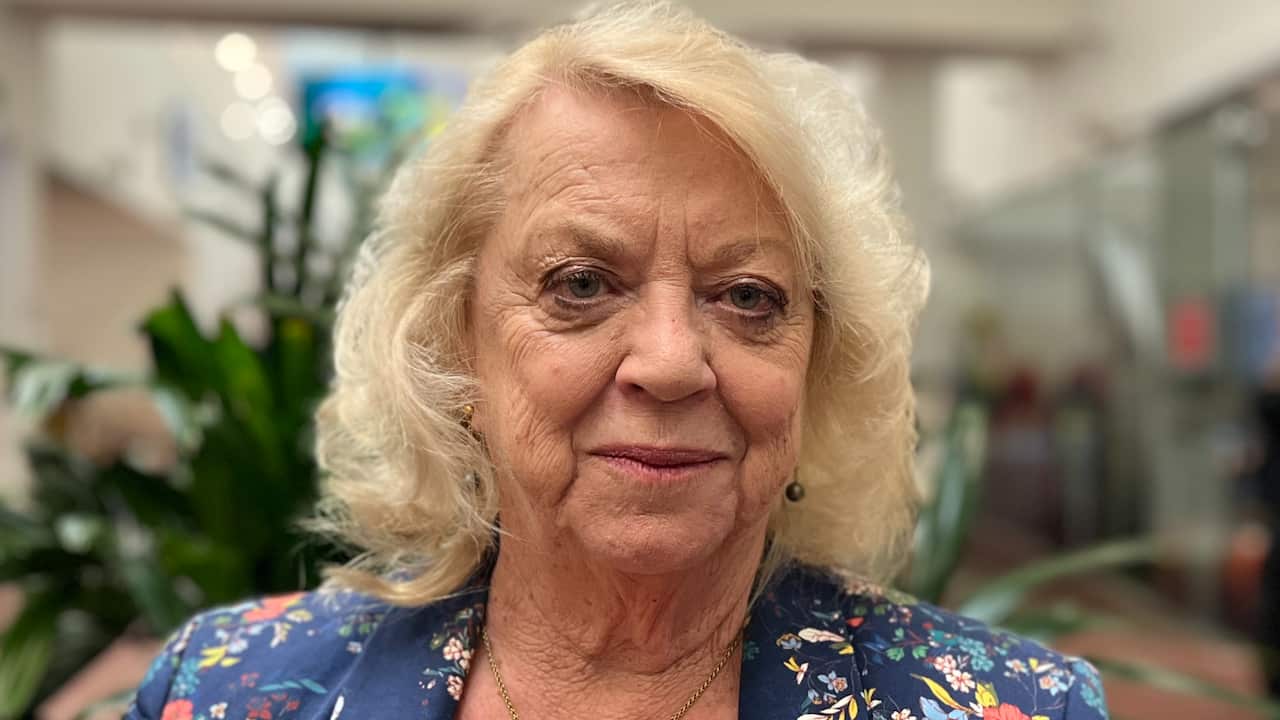
Kara, 55, loves that her mum still works and sees it as "mutually beneficial".
"[Mum] gets the benefits of mental activity and the agility; she stays relevant; she stays needed ... She's put the humanity over the business side of things."
"For me, I get the benefit of her wisdom, her 45 years in practice ... her steadiness and her direction, as well as her clients — I get the financial benefit of that as well."
Susan believes there is a "lot of truth" to the adage "as you age, you become invisible".
"And for me, to stay working allows me to hold on to my individuality and my connection with society in general."
'I have to be earning money to feel worthwhile'
Like Susan, Keiri loves her work. At 73 years old, she has found purpose and joy as a teacher aide in her fifth career pivot.
"I work with students with special needs and I feel like I'm making a difference," she says.
"Without teacher aides, a lot of the teachers would struggle to be able to teach ... The more I work, the more I realise I enjoy it; it's good for my soul."
Keiri is trying to save as much as she can before retiring for good and is unsure whether she will access the age pension.
But apart from the financial aspect, there's another reason Keiri doesn't see herself stopping work anytime soon.
"I have to be earning money to feel worthwhile to myself.
"It is just who I am."
Watch your favourite Insight episodes around the clock on SBS On Demand's dedicated Insight channel. For the latest from SBS News, download our app and subscribe to our newsletter.

Insight is Australia's leading forum for debate and powerful first-person stories offering a unique perspective on the way we live. Read more about Insight

Have a story or comment? Contact Us







