That's a wrap on today's coverage
Thanks for following our coverage of the RBA's unanimous decision to keep interest rates on hold at 4.35 per cent.
While it was an expected move, there are still risks for the board to navigate. Here are the key takeaways from today's decision:
- The RBA has signalled that inflation could remain high "for some time", predicting it will remain above target until mid-2027
- In a statement, the board highlighted the need to stop inflation from becoming "embedded" above the 2-3 per cent target range
- Treasurer Jim Chalmers said the interest rate hold is positive news but has acknowledged there's "more work to do"
- Compare the Market's economic director David Koch said the hold is the "right decision" as Australians deal with "a lot of stress out there"
- Earlier in the day, Domain's chief economist Nicola Powell said a pause may provide some reassurance for homeowners and buyers, but it will do little to shift the broader housing market.
- The RBA next meets in September, when it will again either hold or change the cash rate target
- Australia's major banks are predicting rates will hold until next year, but the board has warned it will increase rates "if upside risks materialise"
We're closing the blog here for today.
For more analysis on Australia's interest rates, you can read more here:
— Cameron Carr
'A lot of stress out there': Experts weigh in on decision
Compare the Market’s economic director David Koch said the hold is the "right decision" as Australians deal with "a lot of stress out there".
"Inflation is still rising at a greater rate than the Reserve Bank would like, but it’s being driven by factors beyond the control of Australian households, who are still facing a massive cost-of-living crisis," he said in a statement.
"And then you layer on that, their biggest asset — property prices — are recently starting to come down and there’s a lot of stress out there."
KPMG Australia chief economist Brendan Rynne said that drops in property prices could also reduce inflation.
"It certainly going to help, because there's an idea of the wealth effect — as we feel like our house[s] are starting to decline that we feel less wealthy and consume less," he told ABC News Channel.
— Cameron Carr
A 'welcome decision' but 'more work to do', treasurer says
Treasurer Jim Chalmers says the interest rate hold is positive news but has acknowledged there's "more work to do".
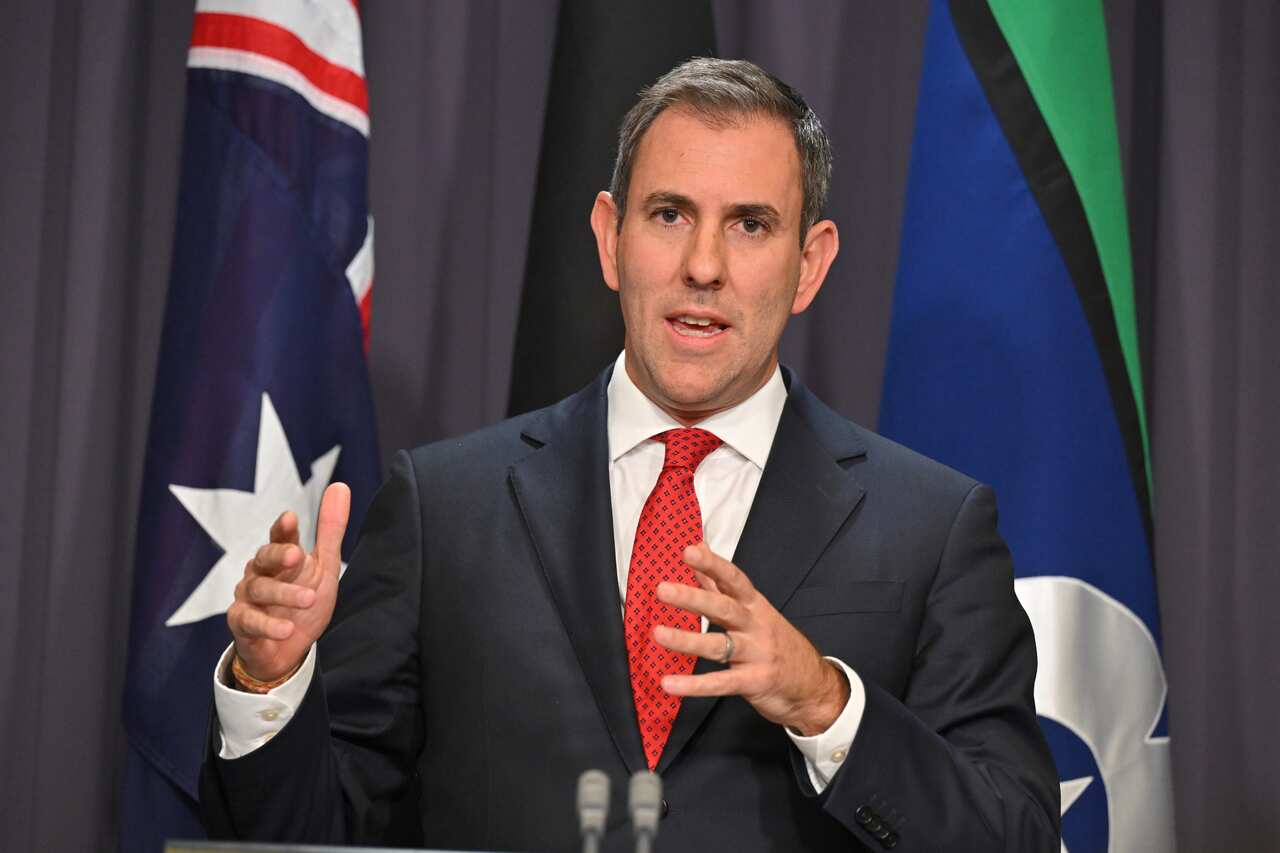
"This will come as a relief to Australians with a mortgage," he said in a post on social media after the decision was announced.
"It’s a welcome decision at a time of heightened uncertainty in the world and persistent pressures at home.
"We've made progress on inflation and in the economy, but there's more work to do because people are still under pressure."
— Cameron Carr
Signs consumer spending growth gradually slowing, RBA says
The RBA board has also weighed in on other financial conditions, beyond inflation, that contributed to its decision.
It noted that consumer spending growth is gradually slowing "as expected", while growth in business debt and investment remains strong.
"Momentum in the housing market has shifted, with housing prices falling in some capital cities and new housing loans declining noticeably," its statement on monetary policy reads.
"Labour market conditions have eased by a little more than expected in recent months. Labour market leading indicators point to only limited easing in the near term."
— Cameron Carr
Rate rises are possible if 'risks materialise', board says
The RBA board predicts that inflation will remain above 2.5 per cent — the midpoint of its 2-3 per cent target range — until mid-2027.
"There continue to be heightened uncertainties about the outlook for domestic economic activity and inflation," it said in its decision statement.
Resolution of the Middle East conflict remains uncertain, the board said, and there are scenarios in which inflation is higher and activity lower than forecast.
"The Board will continue to do what it considers necessary to bring inflation sustainably back to target, including increasing the cash rate target further if upside risks materialise," it says.
— Cameron Carr
RBA says it's focused on ensuring high inflation doesn't become 'embedded'
The RBA has signalled that inflation could remain high "for some time", with disruptions to global oil supply directly contributing and indications higher fuel prices are passing on to the price of other goods and services.
"The Board remains focused on ensuring that high inflation does not become embedded," it said in its board statement announcing the decision to leave the cash rate on hold.
"While the impact of the Middle East conflict on inflation has so far been less than expected, headline inflation is still too high.
"Trimmed mean inflation also remains elevated and is little changed from the March quarter."
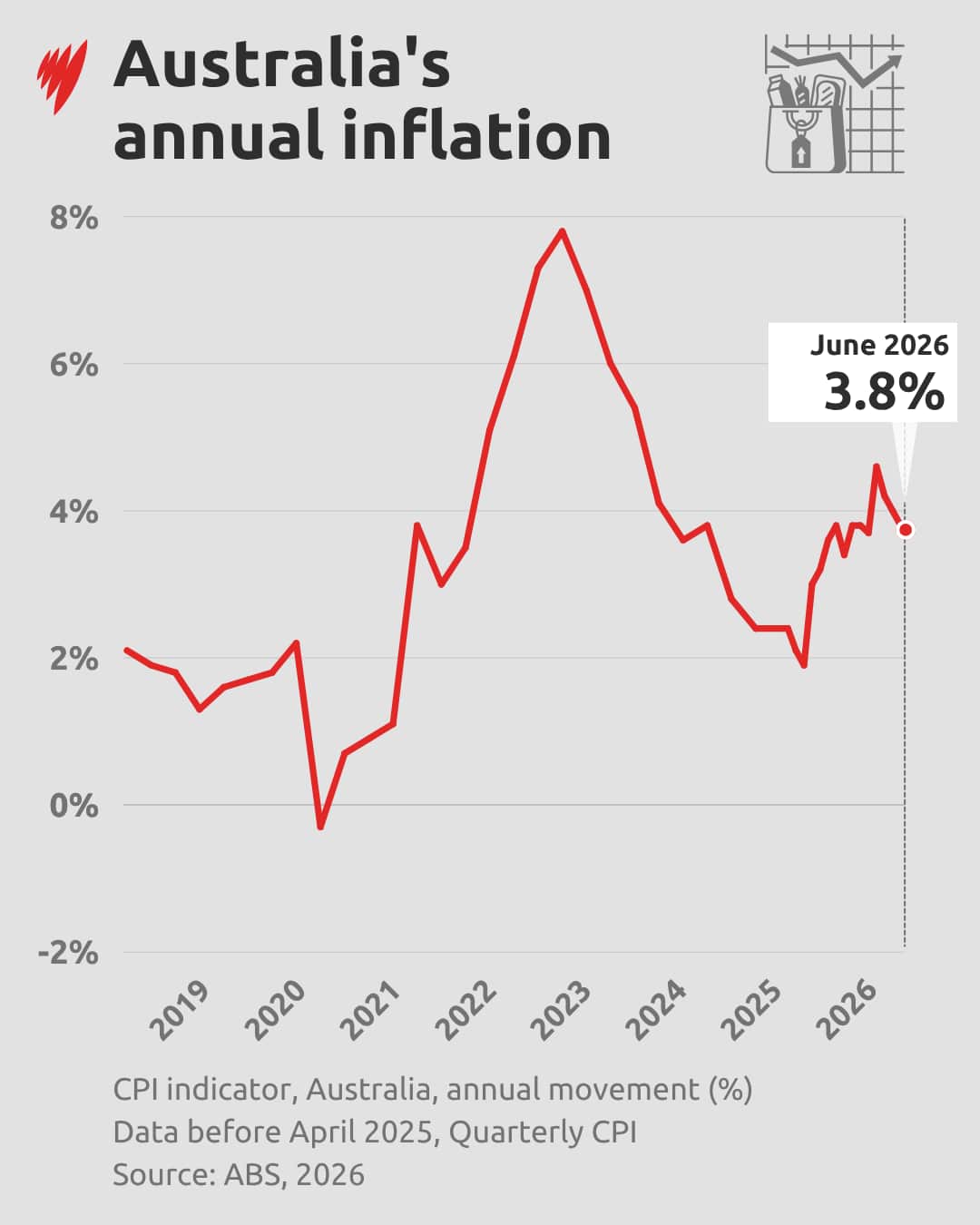
Headline inflation, also called the consumer price index, sits at 3.8 per cent, and the trimmed mean at 3.6 per cent.
— Cameron Carr
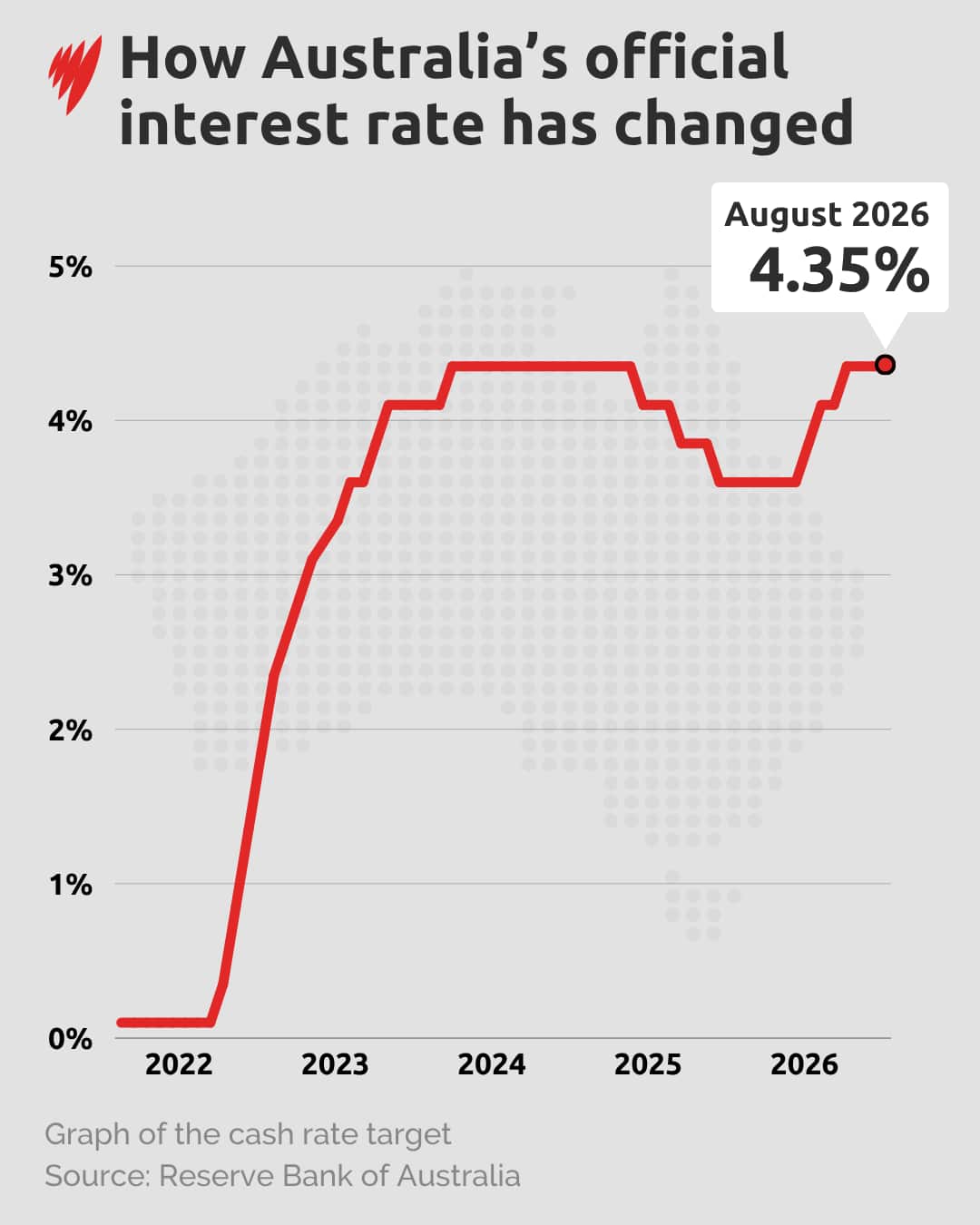
RBA holds cash rate steady at 4.35 per cent
The Reserve Bank of Australia (RBA) has handed down its interest rate decision.
The board left the cash rate on hold at 4.35 per cent, as was widely forecast by economists.
Analysts will be scrutinising the board's statement closely for signals on where rates could be headed in the coming months.
— Josie Harvey
RBA 'shadow board' recommends cash rate hold
The RBA 'shadow board' — an independent group of Australian economists — has recommended the cash rate target remain at 4.35 per cent, acknowledging a "difficult economic backdrop".
The body, hosted by the Australian National University, is not affiliated with the RBA and offers its own policy recommendations a day before the official RBA decision.
"The RBA Shadow Board once again recommends the cash rate be kept on hold, attaching a 58 per cent probability that this is the optimal decision," the group writes.
"The global outlook remains unusually vulnerable to geopolitical and energy-market developments."
— Cameron Carr
What's considered a good interest rate right now?
According to Canstar analysis, the estimated average variable rate for an owner-occupier loan is currently 6.26 per cent, while the lowest variable rate out there is 5.69 per cent.
There are 49 lenders with at least one variable rate under 6 per cent, according to the consumer comparison platform. That's up from 38 lenders at the start of June.
The increase in the number of lenders with variable rates under 6 per cent comes after dozens of lenders cut new customer variable rates since the start of June.
Canstar estimates that an owner-occupier who took out a mortgage five years ago and has never renegotiated their rate is likely to be paying nearly 7 per cent.
Its data insights director, Sally Tindall, said borrowers are "in a stronger position than they have been in some time".
"If you haven't reviewed your home loan in a few years, check what rate your bank is offering new customers. If it's lower, use this as the push to ask for a rate review or look for a sharper rate elsewhere," she said.
— Josie Harvey
Three factors shaping today's interest rates decision
Inflation, unemployment and household spending are three key economic indicators shaping today's RBA decision.
Data from the Australian Bureau of Statistics (ABS) showed a shift in inflation in June.
Headline inflation fell from 4 per cent to 3.8 per cent while the trimmed mean, which strips out volatile items, remained steady at 3.6 per cent.
The unemployment rate was 4.4 per cent, down from 4.5 per cent in April.
As for household spending, this gives the RBA a sense of the average Australian's disposable income after their mortgage repayments.
In June, household spending rose 0.8 per cent month-on-month.
But Sally Tindall, data insights director at Canstar, warned this dataset can be "volatile".
"It's difficult to isolate in this data the families that are doing it incredibly tough versus the ones that aren't really sweating from the economic pressures at the moment," she said.
Read more here:
— Josie Harvey, Cameron Carr
What would a rate hold mean for the housing market?
If the RBA holds the cash rate steady, it may provide some reassurance for homeowners and buyers, but it will do little to shift the broader housing market, according to Domain's chief economist Nicola Powell.
"A hold may remove some uncertainty, but it doesn't change the factors shaping housing market conditions," she said.
"Affordability remains stretched, buyers are cautious and rising supply is becoming increasingly influential."
While inflation remains above target, Powell said a second consecutive hold would suggest the Reserve Bank is becoming more confident that inflation is moving in the right direction.
"Our view remains that the balance of risks has shifted away from further rate rises and towards an extended period of stability, with the first cash rate cut not expected until mid-2027," she said.
— Josie Harvey
Total listings reach seven-year high across Australian capital cities
Total housing supply across the combined capital cities has reached a seven-year high, as buyers gain leverage and sellers face increasingly competitive conditions.
That's according to Domain's July market insights report.
The report found that new listings hit a record July high, as more sellers brought homes to market, and homes are taking longer to sell, indicating buyers have more choice and negotiating power.
It noted that distressed listings remain historically low, suggesting the softer market conditions are not being driven by forced selling, but rather weaker demand.
The Adelaide and Perth markets have been more resilient due to strong demand, but Sydney, Brisbane and Canberra are shifting towards more buyer-friendly conditions.
— Josie Harvey
ANZ forecasts Sydney house prices to fall 14.5 per cent
ANZ has significantly downgraded its housing outlook, forecasting Sydney house prices could fall 14.5 per cent from peak to trough as the downturn extends into next year.
The big four bank now expects capital city prices to fall 4.3 per cent this year and a further 3.4 per cent in 2027, up from its previous forecasts of 2.1 per cent and 3.3 per cent respectively.
ANZ economists Madeline Dunk and Adam Boynton told the Australian Financial Review that the market had softened more than expected since their June forecast, with falls in Sydney and Melbourne accelerating and weakness spreading to Brisbane and Perth.
They pointed to restrictive interest rates, recent tax policy changes and global uncertainty as factors weighing on market sentiment.
Melbourne prices are forecast to fall 12.8 per cent from peak to trough, while Adelaide, Brisbane and Perth are expected to decline by 9.8 per cent, 7.9 per cent and 5.2 per cent respectively.
ANZ expects the housing downturn to be temporary, with prices forecast to begin recovering in the second half of 2027 as interest rates fall.
Capital city dwelling prices are forecast to rise 4.3 per cent in 2028, supported by an expected 50 percentage points of RBA rate cuts.
— Mikele Syron
How much would another rate hike cut borrowing power?
Repeated RBA rate hikes have slashed the borrowing power of individual Australians by $35,400 since January, according to Canstar data.
If Australians are subject to another rate hike, the total reduction in borrowing power since the start of the year would increase to $46,300 per person and $92,500 per couple.
While house prices have slumped, the fall in borrowing power is creating a new barrier for some aspiring homeowners.
"While falling property prices may look like a win for people trying to get into the market, higher interest rates are keeping borrowing budgets in a bind," Canstar's data insights director, Sally Tindall, said.
— Rachael Knowles, Josie Harvey
The potential alternative to raising interest rates
As the RBA prepares to make its latest interest rate decision, economists are debating whether there could be another way to cool spending without increasing mortgage costs.
One proposal is to temporarily increase compulsory superannuation contributions, directing more of workers' wages into retirement savings and reducing the amount available to spend.
Economist Chris Richardson says Australia relies heavily on interest rates to fight inflation, which can place a disproportionate burden on borrowers.
Economist Saul Eslake also sees merit in the idea.
"If people's super contributions are raised temporarily as an alternative to increasing interest rates, they'll have less disposable income for as long as that applies," he told SBS News.
The key difference, he says, is that the money would still belong to workers and would be saved for retirement rather than paid to a bank as mortgage interest.
Modelling by economist Tim Toohey found that a 1 percentage-point increase in compulsory super could have a similar impact on household savings as a 1 per cent rise in interest rates.
But there are significant drawbacks. The extra money would be locked away until retirement, leaving households facing immediate cost pressures with less cash available.
The proposal would also require legislation and could affect wages, businesses and payroll systems.
The RBA says the cash rate remains its primary tool for influencing financial conditions and inflation, and told SBS News it has not modelled temporary superannuation guarantee changes as an alternative.
Treasury also says the super system is designed to provide retirement income, rather than serve as an economic management tool.
— Mikele Syron, Caroline Riches
Are many Australians already experiencing mortgage stress?
As Australians wait to find out if their interest rates will change, many borrowers are already spending more than half of their take-home pay on home loan repayments, new research from financial comparison site Finder shows.
And borrowers are devoting an average of 38 per cent of their after-tax income to their mortgage each month.
It found that saving for a deposit is a "heavy burden" for many new home buyers, but once a property is secured, a new challenge begins.
Many Australians live with mortgage repayments so high they could be considered to be in mortgage stress, according to the report.
But experts also say the widely used benchmark for mortgage stress in Australia might not capture the full situation.
Learn more here:
— Yasmine Alwakal, Josie Harvey
Australia's inflation fight is easing, but it's not over yet
Inflation has eased from the levels the RBA was forecasting, but it remains above the central bank's target range ahead of today's interest rate decision.
The RBA's preferred measure of inflation, the quarterly trimmed mean, was 3.6 per cent in June.
While that remains above the RBA's 2 to 3 per cent target range, it was lower than the 3.8 per cent forecast in the bank's May projections.
Despite a better-than-expected inflation result, which means the RBA will likely hold the cash rate at 4.35 per cent today, economists expect the board to remain cautious about inflation.
Morgan Stanley's Australian chief economist Chris Read and colleagues said the RBA was likely to emphasise the "persistence of above-target inflation" and the risk it poses to inflation expectations.
They said a large increase to the minimum wage in July, a weaker Australian dollar and a lower assumed path for interest rates could continue to put upward pressure on inflation, even as demand softens.
The analysts expect the RBA's forecasts to continue showing inflation not returning to the midpoint of its target band until 2028.
Commonwealth Bank head of Australian economics Belinda Allen also warned the renewed conflict in the Middle East could put upward pressure on inflation, with oil prices rising since the start of July.
However, weaker demand could limit businesses' ability to pass higher costs on to consumers.
The RBA will also be watching the housing market, which has weakened faster than expected since May.
Morgan Stanley analysts say further softening would give the central bank greater confidence that demand is weakening.
So while inflation is moving in the right direction, it remains above target, meaning the RBA is expected to keep the door open to further rate rises even if it holds today.
— Mikele Syron
Why some experts still predict another RBA rate rise
The overwhelming majority of economists expect the Reserve Bank of Australia (RBA) to hold the cash rate at 4.35 per cent today, but there are still concerns another rate rise could be needed later this year.
A Finder survey of 38 economists and experts, released on Friday, found 92 per cent expect a hold today.
But the outlook is less certain beyond this meeting, with 44 per cent forecasting at least one more rate rise before the end of 2026.
So, what is behind the more hawkish forecasts?
Andrew Wilson of My Housing Market told Finder underlying inflation remains stubbornly high, with the RBA's preferred measure still well above its 2 to 3 per cent target range.
He pointed to higher fuel, electricity, rental and construction costs as potential sources of further inflationary pressure.
Queensland University of Technology adjunct professor Noel Whittaker also told Finder the decision was a "line ball call", citing rising fuel and construction costs, uncertainty around the war in the Middle East and reports of continued strong consumer spending.
The concern is that if spending remains resilient while inflation stays above target, the RBA may need to do more to cool demand.
But the case for a hold remains stronger for now.
ANZ's Madeline Dunk told Finder that lower-than-expected trimmed mean inflation and a higher-than-expected unemployment rate give the RBA room to wait and see how the economy evolves.
AMP chief economist Shane Oliver said the latest inflation, labour and housing data should allow the RBA to remain in "wait and see" mode, although he expects the bank to retain a tightening bias while inflation remains too high.
So while today's decision is widely expected to be a hold, the possibility of another hike has not disappeared from the outlook.
— Mikele Syron
What are the 'big four' banks' rate forecasts?
Australia's 'big four' banks — the Commonwealth Bank, NAB, Westpac and ANZ — don't expect any further movement this year.
But they all anticipate a cut in 2027.
- ANZ expects a 0.25 percentage point cut in September and December, lowering the cash rate to 3.85 per cent by the end of 2027
- Commonwealth expects cuts in May and August, bringing the rate to 3.85 per cent by the third quarter
- NAB forecasts three cuts — in June, September and December — taking the cash rate to 3.60 per cent
- Westpac expects cuts in August and December, taking the rate to 3.85 per cent
The forecasts come as the Reserve Bank weighs conflicting signals from household spending and the housing market, with economists warning inflation could remain a challenge.
— Mikele Syron
Welcome to our live coverage
Greetings, rates watchers.
The Reserve Bank of Australia's monetary policy board has convened and is set to hand down its interest rate decision at 2.30pm today.
The board left the cash rate on hold at 4.35 per cent when it last met in June and is widely expected to do so again today.
But all eyes will be on any signals about where rates could head next.
Stay with us as we bring you the latest updates and the key announcement this afternoon.
— David Aidone







