
The World Health Organisation says more than 1300 deaths can now be linked to Europe's unprecedented summer heatwave. As the heat moves east, all-time temperature records have been broken in Germany, Poland and the Czech Republic. Experts say with global warming making heatwaves more frequent, severe, and deadly, Europe is particularly vulnerable when it comes to soaring temperatures.
Listen to Australian and world news and follow trending topics with SBS News Podcasts.
TRANSCRIPT
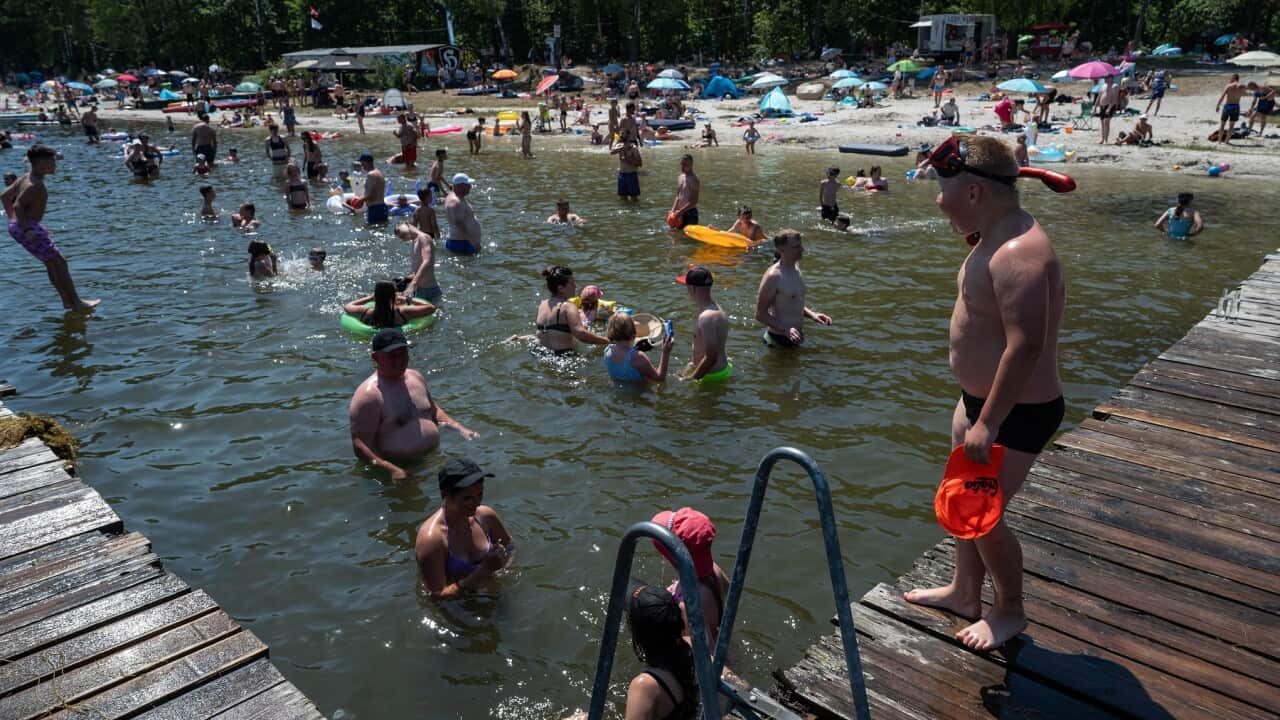
In Berlin, this is the sound of police spraying a water cannon into crowds seeking relief from sweltering heat.
The unconventional cooling method providing a temporary reprieve, as Germany experienced its hottest day on record, setting a new national high of 41. 7 degrees over the weekend.
Heat records have also been broken in the Czech Republic, with an all-time-high of 41.1 degrees noted in Doksany, north of Prague on Sunday.
Raquel Sequeira, a student living in Prague, says it's been hard to find any relief.
“There's very little air conditioning. In my flat, there's no air conditioning, so I keep the curtains closed all day and I open the windows at night to be a little cooler. But I'm kind of just accepting that I'm going to be sweaty for the next month.”
Across the border in Poland, a national high of 40-point-5 degrees was recorded in Slubice in the country's West on Sunday.
A traveller from the UK, Lee Hunter, is in the capital city Warsaw, which reached 37-point-6 degrees over the weekend, breaking its city record.
“I didn't expect the weather to be this bad. I thought Poland would be like okay, like in the 20s, but this is too much.”
As the extreme heat continues its movement east across the continent, the World Health Organisation is warning the soaring temperatures are bringing significant health risks.
In a statement, WHO Chief Tedros Adhanom Ghebreyesus says more than 1,300 deaths linked to the high temperatures have been recorded in Europe since the 21st of June.
In France, where temperatures peaked last week, the national health agency says more than 1,000 deaths in the country are tied to the blistering heatwave.
Dr Ghebreyesus says these dangerously high temperatures are becoming all too common across the continent.
“Europe is the fastest-warming continent on Earth, heating at twice the global average. Right now 150 million people are living under extreme heat, hundreds have died, schools are shut, grids are buckling. Driven by climate change and global warming, the phenomenon of the “once-in-a-generation” heatwave is now occurring nearly annually. We were warned.”
Scientists from the World Weather Attribution group say this heatwave is the most severe Europe has ever recorded.
Dr. Andrew Watkins is Adjunct Professor in the School of Earth Atmosphere and Environment at Monash University, and a Climate Councillor at the Australian Climate Council.
He says the timing of Europe's heatwave is especially concerning.
“In Europe, it's not their peak summer yet. the Australian equivalent of about December. We don't expect to be smashing all time records really early on in the summer. We expect to break records probably a month, 6 weeks after the solstice. So really, you know. They should be breaking records in July or August, and historically, that's when those things have happened.”
A heatwave occurs when the average temperature is unusually hot for three or more days in a row.
Mr Watkins says the record-shattering heat is also alarming because of its length and persistence, with Paris, for example, recording 36 degrees or hotter for 10 days in a row.
He says current evidence shows the severity of this event would have been virtually impossible this early in the summer without climate change.
“The finger is pretty squarely pointed at climate change. Some of the recent climate change attribution work suggests that the degree of this heat wave happening in June so early is almost impossible. 50 years ago, uh, it's as recent as that, you know, basically it just couldn't have happened. So they basically squarely pointing the finger at climate change and and effectively the burning of oil, coal and gas.”
Mr Watkins says in the 50 years before the year 2000, Europe experienced 5 intense heat waves, while in the last 26 years, it's recorded 22.
And it's the type of heat Europe experiences that makes these increasingly frequent heatwaves so dangerous.
“Europe is not traditionally an area of high heat. We think of the Sahara. We think of inland, inland, Australia. We think of Death Valley in the United States. But even though the temperatures might not be comparable in terms of raw temperatures, the problem you have in Europe, though, is that the air is more humid. And it's that humidity that means that our bodies don't cool as they would in in a drier heat. So in other words, you don't get the evaporation of the of the sweat off the skin. So it's harder for your body to cool down.”
Mr Watkins says older people and young children are particularly vulnerable to heat stress, whose natural self-cooling systems don't work as well.
He says the buildings people live and work in are also ill-equipped to protect people against the heat.
“Only about 10 per cent of places have air conditioning. You know, very low percentage of air conditioning. A lot of the architecture is designed to trap heats in rather than release heads out. And so it's a very dangerous combination we have in Europe, unfortunately, where really, it's climate change, that's rapidly altering their climate so that they haven't really had time to adapt to this new climate that they're experiencing now.”
Under the Paris Agreement, countries agreed to substantially reduce global greenhouse gas emissions and pursue efforts to limit global warming to 1.5 degrees above pre-industrial levels.
Earlier this year, the UN Climate Agency projected a 75 per cent chance that average global temperatures between 2026 and 2030 will exceed this threshold.
Mr Watkins says if we don't put a stop to global warming, extreme heatwaves like Europe is experiencing will only become more frequent and dangerous.
“Global warming doesn't just mean, you know, small change in the temperature of the globe. That's not what's going to affect us, what's going to affect us as human beings, these extremes, that we've seen keep happening in. I like to say to people, if you're at the beach, you have a sand castle. What knocks down the sand castle? Is it the slowly rising tide or is it the waves? And we all know that Sandcastle gets knocked over by the waves, by the extremes, long before it gets swamped by the tide. So these extremes are what we are very concerned about, particularly if they keep increasing.”