
Deadly protests in Iran have spread to more provinces presenting a new challenge for the country's leadership. It is the biggest wave of protests since the nationwide demonstrations in 2022, sparked by the death in custody of Mahsa Amini.
Listen to Australian and world news and follow trending topics with SBS News Podcasts.
TRANSCRIPT:
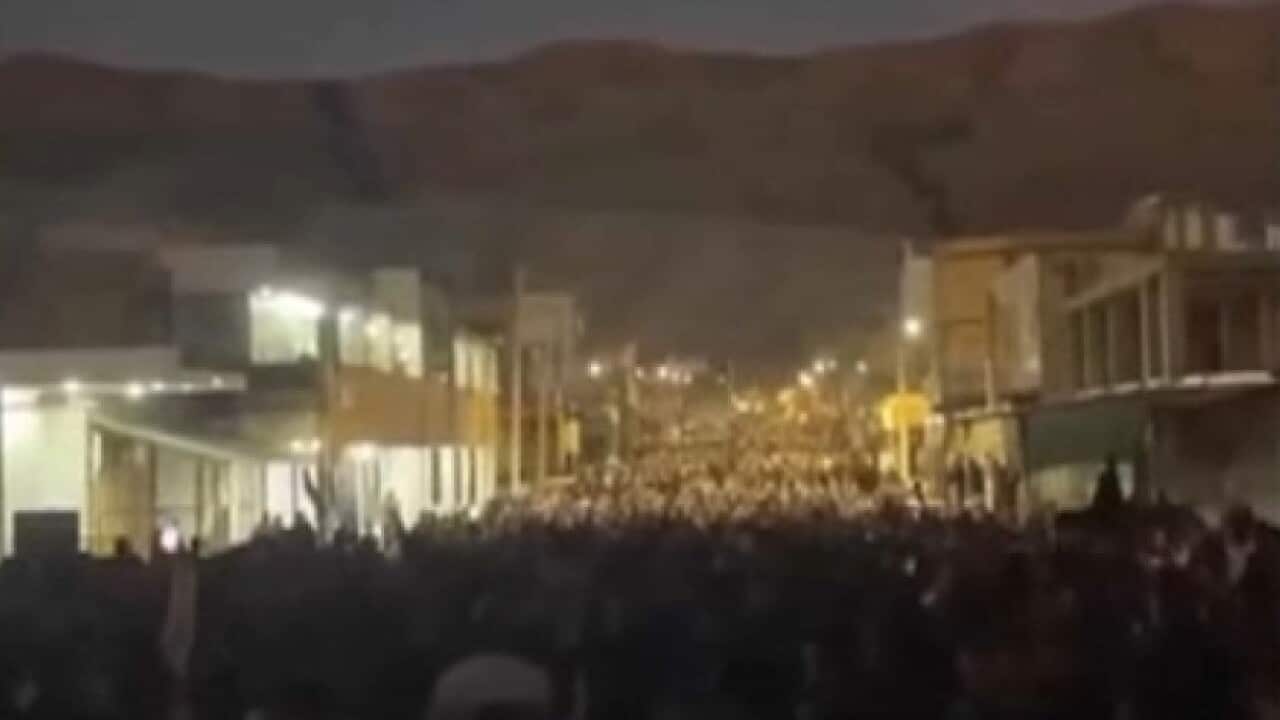
In northern Iran, people in the city of Rasht take to the streets in large numbers - one of a number of protests across the country.
Protests in Iran have continued for 11 days, now spreading to 28 of Iran's 31 provinces, according to the US-based Human Rights Activists News Agency.
The group relies on an activist network inside Iran for its reporting, and has been accurate in its information on past protests.
The agency says the death toll has now reached at least 36 killed, with 2,000 arrests.
The latest wave of protests started with shopkeepers in the capital Tehran, criticising the sharp fall in value in the country's currency against the US dollar.
Tehran shopkeeper Karim Heidari says the sharp decline of the country's currency as well as soaring inflation - above 40 per cent - will see prices of basic items become more unaffordable.
"Every day I see customers who can no longer afford some items. They only buy main staples, they can't afford other stuff. For example when the price of fruit juice more than doubled, they would no longer buy it. They just buy some bread, a bottle of milk and a tray of eggs and then leave."
Even with a three-fold increase in government subsidies for households to buy food essentials, the prices of basic goods in Iran are projected to rise by up to 30 per cent in coming weeks.
Resident Honarbakhsh says it is hard to survive.
"A litre of cooking oil which used to be 790,000 Rials is now 1,850,000 Rials. And as the government announced, prices for other goods will rise by 50 per cent to 100 per cent. As goods become more expensive, costs for all services will increase too. The price hikes will spread into other areas of people's lives."
It wasn't long before the protests spread to provincial cities and university campuses.
Political analyst Shukriya Bradost is a Washington-based Kurdish-Iranian scholar.
She says members of the traditional support base of Iran's rulers are also now joining the protests, with demonstrations in the cities of Qom in central Iran and Mashhad in the north-east.
"It began with the merchants of Iran - in Grand Bazaar - that is what makes it unique. Because these merchants have always been known as a conservative group with a strong connection with the regime, with the government. When even they lost trust and began to protest; it shows that the traditional support (base) is now broken. If the merchants are suffering from the falling currency and economic pressure than the problem is really truly serious."
She says the economic deterioration has been accelerated by the impact of sanctions applied over Iran's nuclear program, as well as government mismanagement and corruption.
"The president (Masoud) Pezeshkian's own words, or explanation, when he said that 12 billion dollar that the government spent for medicine and food for the people - 8 billion dollar - was stolen. That shows the amount of corruption in the system, which means if even one day this sanction can be removed; this system of the Islamic regime; this structure for the Iranian economic recovery will be really difficult. That is how I concluded that the Iranian regime now facing the toughest time of the decades in ruling this country. Because in all the sectors that they have no solution for people."
Beyond the daily economic hardships, protesters have also criticised Iran’s ageing supreme leader, Ayatollah Ali Khamenei.
There was also criticism of Iran's foreign policy objectives of supporting Hamas and Hezbollah to counter the influence of the US and Israel in the Middle East, with protesters chanting in the streets: "Not Gaza, not Lebanon, I sacrifice my life for Iran".
The prospect of regional conflict has firmed in the aftermath of 12-day war in June last year, when Israel launched an attack on Iran's military and nuclear sites.
US President Donald Trump has intervened in recent days, issuing remarks before and after the US military operation in Venezuela, warning Iranian authorities to refrain from killing protesters or they would be - in his words - "hit very hard".
Iranian officials have now shifted their emphasis from dialogue and economic reform to a more hardline response, with the use of security forces to disperse protests and the shutdown of internet access in parts of the country.
Iran's chief justice says the security response is a focus, and he blamed outside forces for inciting the protesters.
"Those who today come into the streets to take part in riots, or lead them, or support them, or assist them, in light of this explicit declaration of position by the criminal Zionist regime and likewise by the criminal President of the United States, and the issues they raised — that if anyone comes into the streets for riots or to create insecurity, or supports them, then no excuse remains for them. The matter has become very clear and transparent. They are now operating in line with the enemies of the Islamic Republic of Iran."
Ms Bradost says the risk of further regional conflict is very real.
"This protest is the first protest after the 12 days of war between Israel and Iran. Now, the Iranian regime faces a very difficult situation: a deadlock in the economy, in politics and in security. The Iranian regime in the security perspective knows more attacks from Israel is almost certain. Not just possible. They know it is just a matter of time before Israel attacks; not if Israel is going to attack."
Meanwhile, foreign governments - including the Australian government - are advising their citizens in Iran to leave as soon as possible due to the volatile security situation.
Australia's embassy in Tehran suspended operations last year in June.
And the government is warning that its ability to provide consular assistance in Iran is extremely limited; adding that Australians - including dual nationals - are at a high risk of being detained.
Suren Edgar is the vice president of the Australian Iranian Community Alliance.
He says the concern is for their loved ones, still in Iran.
"They key issue isn't just the numbers, it's that the use of force is being used and the protests are still continuing. Plenty of protests are still continuing so that tells us the use of repression is no longer containing the crisis. They're coming into the streets and chanting 'freedom' - they've got nothing to lose."









