
Global oil prices have increased by 40 to 50 percent as Iran attacks shipping in the Strait of Hormuz. President Donald Trump says the United States is negotiating with countries heavily reliant on Middle East oil, after he demanded several nations send warships to re-open the Strait of Hormuz. But European allies have so far proved resistant to President Trump's request.
Listen to Australian and world news and follow trending topics with SBS News Podcasts.
TRANSCRIPT
Efforts by Donald Trump to assemble a global coalition to help control the Hormuz Strait and escort oil tankers through the waterway to have so far met with a cool response from world leaders.
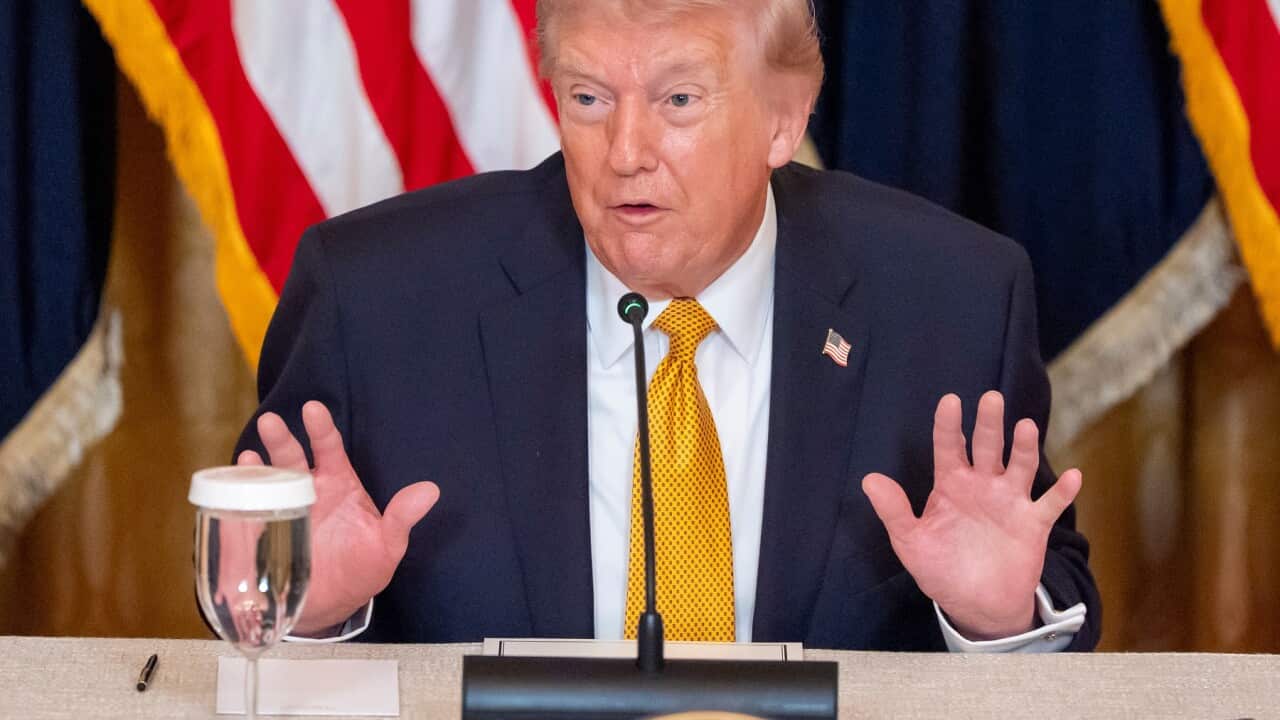
Mr Trump has told reporters at the White House that his country has protected the vital waterway for decades, and that he feels other countries should be doing more.
"You could say we did it out of habit. Which is not a good thing to do. But we did it because we have some good allies there. We have some great Middle Eastern countries there, Israel there. So we did it for a lot of reasons. But it always amazes me that we did it. We never asked for reimbursement and it was really to serve other countries, not us."
Iran has blockaded the waterway, through which a fifth of the world’s crude oil travels, in retaliation for the war launched by the United States and Israel on February 28.
Global oil prices have surged by 40 to 50 percent as a result of Iran's attacks on shipping in the Strait of Hormuz.
President Trump said he thought Britain and France would get involved in efforts to secure the waterway, but European powers have pushed back on a possible joint mission.
EU foreign policy chief Kaja Kallas says foreign ministers met in Brussels to discuss Donald Trump's demands.
She says the EU might consider adapting an existing mission which had been launched in response to action by the Houthis in the Red Sea.
"The point is that whether the member states are willing to actually use this mission. If we want to have security in this region, then it would be easiest to actually already use the operation that we have in the region and maybe change a bit. There is also talk of coalition of the willing in this regard."
But she said there was no appetite for changing the mandate of the operation.
British Prime Minister Keir Starmer said London was working with allies to craft a "viable" plan to reopen the strait, but ruled out a NATO mission, while Berlin also said it "has been clear at all times that this war is not a matter for NATO".
Mr Trump accused the PM of being unwilling to take decisions on his own.
"I don't need advisers to tell me that, I know what it is. You know, the Prime Minister of UK, United Kingdom, yesterday told me, I'm meeting with my team to make a determination. I said, you don't have to meet it with the team, you're the prime minster, you can make your own. Why do you have to meet with your team to find out whether or not you're going to send some minesweepers to us, or to send us some boats? I said, you don't have to meet with your team."
Australia, Sweden, the UK, the EU and NATO have all distanced themselves from Mr Trump's call for countries to form a global coalition to help control the Strait.
President Trump has also found a frosty reception from China.
A spokesman from China's Foreign Ministry, Lin Jian, says Beijing is not interested in any military involvement in the strait.
"Tensions have risen in the Strait of Hormuz and its adjacent waters, disrupting the international cargo and energy trade passage and undermining regional and global peace and stability. China calls on all parties to immediately stop military operations, avoid further escalation of tensions, and prevent regional turmoil from having a greater impact on global economic development."
Despite the world's lack of appetite to be drawn into the US and Israel's war with Iran, Donald Trump said he will “soon” announce countries that have agreed to help the US; and he insisted the war would be wrapped up "soon".
When a journalist asked President Trump on Monday how soon the Hormuz Strait could be re-opened, given the President’s assurance that all of Iran’s mine-laying capability had been destroyed, the president responded that it could be reopened immediately, but that ship-owners were too nervous.
“Well we could, but it takes two to tango. We have to get people to take their billion dollar ship and you know, drive it up … and when… if… When Pepe has his big sugar ships coming around … and they cost a billion dollars and we say I think it’s OK now Pepe, take your ship, drive it through the strait of Hormuz, he may say… let me wait a little while… because it takes ship owners … and you know these ships are very expensive.”
However, on Monday Iranian missiles and drones continued to strike targets in Israel and the Gulf States, and Israeli missiles continued to rain down on Iranian cities.
Analysts say that even if the war were to stop tomorrow, the economic consequences would continue to reverberate for many months.