
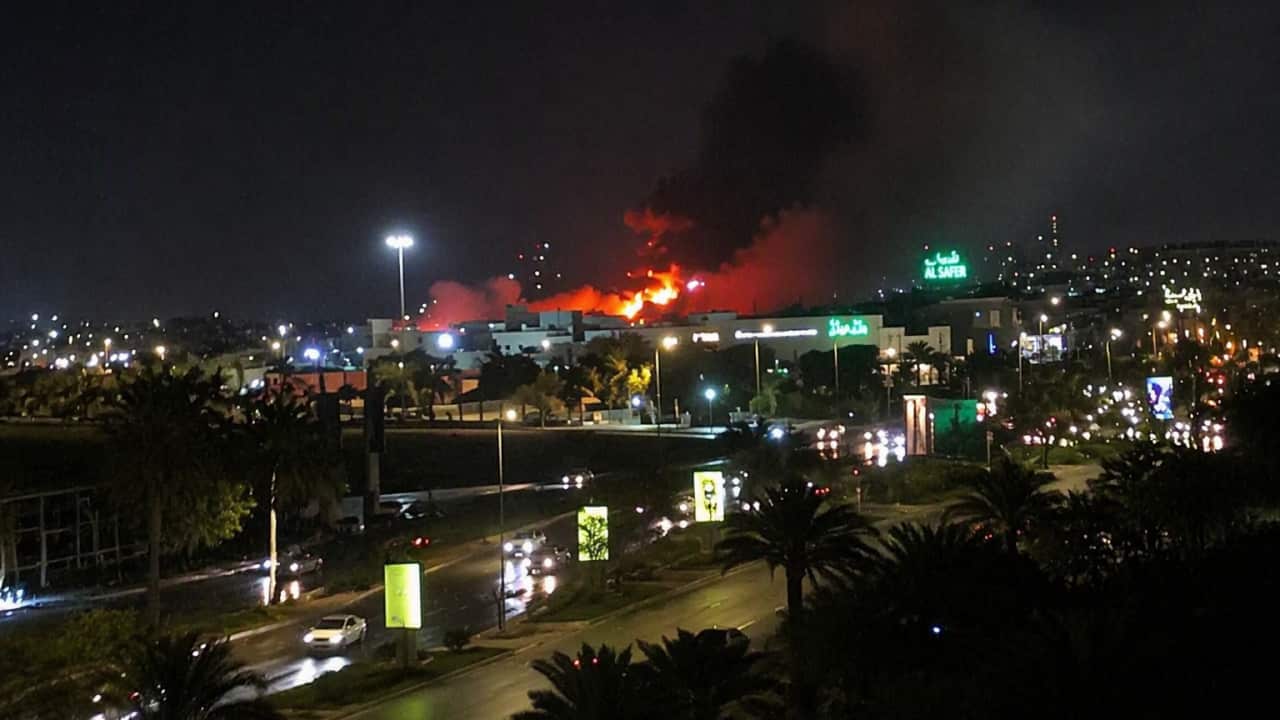

There's been a further exchange of strikes between the US and Iran, putting the three-week old ceasefire deal under fresh strain. The latest strikes comes at the end of mass funeral commemorations for slain Supreme Leader Ayatollah Ali Khamenei, who was killed in the initial US strikes.
Listen to Australian and world news and follow trending topics with SBS News Podcasts.
TRANSCRIPT
The US military's Central Command says it has hit 90 targets across Iran, releasing black-and-white footage of what appears to be strikes on an airport runway and missile launchers.
Other videos show several boats on fire at a fishing pier in Iran's Bushehr province after multiple explosions were reportedly heard there.
Bushehr province is home to Iran's only operating nuclear power plant.
US President Donald Trump says he believes the interim ceasefire with Iran is over.
“We just hit them very hard. And I say we hit them 20 to 1. Every time they hit us, we're going to hit them 20. And we did it last night. We did a little something today, but it was really retribution for last night. They hit actually three boats, not two. And when they hit, we hit back much harder."
Tehran has responded by targeting US allies in the Middle East.
Sirens have sounded at least three times in Bahrain, home to the US Navy's 5th Fleet headquarters, and missiles have also targeted Kuwait and Qatar.
There were sirens too in Jordan, where the US has stationed troops and aircraft.
UN spokesman, Stephane Dujarric, is urging a return to the negotiating table.
“This tit-for-tat needs to stop, right? A return to diplomacy is urgently needed for the sake of stability in the region, for the state of global, sake of global stability. I mean, we keep talking about the impact that this conflict is having on the global economy. And I think all of the parties involved need to understand that the best way to end this conflict is a return to the negotiating table.
In Brussels, where a meeting of European Finance Ministers has been held, Irish Finance Minister Simon Harris has also called for the ceasefire to be restored in full as quickly as possible.
“It's more important than ever that we take stock of where the world is at in relation to the global energy challenges. Obviously if we were having this conversation a number of days ago, only a few short days ago we would have been talking about the fact that there was a ceasefire in place, the reopening of the Strait of Hormuz, the falling oil prices on commodity markets and we've seen obviously a worsening of situations in terms of hostilities in recent days. I've consistently said that the greatest economic intervention we can see in terms of energy prices is de-escalation of conflict and I really do hope that the ceasefire can be restored in full as quickly as possible.”
But the strikes have continued.
Iranian state media report an attack on a railway bridge in Iran's northeastern Golestan province.
The Revolutionary Guard Corp says two bridges were attacked on the route to Mashhad, where tens of thousands of mourners thronged wide boulevards during a funeral procession for the late Supreme Leader Ayatollah Ali Khamenei.
His coffin has been carried around the country's holiest site, the Shrine of Imam Reza, as part of the final day of prayers for the late Supreme Leader.
Khamenei was killed in a US airstrike on the first day of the war on February 28.
Those gathered have waved Iranian flags, and red and black flags which symbolise mourning and revenge, and held pictures of Khamenei.
His successor, Ayatollah Mojtaba Khamenei, was not present, with prayers led by another of Khamenei's sons, Mostafa Khaenei.
Parliament Speaker Mohammad Bagher Qalibaf is a key negotiator in talks seeking a permanent end to the war.
He has been defiant in a post on X, saying America hasn't learning bullying and breaking promises are no longer cost-free.
Iranian Foreign Minister Abbas Araghchi has said in a post on Telegram he spoke by phone with his Saudi, Turkish and Omani counterparts and with Pakistan's army chief, Field Marshal Asim Munir, who has been one of the main mediators in the war.
The outreach suggests efforts may be underway to reduce tensions.
Meanwhile, President Trump says the situation is not likely to escalate to a full-scale military conflict.
“We've already won militarily. They have very little. They have very little left, and they want to make a deal so badly. They called a little while ago. They want to make a deal so badly. I just don't know if they're worthy of making a deal. I don't know that they're going to honor the deal. That's the problem."