
Migrant workers in Lebanon are one of the most vulnerable communities since the war in the Middle East erupted. Experts say they are trapped between the economic impacts of the war, and it's taking a toll on their sense of belonging.
Listen to Australian and world news, and follow trending topics with SBS News Podcasts.
TRANSCRIPT:
"This country, I treat is as my second home. It's not easy, but I think it's about time now to leave this country."
That's Nancy, a Filipina domestic worker in the Muslim majority Shia neighbourhood of Dahieh, to the south of Beirut.
Dahieh is often described as a Hezbollah stronghold.
And Nancy has been working there for 23 years now: from 2003-2026.
She's witnessed it all.
The 2006 Israel-Hezbollah war, Lebanon and Iraq's uprisings in 2015 and 2019, Lebanon’s financial crisis since 2019, Beirut's 2020 port blast.
And more recently, the 2023 the Israel-Hamas war, followed by Israel's invasion of southern Lebanon in 2024.
She has now decided to go back to the Philippines, and says it's the best decision as it's no longer safe with the war in the Middle East.
But a few hours after SBS spoke to Nancy, US President Donald Trump announced a temporary truce between Israel and Lebanon.
Both parties - Lebanese President Joseph Aoun and Israeli Prime Minister Benjamin Netanyahu - had agreed to a 10-day ceasefire.
Iranian-backed militant group Hezbollah - which was not a part of the talks - says any ceasefire must not allow Israel freedom of movement within Lebanon.
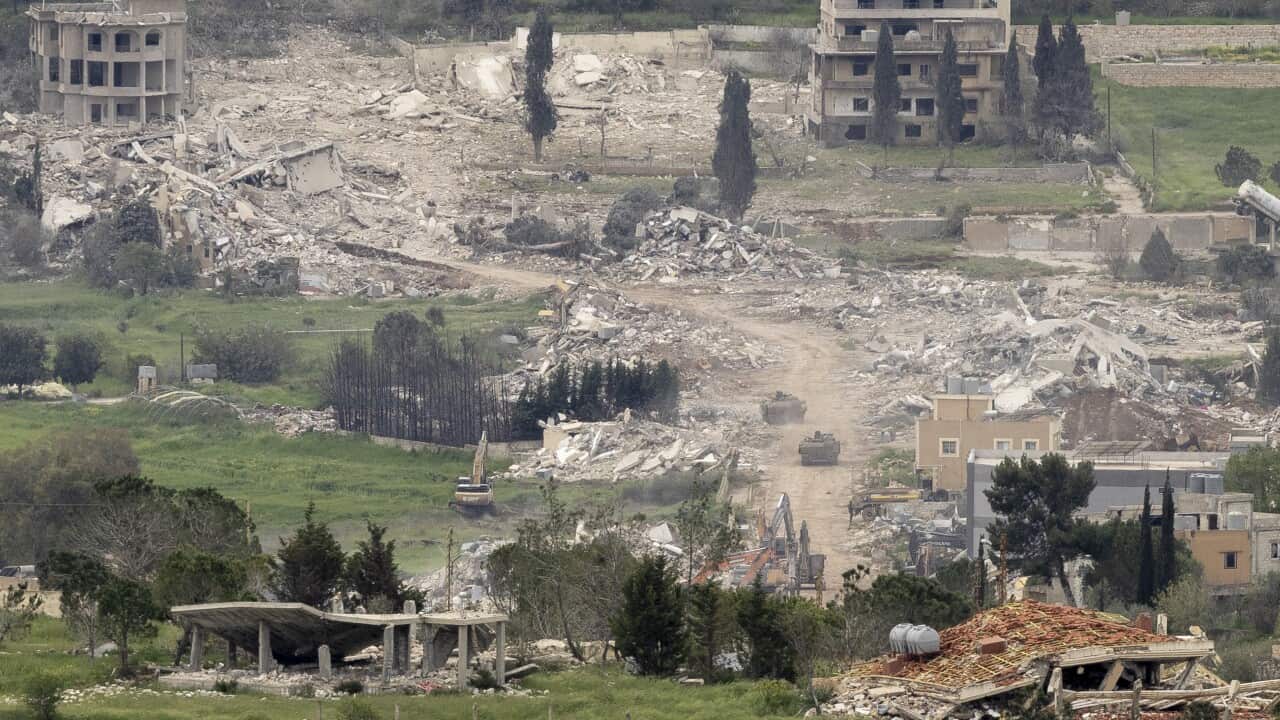
But Mr Netanyahu says Israeli troops will remain in a 10 kilometre-deep "security zone" in southern Lebanon - a region his Israeli army has attacked since the war began.
The US-Israel war spilt into Lebanon on the 2nd of March.
In support of Tehran, Hezbollah had opened fire, which then prompted Israel's offensive in the country, just over a year after the last major conflict.
Israel says Hezbollah attacks have killed two Israeli civilians, and 13 Israeli soldiers have died in Lebanon.
Lebanese authorities have reported more than more than 2,100 people killed, and 1.2 million people have been forced to flee from their homes since.
Nancy describes the danger, as the impact of Israeli drones and airstrikes shook her region.
"During the war here I'm really scared for the sonic bombs especially, when they are passing by here the drone, 24 hours a day non-stop. So everytime like this we want to send a mission, they will give us a warning also, the don't let us to go out from the house.
She says the Philippine embassy in Lebanon is assisting their repatriation by groups.
The Embassy has urged Filipinos facing dire conditions to take advantage of the Voluntary Repatriation Program while it remains available.
Nancy again.
"Our embassy, they are very cooperative also, they are helping us assist the undocumented and documented. Undocumented and the legal they them to assist their paper to process to travel - who is willing to travel."
According to local publication, the Philippine Daily Star [[6 April]], more than 40,000 Filipinos who were set to leave for jobs in Israel, Lebanon and Gulf countries were unable to depart due to the war in the Middle East.
Limited flight availability disrupted worker deployment to the region.
Earlier, the Manila Times reported [[13 April]] Philippine Ambassador to Lebanon Marlowe Miranda calling for the mandatory evacuation of around 15,000 Filipina domestic workers, as Israeli airstrikes on Beirut had put them and their families at risk.
"For now I am working still with my employer. Thank God she didn't leave me, and is still giving me my salary. But most Filipina here don't have work now, and some employers they leave."
But this won't be the first time this has happened.
Dr Paul Tabar is an Adjunct Professor at University of Western Sydney's Institute for Culture and Society.
He's also the former director of the Institute for Migration Studies at the Lebanese American University in Beirut.
According to the International Organisation for Migration [[IOM]] 128,000 people are currently staying in collective shelters in Lebanon.
Dr Paul Tabar told SBS that historically, migration in Lebanon started during the Civil War which erupted in 1975 and continued up until the instability that Lebanon experiences from time to time.
He says migrant workers are mainly divided in two groups.
"One group, and this group is mainly coming from Syria, the neighbouring Arab country. And this group is predominantly occupied and engaged in farming and in also construction industry in the cities, and to a lesser degree, probably in the restaurant sector of the service economy."
Dr Tabar says the other group is part of the broader community of migrant workers - including those from Sri Lanka and the Philippines and other South East Asian countries.
And that they're predominantly involved in house work.
"In looking after families and helping families in the cleaning up and the caring for the kids and so on. In housework, in other words, they are referred to as home workers or helpers, but not all of them are engaged in that sector, if you wish, of the economy, but rather some of them also are engaged in the cleaning industries."
Dr Tabar says many migrant workers are tied to the country’s kafala labour system - a system for migrant workers that has been around for decades.
"They come in with a temporary visa and more so they have their passports controlled and under the, if you wish, supervision of the family or the party which is sponsoring them. So they can be, as a result, in a very unstable situation and position in Lebanon, in that at any time they can be expelled from the country."
He says the system is really unfair and unacceptable.
“There is no set time as to according to which with reference to which you start your day and you finish at a certain time, that doesn't work. You are always on demand whenever you are needed by the family, and that can be open-ended and it's such as even to eat out the time that you might need to sleep as well."
Dr Tabar believes there is excessive exploitation.
He says some will also earn more than others.
"To my understanding, (the wage) ranges between 150 per month US dollars to 350 or $400. Now, the ones who get paid 300 and above are normally more educated and have some qualification regarding probably taking care of children or taking care of elderly, nursing them at home and so on and so forth.”
He adds that, unlike Australia, there is no social security for them.
“They are not covered by the rights that a Lebanese worker would be covered under and protected with according to the labor law in Lebanon. So if they are injured, there is no insurance. If they get sick, maybe they don't get sick pays. And more importantly, they don't have any super or part, they're not part of the security of, sorry, any superannuation kind of scheme that applies to local and Lebanese workers.”
Although a ten-day ceasefire has been agreed upon, the future of Lebanon and migrant workers there remain unclear.
The war has also disrupted the income the migrant workers send home.
Nancy says not all Filipina workers are willing to go home, as they desperately find ways to make ends meet.
"Not all Filipinas here are willing to go home, because they are thinking of their family also there. And they prefer to stay here even though there is a war here, they prefer to stay here because they have their own family there and they need to feed them, and their family to send them to school their children. So that's why some of them they are not willing to go home."
Dr Tabar says it's also difficult for them to move back, as most form bonds and social connections within their communities in Lebanon.
United Nations Refugee Chief Barham Salih visited families who fled from southern Beirut, and are now in makeshift shelters.
"Resilience has its limits. Lebanon has been known for its resilience. Lebanon has been a haven of tolerance and hospitality forever. Lebanon does not deserve this repeated cycles of wars and conflict. Time is for peace. Time is for stability."
Doctors Without Borders [[MSF]] says displaced migrant communities are trapped between the impacts of war and a humanitarian response that often excludes them [[April 2]].
The IOM estimates that, as of last month, around 30 percent - or 48,000 of the identified migrant population in Lebanon - are displaced or living in high-risk areas.
As migrant communities continue to face systemic challenges, it remains unclear if there's an end in sight with a ceasefire hanging by the thread.