
As bird flu takes hold across Australia, experts are warning of widespread mortality in native species, based on how the virus has ripped through environments overseas. The disease rarely infects humans, but it could drive a rise in eco-anxiety, especially among communities that are closely connected with nature.
Listen to Australian and world news and follow trending topics with SBS News Podcasts.
TRANSCRIPT
Caroline Paterson lives on Kangaroo Island.
It's a pristine environment which, within the space of seven years, has been ravaged by Black Summer bushfires, South Australia's harmful algal bloom, and now, bird flu.
"It was really sad. Even though we knew it was coming, we knew it was going to happen, it didn't make it any easier."
Previously the Ranger in Charge for the island's national parks, Caroline now works as the South Australian threatened species Coordinator for BirdLife Australia.
For weeks, she'd been regularly checking her local beaches, peering through a pair of binoculars and searching for signs of the deadly H5N1 strain of bird flu.
"I have found a bird still alive. It was a seagull, roosting with a group of 38 crested terns on a beach. It was still alive and was showing visible signs, trembling, inability to stand. The crested terns flew off quite normally, but of course they've been roosting with this bird. And in front of the group were two vulnerable hooded plovers.”
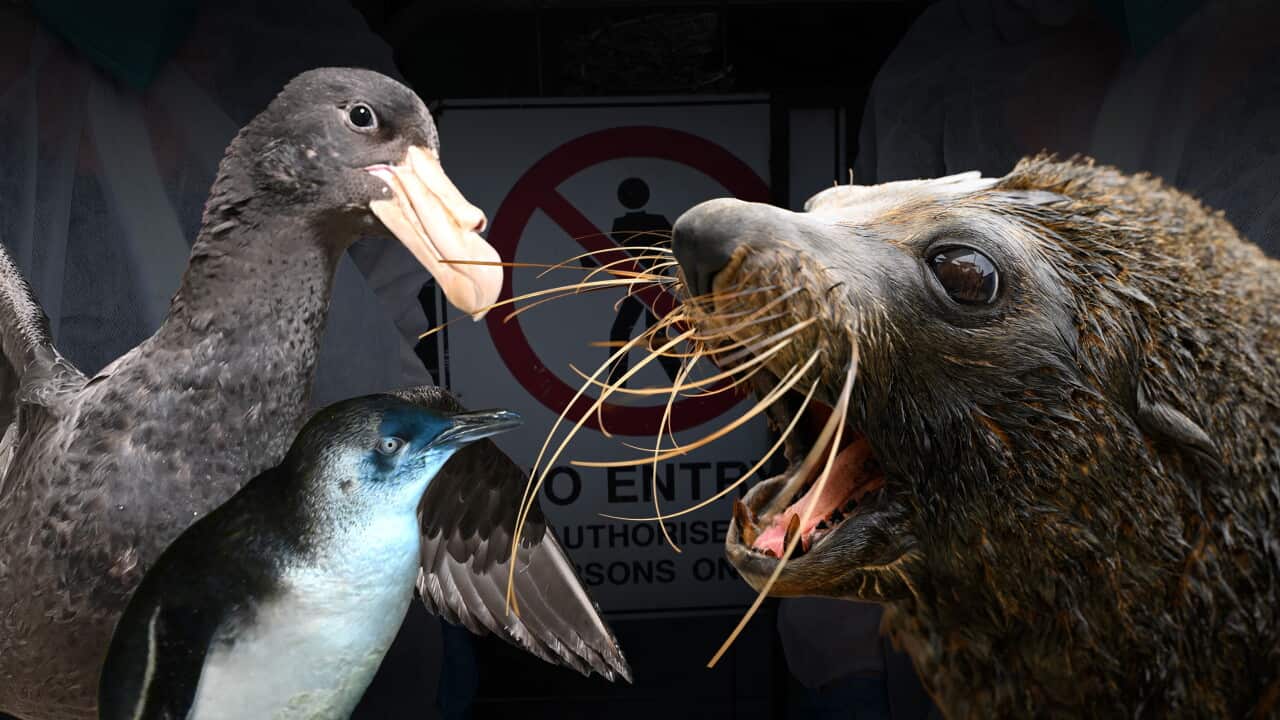
Since then, a rare peregrine falcon has contracted the virus, as well as little penguins.
They're among 12 species on Kangaroo Island confirmed to have the virus so far.
Elsewhere, long-nosed fur seals have tested positive, pointing to the risk of spread between mammals, and prompting fears for the vulnerable Australian sea lion.
Kangaroo Island is home to an important colony, and if the virus takes hold among seals, the CEO of the Invasive Species Council, Jack Gough, says the consequences could be dire.
"We saw in South America, Cape Valdés, 95 per cent of all elephant seal babies dying in one year, whereas the year before it was one or two per cent death rate. So that means you're seeing seals, sea lions dead on beaches, birds essentially falling out of the sky and turning up dead. The public won't miss this. It is going to be very visible in a lot of locations at once. And I think politicians should be ready for a real shift in public perception on environment issues in the same way there was in the wake of the Black Summer bushfires. And in the same way in South Australia there has been in the wake of the deadly algal bloom there."
The virus has been confirmed in six states and almost 30 species across Australia; with nearly 700 species impacted globally, according to Wildlife Health Australia.
South Australia has seen the worst impacts to date, just as the most harmful effects of the state's algal bloom were beginning to recede.
Adelaide University researcher Dr Brianna Le Busque says the algal bloom also impacted public mental health.
"We did find these high peaks of eco-anxiety when it comes to the bloom. So in particular, we looked at those four different types of eco-anxiety and we found that particularly over 60 per cent of people were reporting rumination, so not being able to not think about the bloom, and also feeling like they can't do anything personally to help the bloom. So those were the most common ones that we saw."
Typically, people who spent more time in or around the ocean, like Caroline, were correlated with the most serious impacts.
"With the algal bloom, that place of solace and recreation and connection with nature became a place of devastation. So, you know, my walk down the beach to monitor the hooded plovers' breeding season would end up with me counting hundreds and hundreds of dead fish."
It compounded the devastation of losing her home in Black Summer bushfires, which burned almost half the island over the course of several weeks in 2020.
Then in March 2025, the algal bloom started, with impacts stretching over several months, and into summer.
"At Christmas time, we went down the beach and we were so excited to see a pod of dolphins. We jumped into the sea to swim out closer to them. And there was a bit of a foam in the water and I assumed it was just because the dolphins were feeding and stirring up the foam, but for days we were coughing and wheezing."
Bird flu has already been detected in one dead dolphin, and it has the potential to kill a range of iconic species, which Dr Busque says tends to illicit stronger psychological responses among the public.
Although her research highlights how widespread the experience of ecoanxiety was across demographics during the algal bloom, impacts are often most acute for conservation scientists, workers and volunteers.
Last week, the federal government flagged its plan to withdraw workers from a remote Antarctic base on Macquarie Island, citing psychosocial risks if an elephant seal colony is hit by bird flu.
Dr Le Busque says the anticipated impact across mainland species will take its toll on the public as well.
"You know, it feels like the dust is only just settling with the algal bloom, even though it isn't completely, but at least with public sentiment. And so then to have the bird flu come so soon after, we predict that's going to have a compounding effect."
While it's difficult to say for sure, researchers estimate that, worldwide, the virus has killed millions of wild animals, and led to the death of hundreds of millions of poultry on farms.
South Australia has already seen mass mortality events on three offshore islands, with H5N1 suspected of killing an estimated 1,000 birds roosting in colony environments that are conducive to viral spread.
Authorities are also preparing to manage significant mortality in cities and towns, where susceptible species like seagulls, pelicans, and black swans often congregate.
"That will be concerning or worrying. If you've got highly populated residential areas, then seeing those sort of mass mortalities of birds will be extremely alarming and both PIRSA and the local authority, the councils in the area, will need to mobilise quickly to manage that, because that's not what they want to be having that sort of, unfortunately, dead birds lying around and the numbers of them, it's going to be extremely emotionally stressful for community, but also it's going to need to be cleaned up quite quickly."
Victoria MacKirdy is the CEO of South Australia's Local Government Association.
She says councils have already responded to incidents, and expects more to come.
"But I feel we are well prepared, and unfortunately part of that education is actually getting the community to understand that this is not going away and it's something we are going to have to live with. It's not just going to come and then suddenly be gone. It's going to be how we manage with it ongoing, because it's not an incident that's like a bushfire or flood and it occurs and we recover. This is going to be ongoing support and awareness of how we manage this as we go forward."
South Australia's Department of Primary Industries and Regions, or PIRSA, says field teams have been positioned in key regions to support surveillance and carcass collection if necessary.
Where those bodies end up will be decided on a case-by-case basis.
In addition to landfill and in-situ burial, dedicated composting bio-bins have been installed in some locations.
The Commonwealth says each state will determine its own approach; and in many circumstances, it is better to leave carcasses in-situ to avoid disturbing surviving wildlife or worsening spread.
It's also likely there will be a significant role for the public; double bagging and disposing of bodies in general waste bins.
Invasive Species Council CEO Jack Gough is warning the public to be prepared for what's likely to come.
"What we're going to start seeing is mass numbers of carcasses of those birds on the sidewalk, on the beaches. We're going to see less of those birds in the sky. And unfortunately, if seals are interacting with them, and we know there's a lot of seals in urban areas in Melbourne and in Sydney, those seals potentially dying from it, and so not being able to see as many of those wildlife that people are used to on the coastlines."
State agencies in Queensland, Victoria, New South Wales and Western Australia have said in statements they are developing plans, often working in conjunction with local government.
Authorities say if you see a sick bird, avoid contact, record details, and report the incident to the emergency animal disease hotline.
Credit: Bird call audio from 'David Stewart Sounds'.