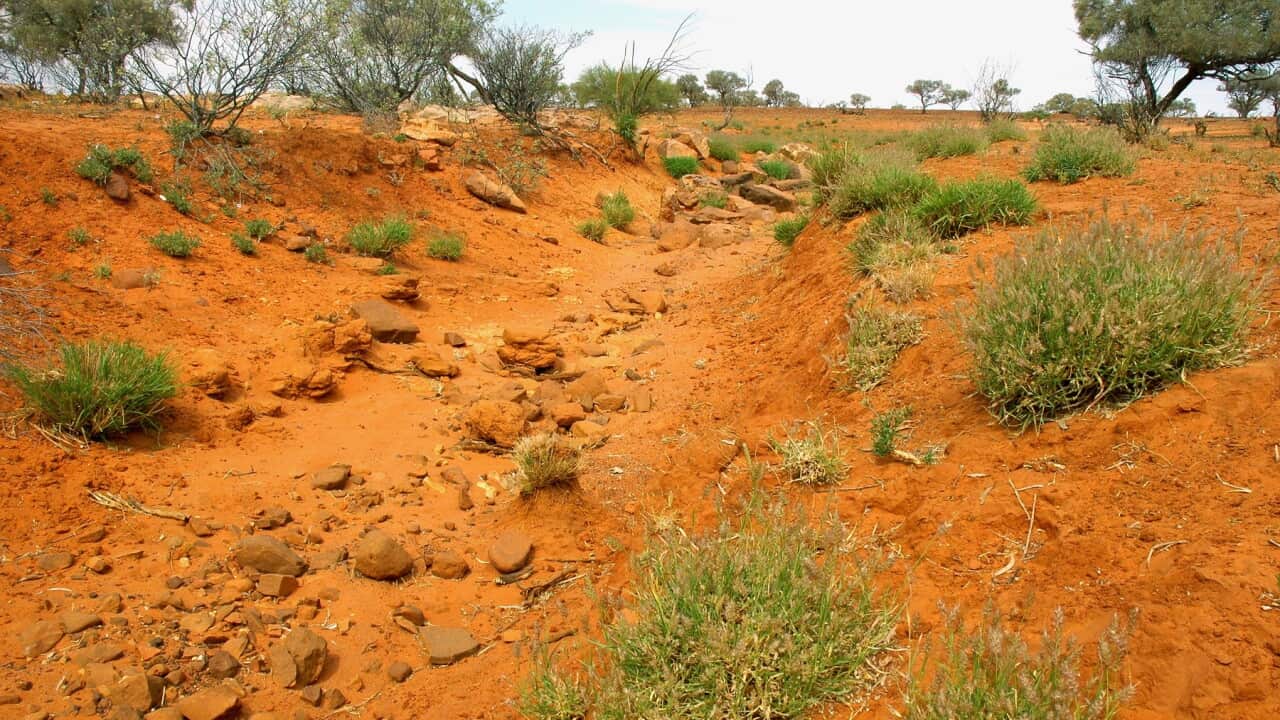

Record rainfall in Australia's outback this year has transformed a usually red desert landscape into a green oasis. The sight can even be seen from space. And while it's welcomed by some - environmentalists and Traditional Owners say, in this instance, green is not good.
Listen to Australian and world news and follow trending topics with SBS News Podcasts.
TRANSCRIPT
This is the sound of Anna Dakin walking through buffel grass on her 20-acre property just outside Alice Springs.
She says the invasive weed has 'overrun' her life.
“At times like this after rain when there is this sudden massive amount of growth it is pretty much logistically impossible to keep on top of. So yeah, it is a big emotional drain. It's a big financial drain. It takes a huge amount of time and it causes stress like I can't explain.”
Anna wants to open a campsite for visitors on her property.
After unusual rain earlier this year, she would spend 10 hours a week on the lawn mower trying to control buffel.
“The grass itself is a monoculture, so it's one kind of texture but also you start to notice that the trees are blackened and there's less kind of mid-level growth. You don't see small seedlings popping up in buffel grass areas because the grass itself is not native and it creates this kind of dense mat blocking the light for seedlings lower down that the seedlings themselves, native plants and trees haven't evolved for.”
She's concerned about its impact on tourism... including the art tours she operates.
“People travel to Central Australia because they're fascinated by deserts. They're fascinated by the resilience of our environment, of our planet. We get to see plants that have evolved to live in an environment that appears to be extremely harsh and inhospitable. But actually what we find when we get here is this incredible tapestry of plants that have evolved to not only survive but thrive in quite harsh conditions and this grass is out competing those plants.
When I start to talk about buffel grass to groups, I personally feel quite embarrassed at the lack of management. Tour groups come through, they connect with the environment. We start to talk about this grass. It's something that's a really big feature of the landscape, unfortunately. And people feel upset when they see it." ]]
Alice Springs is considered ground zero for buffel grass - which is native to Africa and parts of Asia.
Recent NASA imagery published online shows that Australia's centre has transformed to a green look following the NT's third wettest February on record.
The area’s landscape usually appears red due to the oxidation of iron-rich rock, made famous by Uluṟu.
Local government estimates up to 80 per cent of ground cover around Alice Springs is now buffel.
The issue isn't new - but environmental advocates... including Alex Vaughn from the Arid Lands Environment Centre say it's getting worse.
“Buffel grass is a landscape transformer. It's taking over our river systems, hillsides, floodplains, kind of all environments really, and transforming these systems into a fire promoting grassland. Green is not good. It is the canary in the coal mine. The green buffel grass growth cures and dries into a tinderbox before it goes up in flames and creates blackened landscapes. We're talking about iconic and widespread places from the Victorian Mallee to Kati Thanda-Lake Eyre, Uluṟu-Kata Tjuṯa, towns like Alice Springs and Larapinta Trail, as well as huge parts of Western Australia and Queensland.”
Its high biomass can create more frequent wildfires - something First Nation's people are well aware of.
Eastern Arrernte woman, Camille Dobson spoke to SBS in Alice Springs.
“You see it here in Aboriginal communities, it's getting hotter, their housing isn't all that adequate and now with all of the issues that they've got on communities, you've got this additional layer of this invasive species which is on steroids going out and just really having a major impact on Aboriginal communities. A couple of years ago we had a really bad bushfire that went through that country and people who have chronic illness suffered greatly because of the impact of the smoke from the fire and all of the ash that was falling onto the community. There was also issues for them around fear of infrastructure being burnt and there was actually some damage to buildings as a result of the fire and two years later they're still waiting for that to be repaired and it's very costly because of the remote nature of where they live.”
Camille also says traditional bush food is being out-competed.
“There's a lot of plants and animals that that has happened to that just sort of they fade out of our memories and fade out of our language. So it's having a really big impact on our language and culture.”
For graziers in arid landscapes the weed is a lifeline.
It was first brought into the NT by Afghan cameleers in the late 1800's.
Then intentionally planted around the 1950s and 60s to suppress dust and erosion.
Buffel grass is fast-growing and resilient, ideal for feeding cattle.
Romy Carey is the Chief Executive of the Northern Territory Cattlemen's Association.
“I think it's really important that we move beyond whether buffel grass is good or whether buffel grass is bad. I think it depends where you sit and what's really important is that this is a species of pasture that sustains an industry that operates in quite remote and extremely remote regions. It sustains those regional economies, those regional communities and that cattle industry and in areas where it's not utilized or not managed, it does pose a risk. And so through this debate, I think what's been missed when it's oversimplified is that there is a need to manage it where it encroaches on communities or where it interferes with cultural or sacred sites and in our own corridors, but it can't come at the detriment of an industry that sustains our regional economies.
And for the territory, it's an industry that has been here since the beginning and really is a powerhouse for our economy and I think that's the piece that can't be missed here.”
Environmentalists want the Federal Government to list buffel grass as a weed of national significance - a move being considered.
Despite the NT declaring it a weed in 2024 and setting up a 6 year management plan, a permit for buffel grass seed has been approved for a pastoral property in the Alice Springs region.
Alex Vaughn again.
“Local governments, rangers, parks, tourism operators, community members are the ones that are paying for this significant negative impact. And what we are after is recognition that millions and millions and millions of dollars of people's time and money is being spent to deal with this problem and we need national support, recognition and coordination so that we can do that more effectively and in areas that do not have buffel grass... keep buffel grass out.”
The NT Environment minister Joshua Burogyne told SBS News he's spoken to the Federal Environment Minister about buffel, asking for more support and money.
“It's embarrassing to explain to people that what we're doing in the Northern Territory rather than having a really coordinated process of getting rid of the grass, even post its declaration as a weed a couple of years ago, what we're doing here is actually there's small groups of individual volunteers digging it out by hand. That is embarrassing. That's crazy. It's heartbreaking for travelers .”
An uphill battle for people like Anna Dakin, who want government to step up.