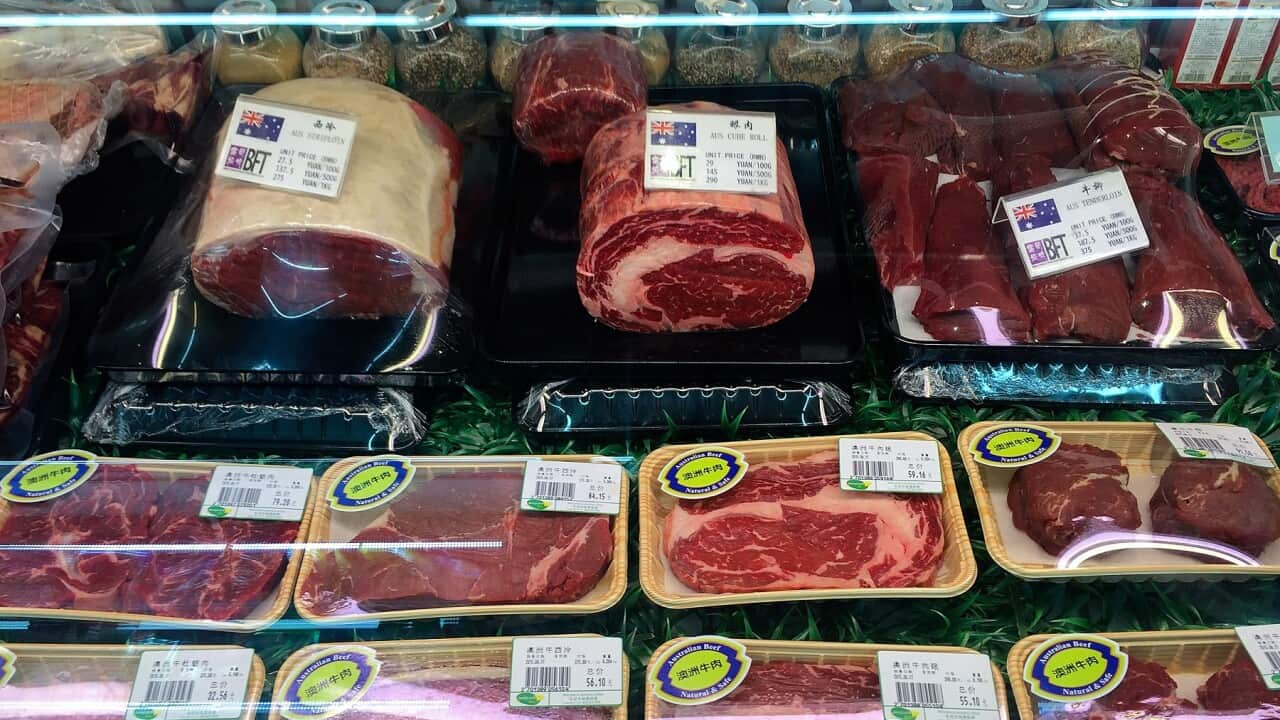

Australia’s billion-dollar beef trade faces a massive shakeup as China imposes a new 55 per cent tariff on imports that exceed strictly capped annual quotas. While the Chinese government claims the move will protect its farmers from oversupply, Australian industry leaders and the Federal Opposition warn the tariff increase breaches the spirit of Australia's long-standing free trade agreement with China.
Listen to Australian and world news and follow trending topics with SBS News Podcasts.
TRANSCRIPT:
China’s Ministry of Finance and Commerce is imposing a new 55 per cent tariff on beef imports from Australia starting January 1st, 2026.
They say the measure is intended to protect China’s domestic cattle industry from oversupply, but it has sparked significant concern among major exporters.
Nationals leader David Littleproud says it could have profound impacts on Australian farmers.
"Well, this is devastating. This is potentially a billion dollars, not just ripped out of farmers pockets, but regional communities pockets. That's money that flows through the local town, from the cafe right through to the stock and station merchant. So we've got to understand, this is a huge shift. It's a tariff on anything above our quota. We usually hit that quota anywhere from between July and September every year, and that means that our beef will have a tariff and we'll have to find a new market."
For 2026, China is setting a total global import quota of 2.7 million tonnes, allocating 205,000 tonnes to Australia, though Australian exporters have exceeded this limit by a large margin in previous years.
The move also impacts other major suppliers like Brazil and the United States.
However, critics like Cattle Australia chairman Garry Edwards say the restrictions contravene the spirit of the free trade agreement established between China and Australia.
On Seven's Sunrise, Liberal Senator Jane Hume said the announcement has taken the government and the industry by surprise.
"We export around 300,000 tonnes of beef to China every single year. These quotas kick in at 200,000 tonnes. So you can see that why the industry is estimating that it's going to be a hit of around a billion dollars. Now we'd urge the government to use everything in their power, all of their contacts, which apparently are very good. Let's not forget that Xi Jinping referred to Anthony Albanese as his handsome boy only a couple of years ago, we would urge the government to use every contact they have to try and lift the ban."
The tax hike is following a year-long investigation by Chinese authorities into rising imports and market competition.
As of 2024, Australia accounted for about 8 per cent of China’s overall beef imports.
The CEO of the Australian Meat Industry Council, Tim Ryan, says the measure will see Australian beef exports to China cut by one-third.
He says this will cost the industry approximately A$1 billion in losses.
"The challenge for us is that the quota allocated to Australia is significantly below what we have been trading into the market over the last 12 months. So going forward, we are expecting it to hinder what we will be exporting into China - going forward - to the degree of about a third of what we're currently doing. I don't think anyone can afford a 55 per cent tax on top of the price of beef. So when that happens we will then redirect exports to alternative markets."
Opposition leader Sussan Ley says Australia will not accept a $1 billion hit to its bottom line.
She describes the Australian beef industry as an export powerhouse that anchors international trade for domestic commodities.
She says this influence is most evident in Australia’s trade relationship with China.
“The Prime Minister should be getting on the phone to his Chinese counterpart and make it very clear indeed that the excuses that he gave yesterday with respect to beef tariffs will not cut it with Australians, and they certainly won't cut it with Australian farmers, who I am proud to represent here in rural Australia. For the Prime Minister to say, 'Oh, well, everyone is affected by this - we haven't been singled out,' is pathetic. What he needs to do is step right up, call his counterparts. Have the conversation with President Xi. He says he has a good relationship with President Xi. He needs to call on that relationship now."
However Prime Minister Anthony Albanese says Australia has not been singled out by China.
He says he is optimistic about the beef industry’s prospects in new markets.









