
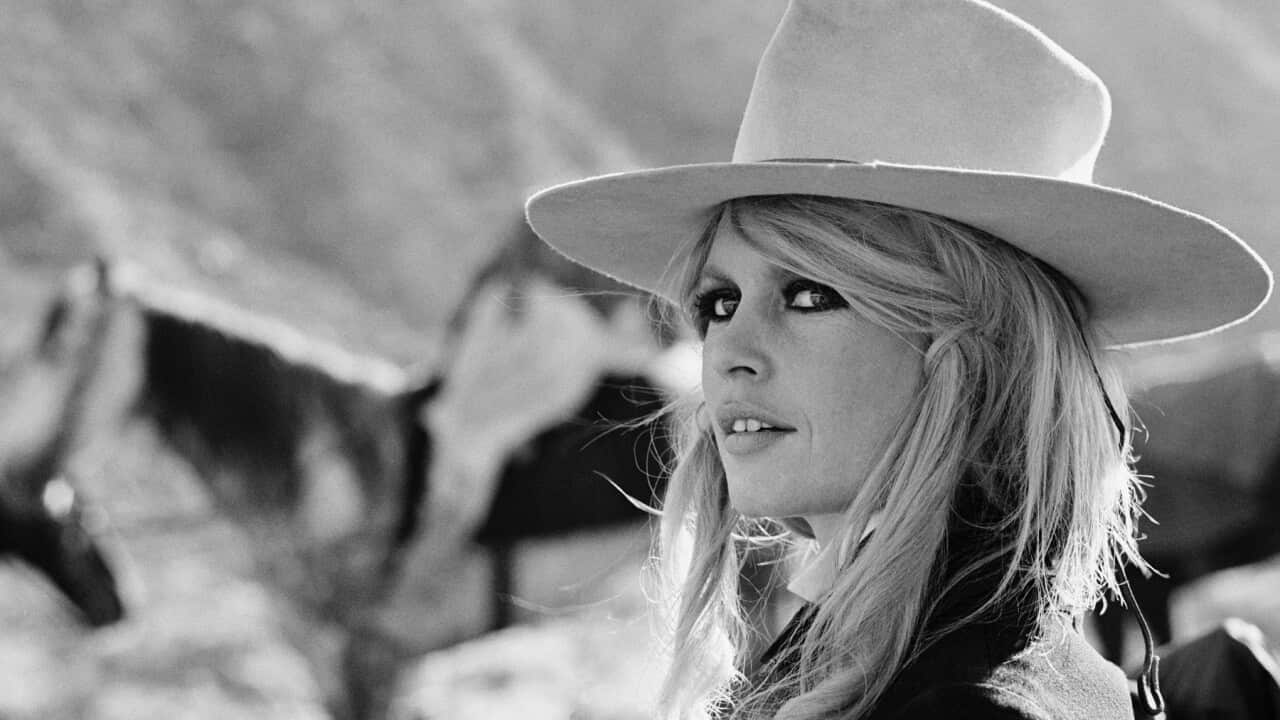

Brigitte Bardot, cinema icon, has died in France at the age of 91. A person of strong political views, she stopped acting in the 1970s and dedicated herself to the welfare of animals.
Listen to Australian and world news and follow trending topics with SBS News Podcasts.
TRANSCRIPT:
Brigitte Bardot, the French 1960s actor who became one of the greatest screen sirens of the 20th century and later a militant animal rights activist, has died aged at her home in southern France.
Bardot was born September 28th, 1934, to a wealthy industrialist family.
She studied classical ballet and was 'discovered' by a family friend who put her on the cover of Elle magazine at age 14.
But it was French movie producer Vadim, whom she married in 1952, who made her an international celebrity as a sexualised teen bride in the 1956 movie “And God Created Woman.”
At the height of a cinema career that spanned some 28 films and three marriages, Bardot became one of France's best-known stars.
Paris Resident Clovis Pontevin says for many people, she was a household name.
"She was an icon. Even at the international level. Bardot, for me, a man of a certain age now, I have always known the era of Bardot. We have appreciated her films. Some of her first films caused a furore, not a scandal but.. No. No it is a shock for me to learn that she has died."
French President Emmanuel Macron paid tribute to Bardot in a social media post.
"Her films, her voice, her dazzling fame, her initials, her sorrows, her generous passion for animals, her face that became Marianne—Brigitte Bardot embodied a life of freedom. A French existence, a universal radiance. She touched us. We mourn a legend of the century."
Such was her widespread appeal that in 1969 her features were chosen to be the model for “Marianne,” the national emblem of France and the official Gallic seal.
Bardot’s face appeared on statues, postage stamps and even on coins.
Bardot’s second career as an animal rights activist was equally sensational.
She travelled to the Arctic to blow the whistle on the slaughter of baby seals; she condemned the use of animals in laboratory experiments; and she opposed sending monkeys into space.
Isabelle Goetz is the spokesperson for the French branch of the activist group People for the Ethical Treatment of Animals.
"What was the most important thing for her was to defend animals. She did so with her heart, her voice, her image and even with her heritage since Brigitte Bardot started her foundation by auctioning her personal things that she auctioned in order to generate funds to start her foundation to defend animals. So it really was her whole life, her spiritual life, her material life, which finally became animals."
In 1985, she was awarded the Legion of Honour, the nation’s highest honour, for her work with animals.
Later, however, she fell from public grace as her animal protection diatribes took on an extremist tone and her far-right political views frequently decried the influx of immigrants into France, especially Muslims.
She also made a number of public homophobic slurs.
And she was convicted five times in French courts of inciting racial hatred.
Bardot never adjusted to the limelight.
She blamed the constant press attention for the suicide attempt that followed 10 months after the birth of her only child, Nicolas.
Bardot soon gave up her son to his father, and later said she had been chronically depressed and unready for the duties of being a mother.
Bardot married her third husband, West German millionaire Gunther Sachs, in 1966, and retired to her Riviera villa in St. Tropez at the age of 39 in 1973.