
Knockoffs aren't anything new in the fashion industry, but experts say the rise of online shopping has made it easier to find duplicated designs. Business owners and fashion law experts are calling for better education to ensure smaller designers can protect their creative work before it hits the runway.
Listen to Australian and world news and follow trending topics with SBS News Podcasts.
TRANSCRIPT
Sleek, stylish and slightly chaotic.
That's how Melbourne designer Bessie Joseph approaches fashion.
"Lots of my friends, we would go to parties and events and would always be like: 'We're too loud, we're too chaotic'. And just, we didn't feel like there was a community; we always felt bad for being silly. So it really came about that [way] and just creating a community, and as women being heard."
She founded the clothing label, Khaos, in April this year.
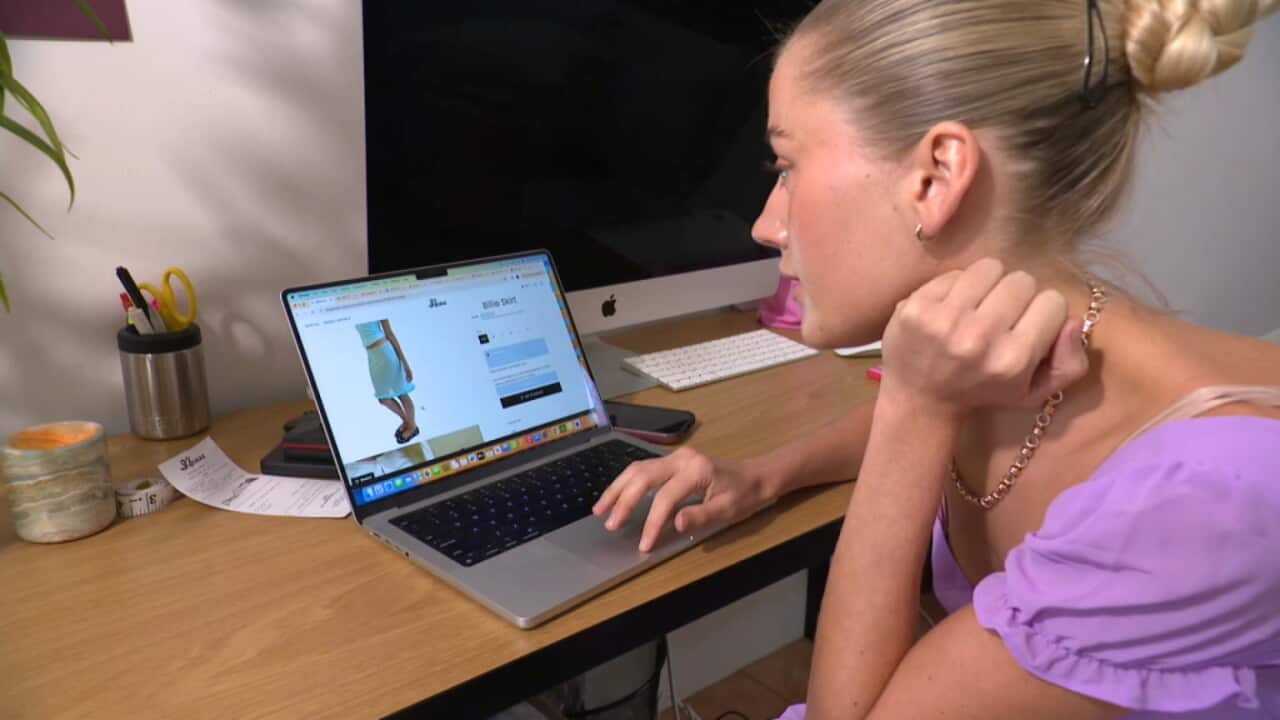
Her signature piece: a sheer turquoise skirt complete with frills.
"It was actually my first ever piece that I put into manufacturing. So, it was a big deal ... and I think it's what our brand is known for. That bright blue sheer and frills. It's a little bit ridiculous, but it's just fun. It's chaotic."
Recently, Bessie woke up to messages from friends sharing images of a skirt she says resembles her original design.
It was advertised online for a lower price by Australian fashion retail company Universal Store.
Feeling helpless, the designer took to social media calling out the label, an in-house brand of Universal Store.
She also filed a cease-and-desist letter.
"It was just like, at least six months of working for this skirt and they just probably just screenshotted it and sent it to their manufacturer and their manufacturer would have a lot more money and bigger technology to copy it really fast."
Bessie says she didn't copyright her design, citing the process as complex and expensive to navigate as a small business.
"A lot of brands are feeling a little bit lost when it comes to trademark and IP protection. So, a lot of the time you'll find that they don't necessarily prioritise it until it's too late and they're in a position where they've been, you know, counterfeited or duped by a company that is then mass producing their designs."
That's fashion and intellectual property lawyer Mariah Saad.
For years, she's travelled between Australia and New York to better educate herself in fashion law, which she says covers a range of industry nuances, including intellectual property rights and trademark licensing.
Ms Saad believes the proliferation of social media and artificial intelligence has made the duplication or "duping" of designs easier than ever.
"The prevalence is definitely increasing, and I feel like when a brand is really viral, and taking off, they could be duped in a matter of weeks. People are able to use a lot of different ways to copy them, whether it be through AI now, which we're finding is a new legal problem that we didn't face a couple of years ago. Unfortunately, the time and effort these designers are putting into their work is easily being ripped off."
She also founded the Fashion Law Lab, which aims to provide Australian business owners with foundational knowledge about the industry.
"My biggest concern is that people are getting involved in a business that they love, but they haven't necessarily done the research in protection their most important asset, which is their intellectual property."
American fashion designer Nicole Miller founded her namesake label in 1982.
Over the years, she's come to believe that dupes are inevitable in fashion.
"There's no protection in the United States for anything other than the print design. So, you do have protection for the print design, but you don't have protection on the silhouette design. And so, over the years I have been copied a lot. But, you know at this point, I'm kind of flattered if they copy my design. I used to get like really angry or whatever, but fashion changes so fast and it just turns over, and new things come around."
Ms Miller has dressed the likes of Naomi Campbell and Cindy Crawford.
She's also seen fashion trends come and go.
"I feel like sometimes designers have too big an ego over their designs and a lot of times, I see things that are derivative of things that were, you know, 20 years ago, 30 years ago, 10 years ago. So, you know, I feel like it's very rare when I see something that is completely original and different."
Ms Miller does believe knockoff footwear - which can be more complex to design and manufacture than some forms of apparel - can present ethical concerns.
"I mean the shoe industry, they copy things, and I feel like there's maybe far more original and unusual things going on in the shoe industry than in clothing. But I think that area needs a lot more protection, far more than clothing."
Designers like Bessie acknowledge that dupes can provide consumers with a cheaper alternative during a cost-of-living crisis.
So, in an attempt to draw attention to her alleged dupe, Bessie decided to temporarily price match her skirt.
"It's been crazy, I really didn't expect it. But just the support from influencers, other small Australian brands personally messaging me and then also resharing. Just my community, I was just really, really shocked by how much love and support everyone gave me."
She hopes that Australians who are able to afford original designs will continue to support small businesses.
SBS News also contacted Universal Store for comment.