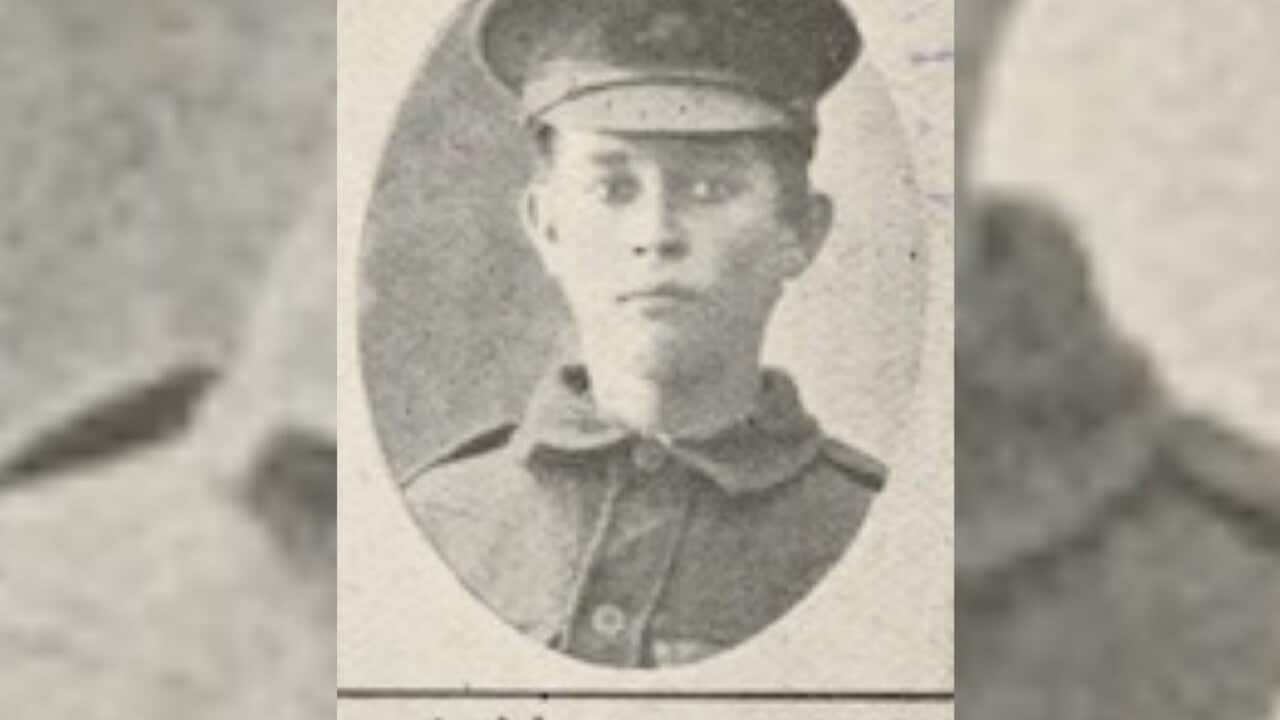

[[WARNING: Aboriginal and Torres Strait Islander people should exercise caution when listening to this audio as it contains names and images of deceased persons, which may cause distress to members of these communities.]] Since the First World War, Indigenous men and women have served in Australia's defence forces, despite the government's refusal to recognise their rights. NITV Radio's Kerri-Lee Barry has spoken to Michael Bell about members of her own family who served in Australia's defence forces.
Listen to Australian and world news, and follow trending topics with SBS News Podcasts
TRANSCRIPT:
A warning, Aboriginal and Torres Strait Islander listeners are advised that the following audio contains voice and image of someone that has passed.
Family permission has been granted for the use of Iris Glenbar's voice and image.
In 1914, when the First World War broke out, Aboriginal and Torres Strait Islander people were still denied citizenship rights in Australia.
Despite this, hundreds volunteered to serve the country overseas.
Among them was Valentine Hare.
"Well, he's one of the approximately 140 Aboriginal men from Queensland who enlisted. He enlisted at 19 years and eight months. When he enlisted, he enlisted into the Second Light Horse Regiment, the 27th reinforcements."
Michael Bell is the Indigenous Liaison Officer at the Australian War Memorial.
While the Defence Act at the time prevented Indigenous Australians from entering military service, Michael Bell has told NITV Radio, doctors would often make the assessment based on skin colour.
"So it was subjective nature of the medical authorities that applied the colour bar. So Uncle Valentine was deemed to be British subject and never had any trouble with his enlistment, as opposed to other men who were rejected for the same for being Aboriginal. So it's just a subjective nature of it. And it was, in fact, an implication of the restrictions imposed by the government after the White Australia Policy and after Federation that the Defence Act was amended to reflect that people of non-substantive European heritage or origin are exempt from service."
As part of the 2nd Light Horse Regiment, Michael Bell says Valentine Hare was skilled with horses.
Patrolling the deserts around Palestine and Syria, Mr Bell says mounted troops played a vital role in the Australian Army.
"Despite the restrictions on our men of being exempt from service due to not being of European heritage or origin, the Army found that the skills of our men that they already had, fitted naturally with working with horses, because our men, especially from Queensland, had already worked on stations, could manage and control and could ride horses. So rather than having to train somebody to do it, they could put men that already had that skill and ability. So they utilise the resources best at hand. And we've got about 125-130 Aboriginal men in the Light Horse through the First World War. And of course, they strike a symbol of the quintessential Australians with the Emu plume the slouch hat and made famous by the charge of Beersheba."
After sustaining a gunshot wound to the leg, Mr Hare was medically discharged and returned to Australia near the end of the war.
But while he was treated as equal during military service, his return to Australia meant returning to deep inequality.
Michael Bell says that upon their return, Aboriginal veterans were denied access to many of the rights and supports that were offered to others in their position.
"Our men came out of and went back to a desperately unequal society. Our men, who fought in the First World War, were fighting for rights that they weren't allowed to have in their own home country. And they were fighting for freedom when we had segregation. They were fighting for equality, and we didn't have that as an Aboriginal race, they were fighting for a fair and balanced Australia, which we weren't receiving, which we weren't in receipt of."
After spending 40 years in search of information, his niece and respected elder Auntie Iris Glenbar says a breakthrough occurred in 2015 thanks to a local council project documenting the stories of Indigenous World War One servicemen and their families.
Official records show that Valentine Hare was 19 at the time of enlistment in 1917.
In an interview with NITV Radio in 2020, Auntie Iris Glenbar said the family believes he bumped up his age on the forms, because he was eager to get out and do something.
"Probably about 16 or 17, He wasn't 20. He wasn't 20, but they put their ages up, like most of them did in those days, you know?"
Before the war, many of Valentine's family were forcibly removed from their homes and sent to the Cherbourg mission, a strict, state-run and ration-controlled government site.
Upon his return, Valentine Hare went to see his family, but was not allowed to stay.
"He came back from Egypt, went to Barambah, and they only allowed him to stay at Barambah for two weeks, because he didn't actually reside then. They said that he had to move on, because it was a government community, and he didn't reside, as I said, he had to move on. So he went back up north to his other brother up in Yarrabah, which is outside of Cairns. And he and he went back to Yarrabah, and then he couldn't stay there as well, so then he went back to Cairns and sort of stayed around Cairns area."
Mr Bell says many Aboriginal men who had served were seen as a threat to authority at the stations, and often prevented from returning.
"Sometimes it was seen by mission managers as a threat, because they deemed our men - they'd had a taste of equality. They knew about equality, and they had had an equal pay and so they were deemed threats, and they were riotous, and spreading ideas about equality wasn't seen fit and becoming. And a lot of our men weren't allowed back into their home communities."
Stories like Valentine's, while not unique, are not often told.
In 1942, after the bombing of Darwin, Aboriginal communities in Darwin were hit hard.
A relative of Valentine Hare, 42 year old Joseph Hegarty, was a little too old to fight when the Second World War broke out.
However, determined to serve, he enlisted in the Volunteer Defence Corps.
"So he serves his three years in the 20th battalion in the VDF, providing services to the military, such as, he'd be ensuring training, the maintenance of battalions and headquarters, maybe some road works, maybe some simple things as traffic control, just to make the flow of supplies efficient and effective. So this is an older man wanting to serve, taking the option of not actually at the front, but the VDC provided very, very strong support for the military at home to allow fit young men to go and do the jobs at the front."
Another relative, Peter Hegarty, was one of over 250 Aboriginal men recorded as serving in the Vietnam War.
Peter Hegarty served as a member of the Royal Australian Engineers, who often worked digging trenches and building infrastructure used by troops during the war.
While only spending a few months in Vietnam, he also served in Malaya and Singapore.
Michael Bell says his service as a volunteer, not a conscript, highlights his strong desire to defend Australia.
"So, in the engineers. They're the guys that do road and bridge building. They're the guys who dig the trenches. They're the guys who provide the infrastructure for the military to set up bases. But they're also they're also infantry men as well. They're not just digging trenches, they're also defending the front line, the broad range of service, and he had six years of service across that period."
According to Peter Hegarty, who was interviewed about his service in 2021, his experience in the army was one of brotherhood and equal standing with other troops.
But after his return from Vietnam, he says that service was not honoured by the general public.
This ANZAC Day, Michael Bell says there will be a dedicated Indigenous service at the Australian War Memorial to honour all those who fought for Australia.
"It is Indigenous led, Indigenous controlled, and the voices are all Indigenous. The service will be about continuing defence of country with the Navy focus this year to commemorate 125 years of Navy. We welcome all members of the public to join. If they're down in Ngunnawal country, come along or just watch it online, it'll be wonderful to be able to share how we commemorate, what we do, and where we're moving forward to in this Australian War Memorial and also ATSIVA the Aboriginal Torres Strait Islander Veterans and Services Association."
Previously laid to rest at an unmarked grave, Auntie Iris has told NITV that a plaque is now in place for her uncle Valentine.
"Now ANZAC day every year means something to my family, and we can identify with it now. We didn't identify with it before."